

European seabass and gilthead seabream form the backbone of\r\nMediterranean finfish aquaculture. While both species account for around 12\r\npercent of the EU’s total aquaculture production they each...
European seabass and gilthead seabream form the backbone of\r\nMediterranean finfish aquaculture. While both species account for around 12\r\npercent of the EU’s total aquaculture production they each represent 22 percent\r\nof the whole production value.
However, although the overall revenue of European seabass\r\nand sea bream aquaculture has been increasing in recent years, the growth in\r\nproduction of these species has stagnated, particularly in the Mediterranean. Both European seabass and gilthead seabream display a\r\ncomplex larval development which requires specialised rearing systems,\r\nfine-tuned protocols, premium feeds and highly skilled staff. Hatcheries for\r\nthese species have now fine-tuned efficient culture protocols and are being\r\nencouraged to produce fry that perform well in grow-out farms. Favouring\r\nquality over quantity is unquestionably the most economic and environmentally\r\nsustainable approach for aquaculture producers willing to participate in the\r\nongoing Blue Revolution.
Bottlenecks in the\r\nMed
European seabass and gilthead seabream show a complex\r\nlifecycle (Figure 1), which has been, and still is, a bottleneck to upscaling\r\nproduction. Broodstock selection plays a pivotal role in the production of\r\noffspring with optimal genetic traits. Larviculture protocols must guarantee\r\nthat larvae are exposed to optimal conditions, in order to exploit their\r\ngenetic potential to its full extent and give rise to premium fry and juveniles\r\nthat are more resilient and that are able to rapidly attain commercial size\r\nduring grow-out.
Parental investment is often determined by broodstock\r\ngenetic quality, husbandry practices and nutrition, whereas larval quality and\r\njuvenile development are mostly determined by rearing technology, environmental\r\nsettings and nutrition. All these factors are paramount in an interconnected\r\nmanner to secure a premium performance during grow-out. Maximum fish farming\r\nperformance can only be safeguarded if fry quality potential is totally\r\nexpressed and acknowledged as the basic start to secure performances during\r\ngrow-out. Fry must be perceived as finely tuned machines that are programmed to\r\nturn feed into biomass. The more accurate the match between feed quality and\r\nfry energetic demand, the better the capacity to fully explore their genetic\r\npotential to grow faster and to be more resilient.
Genetic potential,\r\nrearing technology and nutrition
Suboptimal rearing conditions and feeding experienced by fry\r\nand juveniles will ultimately promote suboptimal growth performances. Overall,\r\nthe history of early life stages in fish can be carried over to later stages\r\nand its effects are only to be detected when the fish are already juveniles or\r\nyoung adults. Just as hatching or any other dramatic shift from one life\r\nstage to another are not new beginnings that “reset” embryonic or larval\r\nhistory, entrance at the farm gate will not retrospectively reset the\r\nconditions experienced during larval and juvenile stages. Indeed, even when\r\nplaced under optimal conditions and fed premium feeds during grow-out, juvenile\r\nfish that have experienced suboptimal conditions earlier in their life cycle,\r\nparticularly in the hatchery or during pre-ongrowing phases, are likely to fail\r\nto perform as expected.
Good genes are particularly important for species such as\r\nseabass and seabream, which have a relatively fragile larval life. However,\r\ngood genes are not sufficient if fry face poor hatchery and pre-ongrowing\r\npractices. Hatcheries and pre-ongrowing units must rise to the challenge of\r\nproducing and achieving consistently high standards so European seabass and\r\ngilthead seabream are able to excel from hatching to harvesting. The\r\nperformance of the fish from hatchery to harvest must be viewed more\r\nholistically.
Setting new standards
If premium juvenile and adult performance are not possible\r\nbecause fish have been exposed to suboptimal conditions in the hatchery, can\r\nhatcheries screen for latent effects? This is far from an easy task. At the\r\nfarm gate, producers often target features which may not be the best means to\r\nidentify the fish that are likely to produce the ideal grow-out performance.\r\nFor instance, one can refer to behavioural or morphological traits of juvenile\r\nfish, such as size or deformities, when grading specimens that will be used to\r\nstock a cage. These features are useful but not enough to truly identify the\r\ngrowth potential of fish. For instance, larger juveniles are often selected\r\nover smaller ones. However, if no information is available on fry performance\r\nat the hatchery, larger specimens may not be the ones displaying the best\r\nperformances during grow-out. The conditions experienced in larval life often\r\ngenerate an energy burden that lies dormant until later stages of the fish life\r\ncycle and this must be identified and tackled at the hatchery.
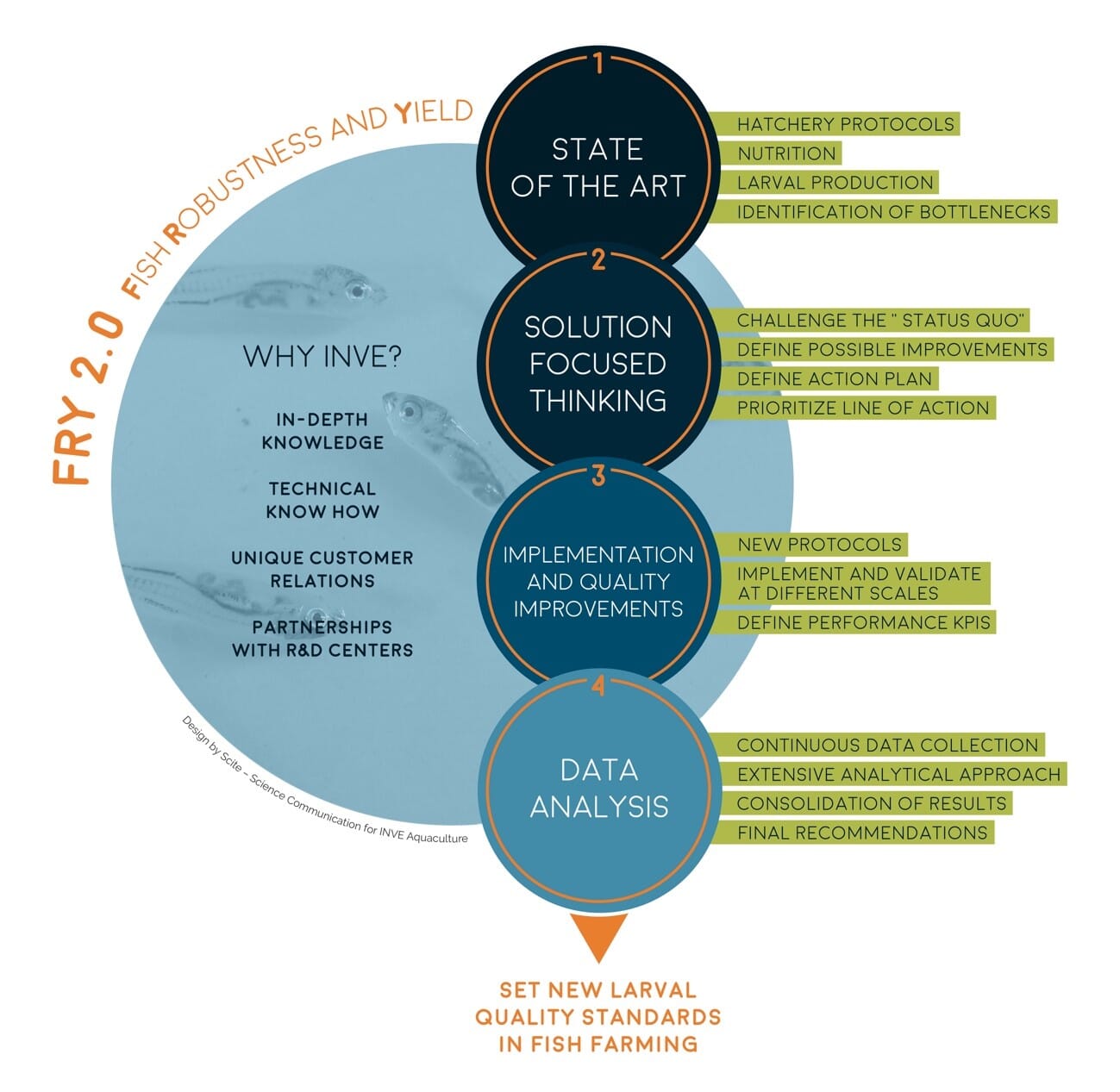
Outline of fish robustness and yield: INVE's FRY 2.0\r\nproject promoted aims to critically assess the current methods of fish farming\r\ntoday, develop tailor-made solutions driven by focused thinking and develop a\r\nholistic approach of the fish farming cycle
It is critical that detailed information on the life history\r\nof juvenile fish is available to producers. Project FRY 2.0 by INVE Aquaculture is based on generating sound scientific knowledge to further improve\r\nprotocols and create solutions to the current bottlenecks in producing\r\nbetter-quality fry and fingerlings rather than solely focusing on increasing\r\nproduction quantities. Launched in 2015, the FRY 2.0 project is a voluntary\r\ncollaborative agreement between producers and INVE, in which all participants\r\nagree to work together to achieve a common purpose (Figure 2). Synergy and\r\nknowledge are the powers behind this partnership, in which all parties will\r\nundertake specific tasks and share risks, responsibilities, resources, competencies\r\nand benefits. The main European fish farming players are already involved in\r\nthe project – or at least have showed interest in joining FRY 2.0 – and\r\nacknowledge that this is a long-term customised project based on confidence,\r\ncredibility and mutual benefits.
Source : The Fish Site
\r\n\r\n\r\n\r\n\r\n\r\n\r\n\r\n\r\n\r\n

Ditulis oleh
Tim Minapoli
Kontributor
Pakar di bidang akuakultur dengan pengalaman lebih dari 15 tahun. Aktif berkontribusi dalam pengembangan industri perikanan Indonesia.