

Efforts are underway to create value from uneaten fish feed\r\nand, yes, fecesNorwegian firm Hyperthermics utilizes volcanic matter to\r\ntransform salmon waste, including feces and uneaten feed, from...
Efforts are underway to create value from uneaten fish feed\r\nand, yes, feces

Norwegian firm Hyperthermics utilizes volcanic matter to\r\ntransform salmon waste, including feces and uneaten feed, from farms into a powder containing high protein levels. Photo courtesy of Hyperthermics.
The intensification of aquaculture has resulted in more\r\ninputs and increased waste from production systems. Treating and dealing with\r\nwaste material and suspended solids, such as feces, can be expensive and\r\ntime-consuming.
But instead of seeing waste as something to get rid of, a\r\ndifferent approach is taking shape. Norwegian fermentation technology firm\r\nHyperthermic is eliminating fish waste in a creative way. Its new technology\r\nutilizes volcanic matter (living hyperthermophilic organisms) to transform\r\nsalmon waste, including feces and uneaten feed, from smolt, post-smolt or\r\nland-based salmon farms in Norway into a powder containing high protein levels.\r\nThe company is now exploring the possibility of selling the powder as an\r\nalternative feed ingredient.
The technology also creates sustainable and environmentally\r\nfriendly biogas to power its factory. Depending on the amount of undigested\r\nfeed and feces in the sludge, up to 40 percent of the sludge will become\r\nprotein after the treatment.
“Our latest technology is a good incentive for aquaculture\r\nto embrace and introduce green, sustainable solutions,” Hyperthermic CEO\r\nErlend Haugsbø told the Advocate. “Our bacteria have been doing\r\nenvironmental work on our planet for billions of years. Now that we’ve trained\r\nthem to perform their green magic in our reactors, they do the world’s fastest\r\ndecomposition of biomass. And it’s even greener than before, as they reduce\r\nclimate gas emissions by producing biohydrogen or biomethane inside the\r\nreactors.”
Haugsbø added that “soon, sea-based aquaculture facilities\r\nwill also be obliged to harvest and handle fish waste from their cages in\r\nclosed-containment systems.”

An overview of the feces-to-feed process. Image courtesy of\r\nHyperthermic.
Aquaculture needs to find fishmeal alternatives to improve\r\nsustainability. By using fish waste, Hyperthermics hopes to bring the industry\r\nto a new level in the search for such alternatives. But deciding which species\r\nto target has been challenging. According to EU regulations, fish cannot be\r\ngiven feed made from their own species or their byproducts, so the salmon\r\nsector may not be viable. But Haugsbø doesn’t see this as an obstacle.
“I haven’t found any evidence that giving [a salmon- or\r\nsalmon byproduct-based feed] to salmon is risky,” he said. “I think the\r\nconcerns are mostly out of fear, to be on the safe side, so we’re also staying\r\non the safe side and focusing on species such as shrimp and lumpfish. The\r\nregulations could change as the population continues increasing and protein\r\nbecomes harder to get but I don’t think that will be on the agenda just yet.
“Cost reduction and reduced environmental impact are two\r\nimportant features for farmers today,” he continued. “We expect stricter\r\nregulations in the future related to discharge permits, but we also hope for\r\nincentives to stimulate farmers’ efforts in upgrading waste to reused\r\nmaterial.”
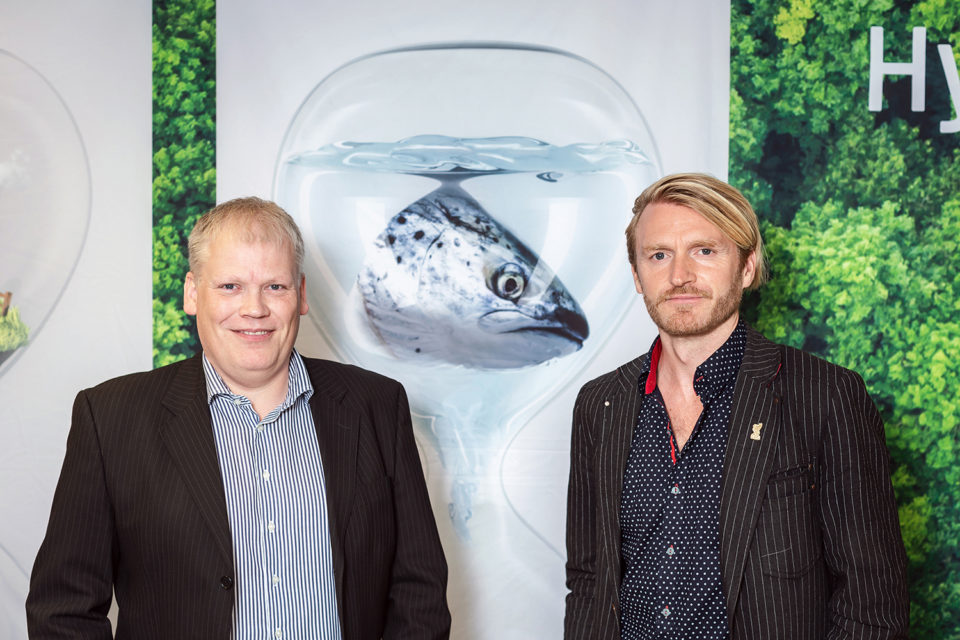
Hyperthermic CEO Erlend Haugsbø and Sales Manager Stig\r\nAmdam. Photo courtesy of Hyperthermics.
Haugsbø is engaged in positive discussions with the Asian\r\nshrimp market and feed producers for lumpfish in Norway. He’s also looking into\r\nthe possibility of applying his technology to other similar waste types.
Meanwhile, Faroese salmon firm Bakkafrost is aiming to\r\nbecome a recognized expert in the use of poo power – generating electricity and\r\nheat from fish feces. For several years Bakkafrost has been increasing smolt\r\nproduction on land by expanding existing hatcheries and constructing new ones.\r\nThis has made it possible to breed larger smolts before releasing them into the\r\nsea. However, hatchery expansions have significantly increased biomass on land\r\nwith an associated increased amount of feces.
In order to address this, the company is building a\r\n12,000-square-meter biogas factory called Förka, the first and only biogas\r\nplant in the Faroe Islands that will convert salmon and cattle feces into\r\nelectricity, heat and even high-quality fertilizer.
Waste will be broken down into smaller molecules through\r\nanaerobic digestion. The biomasses will be mixed into a uniform mass and all\r\ndry matter disintegrated to a particle size of below 10 mm. They will also be\r\nconverted into carbon dioxide and methane, the latter used for renewable energy\r\nproduction and digestate, which is used as fertilizer. Heat treatments will\r\nmitigate any risks associated with fish waste and eliminate potential pathogens\r\nand diseases.
“Cattle farmers will get the fertilizer back free of charge\r\nand be able to fertilize their fields with better manure than before,” said\r\nPoul Andrias Jacobsen, marketing manager at Bakkafrost. “Meanwhile, the biogas the plant will supply green energy in the form of electricity, which will feed into\r\nthe national grid, as well as heat.
“Concerns have been high that the large scale-up of\r\nland-based production in our new hatcheries will [increase] fivefold the\r\nbiomass and possible outlet of feces into the fjords,” Jacobsen continued. “If\r\nnothing is done, this will increase environmental footprint significantly. The\r\nidea behind the new system is to reduce environmental impact by decreasing\r\nrun-off into fjords. It’s all part of our Healthy Living Plan — our\r\nsustainability plan setting goals for how we improve our farming procedures.”
Förka is expected to convert 30,000 metric tons (MT) of\r\ncattle manure and 12,000 MT of salmon waste. All silage from Bakkfrost’s sea\r\nfarming — 8,000 MT – will be increased over time. Although the plant is\r\nexpected to produce 50,000 MT of natural liquid fertilizer, it has a capacity\r\nof 100,000 MT per year. 50,000 MT of manure/fertilizer should generate 9,300\r\nMWh of electricity and 9,300 MWh of heat.
“Using salmon waste has several advantages,” said Jacobsen.\r\n“Compared to cow manure it contains more energy per volume. It allows\r\nsustainable fertilizers to be used on Faroese farmland and we can reduce feces\r\ndisposal into the sea, minimizing local pollution.”
If treated correctly, salmon waste can also produce a\r\nfertilizer that is much more nutritious than cow manure, smells less and is\r\nmuch more liquid in form. This allows nutrients to quickly penetrate through\r\nthe soil.
Fish waste is currently processed in the Faroe Islands and\r\nshipped to Denmark but shipping can be difficult, expensive and unsustainable.\r\nSeeing this as an opportunity, Bakkafrost decided to establish something closer\r\nto home. All waste will be transported to the new factory using just one truck.
Close neighbors are skeptical regarding the possible smell\r\nissues, but the feedback has been positive, said Jacobsen.
“We’re now planning to work with the authorities to adapt\r\nlegislation and make it possible to use other organic biomasses like household\r\nor industrial waste,” he said.
\r\n\r\n\r\n\r\n\r\n\r\n\r\n\r\n\r\n\r\n\r\n\r\n\r\n\r\n\r\n\r\n\r\n\r\n\r\n\r\n\r\n\r\n\r\n\r\n\r\n\r\n\r\n\r\n\r\n\r\n\r\n\r\n\r\n\r\n\r\n\r\n\r\n\r\n\r\n\r\n\r\n\r\n\r\n\r\n\r\n\r\n\r\n\r\n\r\n\r\n
Förka’s construction began around May 2019 and is expected\r\nto finish in May 2020. The plant is expected to contribute to the Faroe\r\nIslands’ goal of using 100 percent green energy by 2030.
Source: Global Aquaculture Alliance
Ditulis oleh
Tim Minapoli
Kontributor
Pakar di bidang akuakultur dengan pengalaman lebih dari 15 tahun. Aktif berkontribusi dalam pengembangan industri perikanan Indonesia.