

Veramaris, a joint venture between DSM and Evonik, won the Future\r\nof Fish Feed F3 Fish Oil Challenge by a wide margin, selling about 90 percent\r\nof the total fish oil alternatives produced for th...
Veramaris, a joint venture between DSM and Evonik, won the Future\r\nof Fish Feed F3 Fish Oil Challenge by a wide margin, selling about 90 percent\r\nof the total fish oil alternatives produced for the contest by all\r\nparticipants.
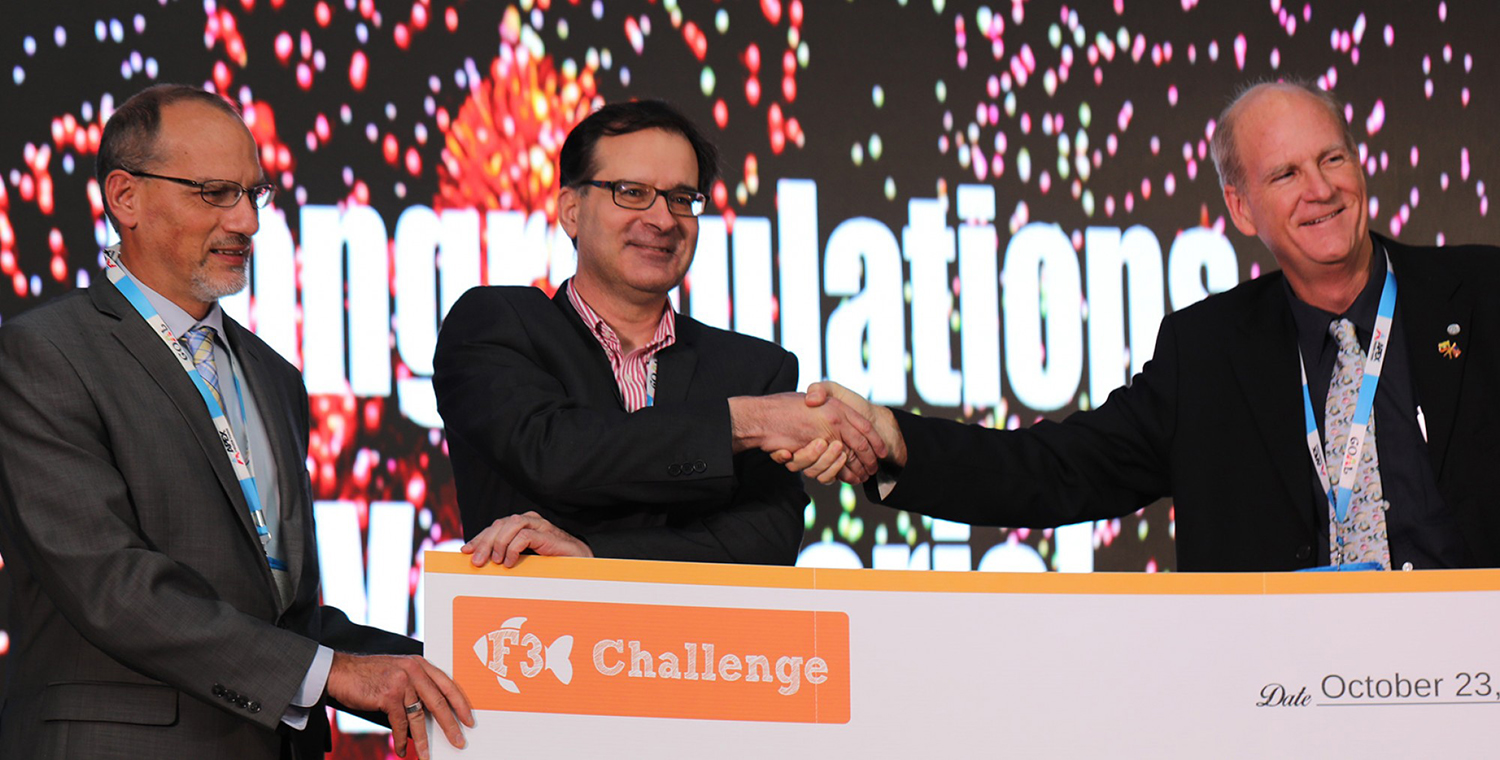
CEO Karim Kurmaly was presented with a $200,000 prize at the\r\nGlobal Aquaculture Alliance’s annual GOAL conference, held this year in\r\nChennai, India. Kurmaly said winning the prize – logging 769,038 kg of the\r\n850,000 kg submitted for the two-year contest – required a lot of “sacrifice”\r\nfrom his team.
“A lot of weekends. A lot of hard work. Work-life balance\r\nwent out the window. We decided to give it our all,” said Kurmaly, who also\r\ncredited “courageous” leaders in Norway and Chile who incorporated Vermaris’\r\nnatural marine algal oil into their salmonid feeds. “I’d like to thank those\r\nfarmers that helped us along this way.”
Kurmaly added that the rise in awareness for alternative\r\nfeed ingredients that do not deplete marine resources has been spearheaded by\r\nits retailer partners, including Tesco, Match, Kaufland and others.
Can corn fuel\r\naquaculture’s growth? Veramaris says yes
“Aquaculture has the opportunity to provide ‘beyond\r\nprotein.’ The rate of omega-3 EPA-DHA algal oil adoption is accelerating,”\r\nKurmaly told the Advocate. “This has all happened in the past 12 to 18\r\nmonths. Our business model is not only to provide a product solution. We work\r\nwith all stakeholders along the value chain from farmers, feed millers,\r\nprocessors, certification bodies and retailers to create value and capture\r\nvalue in seafood. We help create the pull and we do this by working along the\r\nentire value chain. Supporting to create and capture value is what we do for\r\nwith partners.”
Norway-based Mowi, the\r\nworld’s largest Atlantic salmon producer, earlier this year committed to test\r\nthe winning formula from the F3 Fish Oil Challenge, along with China-based\r\nYuehai Feed Group and AlphaFeed.\r\nThe companies will provide the results of their trials through the F3 Feed Innovation Network.
That Veramaris won this contest with production solely from\r\ntwo pilot facilities – one in Slovakia and another in the United States – is\r\ndoubly impressive given that its full-scale commercial plant in Blair,\r\nNebraska, USA, only came online in July 2019, too late to contribute to the F3\r\ncontest. Veramaris has repeatedly claimed that the Nebraska plant is capable of\r\nproducing 15 percent of the global salmon aquaculture demand for the\r\nomega-3 fatty acids EPA and DHA, which Kurmaly said are “essential for brain,\r\neye and hearth health.”
The first F3 challenge, won by Guangdong\r\nEvergreen Feed Industry Co., Ltd., illustrated that aquafeed\r\ningredients and proteins that do not contain any marine resources can be\r\nproduced at scale. Producing a fish oil substitute, a far more difficult\r\nchallenge, gives Veramaris an edge, said Kurmaly.
“Our customers prefer an oil. Additionally, our natural\r\nmarine algal oil has an EPA & DHA concentration above 50 percent that\r\nallows customers to provide a final product that is both nutritious and healthy\r\nto consumers. Our mission is to provide healthy fish, healthy food, healthy\r\noceans.”
F3 sees itself as more than a contest – it is a\r\ncollaborative community of aquafeed manufacturers, fishmeal and fish oil\r\nalternative makers and others in the aquaculture value chain working toward a\r\nsolution to eliminate the fishmeal and fish oil bottleneck that could impede\r\nthe aquaculture industry’s growth.
“I know this is just the beginning for Veramaris and others\r\nto address a major bottleneck in supply chain for aquafeeds support healthy\r\nfarm-raised fish and healthy oceans in the future,” said Kevin Fitzsimmons, F3\r\nChallenge chair and professor at the University of Arizona.
“The network and connections made have been invaluable and\r\nmore importantly the involvement of stakeholders along the value chain from\r\nfarmers to retailers and NGOs, has been amazing,” said Kurmaly. “We work with\r\nall stakeholders along the value chain from farmers, feed millers, processors,\r\ncertification bodies and retailers to create value and capture value in\r\nseafood. We help create the pull and we do this by working along the entire\r\nvalue chain. Supporting to create and capture value is what we do for with\r\npartners.
“There are many courageous leaders amongst the audience who\r\nwant to do the right thing for a sustainable aquaculture industry. The F3 has\r\nbeen the catalyst required.”
\r\n\r\n\r\n\r\n\r\n\r\n\r\n\r\n\r\n\r\n\r\n\r\n\r\n\r\n\r\n\r\n\r\n\r\n\r\n\r\n\r\n\r\n\r\n\r\n\r\n\r\n\r\n\r\n
Kurmaly concluded his on-stage remarks at GOAL by saying\r\nthat the company’s sights are moving beyond salmonids: “We also would like to\r\ncollaborate with shrimp farmers here in India and elsewhere to take you on this\r\njourney as well,” he said. “We want to connect, collaborate and we will\r\ndefinitely commit.”
Source : Global Alliance Aquaculture

Ditulis oleh
Tim Minapoli
Kontributor
Pakar di bidang akuakultur dengan pengalaman lebih dari 15 tahun. Aktif berkontribusi dalam pengembangan industri perikanan Indonesia.