

Several non‐conventional proteins have gained interest as\r\npotential alternative protein sources for fish feeds. A number of earthworm\r\nspecies have been tested for fish feed production; some have...
Several non‐conventional proteins have gained interest as\r\npotential alternative protein sources for fish feeds. A number of earthworm\r\nspecies have been tested for fish feed production; some have nutritional\r\ncontent comparable to fishmeal and are within the recommended nutritional\r\nrequirements of most fish. However, many of these worm species are not\r\nadaptable to a wide range of climates and excess handling, and most have\r\nresulted in depressed fish growth and poor feed utilization.
The red earthworm (Eisenia fetida) – also known as redworm,\r\nbrandling worm, panfish worm, trout worm, tiger worm, red wiggler worm and\r\nother common names – is a species of earthworm adapted to live and thrive in\r\ndecaying organic material like rotting vegetation, compost and manure. Studies\r\nhave shown that the red earthworm has adequate levels of protein, essential\r\namino acids and lipids similar to those found in fishmeal and are aligned with\r\nthe nutritional requirements of many fish species. Other studies have\r\nrecommended E. fetida meal to replace conventional fish feed protein\r\nsources without compromising the growth performance and reproduction of the\r\ncultured fish species.
Red earthworms have excellent growth rates, are adaptable to\r\ndifferent organic materials with the ability to convert biodegradable matter up\r\nto five-fold. Compared to most earthworm species, they have a relatively high\r\nreproduction rate (i.e. three hatchlings per egg) with a short maturation\r\ncycle, and low mortality compared to most earthworm species. Worms can survive\r\nin extreme conditions such as low temperatures, toxic and saline environments.\r\nAlso, it is a surface dweller, which facilitates its harvesting at a lower\r\nproduction cost, as it requires less human labor to feed and continuously turn\r\nits substrates to promote aeration. Worms can be efficiently contained in and\r\nraised in great quantities within several levels of production units using\r\nsimple vermicomposting (composting process with various species of worms in a\r\nmixture of decomposing, waste and bedding materials) techniques.
Because of its biological and economic attributes, several\r\npublished studies have reviewed the potential of red earthworms as a\r\nreplacement for fishmeal. This article summarizes the production systems and\r\nutilization sections of the original publication, which comprehensively reviewed the\r\nbiological and biochemical composition, production and processing methods\r\nas critical aspects for sustainable production and utilization of the red\r\nearthworm in the fish feed industry. For detailed information on reproduction\r\nbiology of E. fetida; its culture substrates; production systems;\r\nprocessing techniques; and its biochemical composition and utilization in fish\r\nfeed formulation, consult the original publication.
Production systems
Vermicomposting uses the mutual action of earthworms and\r\nmicroorganisms to bio‐transform organic matter into safe and stable compounds.\r\nTherefore, earthworms are usually a byproduct of vermicomposting alongside\r\nvermicast (solid phase) and vermiliquid (liquid phase) fertilizers. Producing\r\nearthworms as ingredients for fish feeds depends on the intensity of the\r\naquaculture system. In intensive aquaculture systems, aquatic organisms are\r\nusually stocked at high densities and depend on high quality and complete feeds,\r\nand thus earthworms must be mass-produced to meet feed demand. In Japan, for\r\nexample, there are more than 3,000 vermicomposting plants that provide\r\nearthworm for processing fish feed for intensive aquaculture systems such as\r\nfor eel (Anguilla japonica) farming.
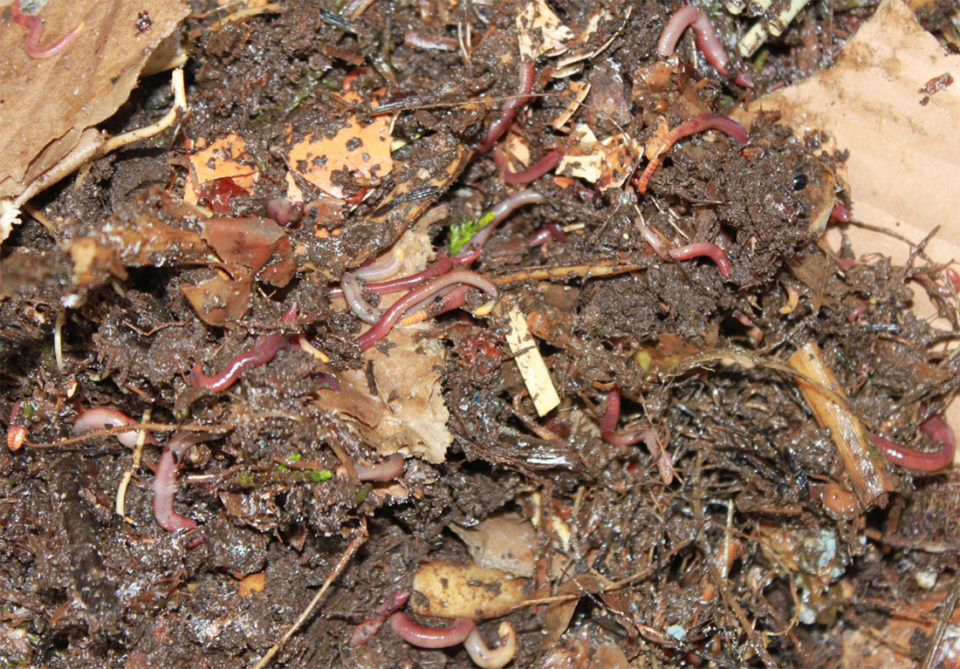
In contrast, in semi‐intensive aquaculture, aquafeeds often\r\nsupplement the natural production in ponds, and earthworms are usually produced\r\ndepending on the primary production of culture systems. For example,\r\nresearchers have demonstrated that red earthworm meal can supplement natural\r\nfeeds at a 50 percent replacement level of fishmeal in Indian carp semi‐intensive\r\nfarming. In addition, vermiculture is utilized to supply organic fertilizer for\r\nimproved primary production in semi‐intensive farming. Several studies have\r\nshown that the vermicast fertilizer has about the same impact on primary\r\nproductivity in semi‐intensive fish ponds as livestock manure. And the\r\nvermiliquid can also be utilized as an ingredient in formulating feeds for\r\ntilapia.
Large‐scale earthworm\r\nproduction
Industrial/commercial vermicomposting is done principally\r\nfor the management of municipal, agricultural and industrial bio‐solids. Since\r\nthe inception of vermicomposting in Canada in 1970, various innovative\r\nproduction systems have been established in many countries (USA, Italy,\r\nAustralia, Cuba, Philippines, India and others). Commercial vermicomposting is\r\nbroadly categorized into windrow and flow‐through systems.

Windrow systems are a simple technology commonly used for\r\ncomposting crop waste materials for fertilizer production, and it has been\r\nmodified for large scale/industrial vermicomposting in several countries. The\r\nbiodegradable materials are placed either vertically or horizontally up to one\r\nmeter high, and then inoculated with earthworms. The beddings are periodically\r\nwatered to keep the bedding moist, and depending on the weather, the windrows\r\ncan be kept open or covered. It is advisable to use a concrete floor for easier\r\ncollection of the vermiliquid. Mass harvesting of cast‐free earthworms from\r\nthis system is done using commercially available, mechanical, centrifugal\r\nharvesters.

In the flow‐through (or open bed) system, the earthworms are\r\ncultured indoor typically using large, rectangular beds. In this\r\nvermicomposting system, cast‐free earthworms are normally harvested by slightly\r\nstarving the earthworms for at least one week, then adding new food or bait\r\n(preferably cattle manure mixed with nettle, valerian or flaxseed) at the\r\nsurface to attract the worms to move upwards.
Small‐scale earthworm\r\nproduction
Small‐scale vermiculture is commonly done using plastic bins\r\nand wooden boxes layered with polyethylene. Earthworms are normally fed on\r\nlocally available plant biomass, kitchen and market wastes, biogas slurry,\r\nurine free cow dung, wheat straw, leaf litter and saw dust that are known to be\r\nhigh in organic matter. Harvesting earthworms can be done by pouring the\r\ncontent from culture bins on a plastic sheet and manually collecting the\r\nanimals.
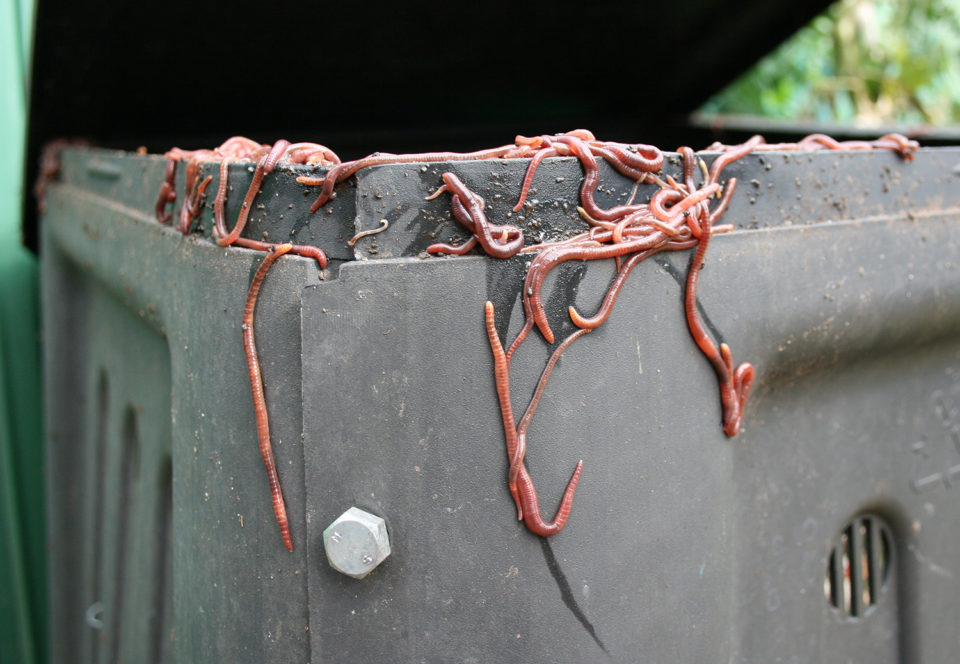
Small‐scale earthworm production systems have long been used\r\nto improve fish yields in semi‐intensive farming systems. For example, small‐scale\r\nvermicomposting can improve common carp production yields by 75 percent in semi‐intensive\r\naquaculture system in northern Vietnam. And in India, integrated\r\nvermiculture/fish culture system provide both earthworm biomass and vermicast\r\nas organic fertilizer in catfish semi‐intensive ponds.
Utilization in\r\naquafeeds
Many studies have reported the efficacy of red earthworms\r\n(alone or in combination with other ingredients) in promoting fish growth\r\nperformance, increasing reproduction, enhancing feed digestibility, reduced\r\nstress, improved survival, lower feed conversions and better feed utilization\r\nand assimilation efficiency (Table 1).
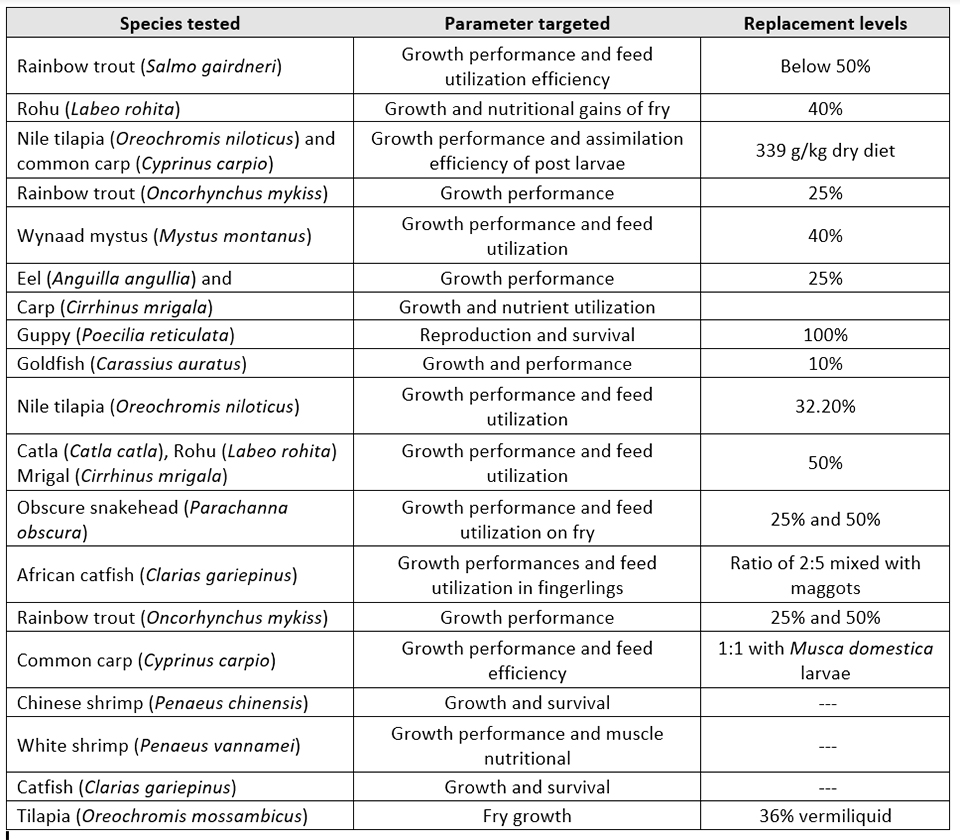
Table 1. Fishmeal replacement levels using red earthworm\r\nmeal in diets for various fish species.
Most of these studies showed that red earthworm meal can\r\nreplace fishmeal up to a 50 percent inclusion levels, but some reported reduced\r\nfish growth with inclusion levels above 25 percent, mentioning indigestible\r\nchitin and foul‐smelling coelom fluid that reduce digestibility and\r\npalatability. For example, research showed that common carp and Nile tilapia\r\nhad lower specific growth rates of 2 and 1.3 grams per day, respectively,\r\nwhen fed on diets with red earthworm meal, compared to 2.2 and 2 grams\r\nper day obtained when fed on diets with fishmeal.
Research needs
Improved harvesting techniques are needed, to better recover\r\nthe worms from the production systems. The sensitivity of the earthworms to\r\nlight could be one approach, and this could also be used to transfer the\r\nanimals from old to new substrates during culture. Additionally, because the\r\nchitin (a polysaccharide component of the exoskeleton) levels in the worms is\r\ndirectly proportional to their age, improved harvesting system should target\r\nthe collection of medium aged worms only. Also needed is a nutritionally\r\ncomplete and soft textured culture substrate, which would reduce the\r\ndevelopment of the indigestible chitin in the worm’s exoskeleton. This will\r\nfurther reduce unnecessary movement and burrowing in search of food materials.
Perspectives
There is a significant body of information on the biology,\r\nproduction and processing methods of red earthworms – reviewed in this study –\r\nrelevant to the commercial mass production of nutritionally complete E.\r\nfetida meal for fish feed formulas. In addition, together with other\r\nvermicomposting by‐products like vermicast and vermiliquid, local production of\r\nred earthworms can benefit small‐scale fish farmers who often have under‐utilized\r\norganic wastes.
\r\n\r\n\r\n\r\n\r\n\r\n\r\n\r\n\r\n\r\n\r\n\r\n\r\n\r\n\r\n\r\n\r\n\r\n\r\n\r\n\r\n\r\n\r\n\r\n\r\n\r\n\r\n\r\n\r\n\r\n\r\n\r\n\r\n\r\n\r\n\r\n\r\n\r\n\r\n\r\n\r\n\r\n\r\n\r\n
Red earthworm meal can efficiently and sustainably replace a\r\nnumber of conventional animal and plant protein sources while supporting fish\r\ngrowth. More research is needed to achieve the commercial production of red\r\nearthworms meal to formulate low‐cost, practical and environmentally-friendly,\r\nnutritional feeds for sustainable farming of various fish species.
Source : Global Aquaculture Alliance

Ditulis oleh
Tim Minapoli
Kontributor
Pakar di bidang akuakultur dengan pengalaman lebih dari 15 tahun. Aktif berkontribusi dalam pengembangan industri perikanan Indonesia.