

New advancements in water filtration and circulation make it\r\npossible for indoor fish farms to dramatically grow in size and productionAn artist’s rendition of salmon swimming through Nordic\r\nAqu...
New advancements in water filtration and circulation make it\r\npossible for indoor fish farms to dramatically grow in size and production
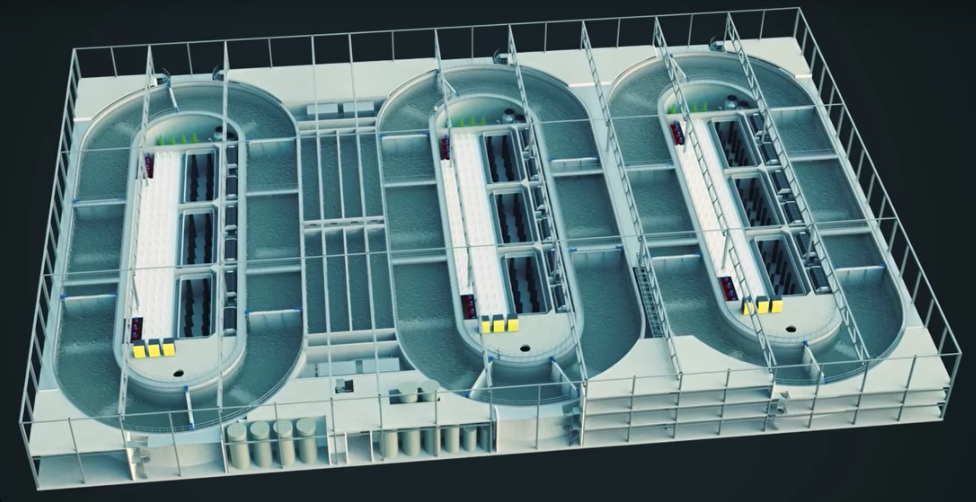
An artist’s rendition of salmon swimming through Nordic\r\nAquafarm’s proposed tanks in Belfast, Maine. A constant current in the tanks\r\nwill provide fish with exercise for optimal health and meat quality, the\r\ncompany says. Credit: Nordic Aquafarms
On a projection screen in front of a packed room in a\r\ncoastal Maine town, computer-animated salmon swim energetically through a\r\nmassive oval tank. A narrator’s voice soothingly points out water currents that\r\npromote fish exercise and ideal meat texture, along with vertical mesh screens\r\nthat “optimize fish densities and tank volume.” The screens also make dead fish\r\neasy to remove, the narrator cheerily adds.
The video is part of a pitch made earlier this year for an\r\nambitious $500-million salmon farm that Norway-based firm, Nordic Aquafarms,\r\nplans to build in Belfast, Maine, complete with what Nordic says will be among\r\nthe world’s largest aquaculture tanks. It is one of a handful of projects in\r\nthe works by companies hoping these highly mechanized systems will change the\r\nface fish farming—by moving it indoors.
If it catches on, indoor aquaculture could play a critical\r\nrole in meeting the needs of a swelling human population, Nordic CEO Erik Heim\r\nsays. He believes it could do so without the pollution and other potential\r\nthreats to wild fish that can accompany traditional aquaculture—although the\r\nindoor approach does face environmental challenges of its own. “There’s\r\nalways some risk, but the risk of the land-based system is a small percentage\r\nof the risk of an outdoor system,” says Michael\r\nTimmons, an environmental engineer at Cornell University who has\r\nstudied aquaculture for more than 20 years and is not involved in the Nordic\r\nproject.
Fish farming has often been touted as an extremely efficient\r\nway to produce animal protein: the Global Aquaculture Alliance claims 100 kilograms of fish\r\nfeed can deliver up to 15 times more meat than an equivalent amount fed to\r\ncows. The industry has gained international traction, with farmed fish\r\nsurpassing wild-caught ones (pdf) in the global food supply in 2014. But traditional\r\nfish-farming methods come with significant environmental drawbacks. For\r\nexample, salmon farmers in Norway and Chile—the world leaders in salmon\r\nproduction—typically use open-ocean cages that corral fish in suspended netting\r\nor pens. This setup allows waste to flow directly into the environment, along\r\nwith pathogens and parasites that can infect wild\r\npopulations. Open-air pond farms—found worldwide and representing the most common\r\ntype of aquaculture in China, the top global producer of farmed fish—also have\r\na track record of polluting local waterways with fish effluent and veterinary medicines that are used to keep disease at\r\nbay.
Timmons contends land-based indoor systems can greatly\r\nreduce such risks. They isolate fish from the environment and remove most of\r\nthe waste from the water using recirculating aquaculture systems (RAS), which are akin\r\nto filtration systems in a household fish aquarium, he says. But to date,\r\nindoor RAS farms have made up only a tiny fraction of the global market and are much smaller\r\nthan Nordic’s planned operation. For example, Blue Ridge\r\nAquaculture—the world’s largest RAS tilapia farm, located in\r\nVirginia—produces less than 10 percent of the quantity of fish Nordic expects\r\nto produce in Maine.
This recirculating technology has existed in some form since the 1970s, but has evolved enough in recent years that\r\nthe Monterey Bay Aquarium’s Seafood Watch now ranks\r\nRAS-farmed fish as one of the most sustainable seafood choices available. So\r\n“the natural thing to do is to scale up,” Heim told Maine residents during his\r\nrecent presentation. The Belfast operation would include 18 of what Heim says\r\nwould be among the world’s largest aquaculture tanks—each three times the\r\nvolume of an Olympic pool—and would ultimately produce 33,000 tons of fish, or\r\nroughly 8 percent of U.S. consumption, each year. The company plans to\r\nconstruct a similar farm in Norway next year that would contain tanks the same\r\nsize, he says.
Although there are questions as to whether scaling up\r\nincreases such a system’s environmental riskiness, some experts think the\r\ntechnology can make a sustainable transition to the big time. Community members\r\nin Heim’s audience voiced concerns about how wastewater might affect nearby\r\ncoastal waters, but Timmons says the small amount of water discharged from RAS\r\nsystems (from tank overflow and spray-cleaning waste from filters) is often\r\ncleaner than when it enters. Water in RAS tanks flows through a bubbling\r\ncontainer called a bio-filter, in which bacteria consume fish urine and convert\r\nit into a form of nitrogen that is safe for the fish and environment,\r\nsays Michael Schwarz, director of the Virginia Seafood Agricultural\r\nResearch and Extension Center. Physical filters gather fish feces and leftover\r\nfood that can be stored away and resold as compost or raw material for biogas.\r\nOzone treatment helps break down frothy organic solids, and ultraviolet light\r\nis used to kill pathogens.
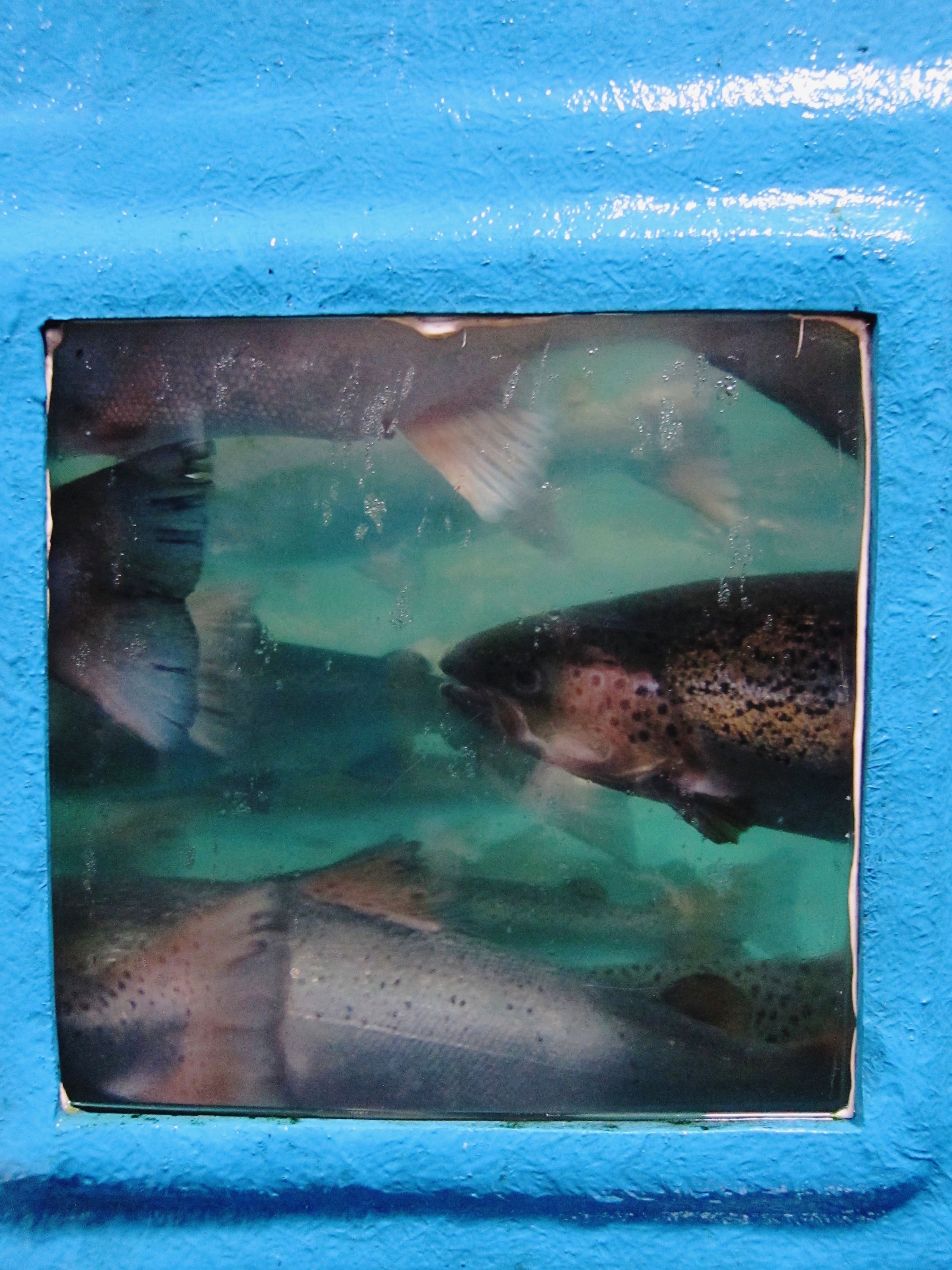
Salmon crowd together in a tank at the National Cold Water\r\nMarine Aquaculture Center in Franklin, Maine—a land-based aquaculture research\r\nfacility that consults with companies like Nordic Aquafarms about best\r\npractices in salmon farming. Credit: Laura Poppick
This technology has already been tested and automated enough\r\nthat scaling up can be as straightforward as “doubling the batter” for a batch\r\nof cookies, says Schwarz, who is not involved in the Belfast project. “There\r\nshouldn’t be any surprise if you design it properly and operate it properly,”\r\nhe says. “If there is a surprise, someone didn’t do their job.”
This risk of human error should not be overlooked,\r\nsays Brian Peterson, director of the National Cold Water Marine\r\nAquaculture Center in Maine, where he uses recirculating systems to raise\r\nsalmon for research purposes. Bio-security routines that require sanitizing\r\nhands and dipping shoes in disinfectant bins minimize the risk of disease and\r\nthe need for antibiotics that other forms of aquaculture heavily rely on, says\r\nPeterson, who has advised Nordic Aquafarms regarding best practices. However,\r\njust one employee who fails to complete the process correctly or neglects other\r\nbasic protocol could contaminate the operation—with pathogens potentially\r\nlooping through the recirculating system and killing an entire tank of fish.\r\nLarge-scale companies could guard against this with monitoring equipment that\r\nlets them respond quickly to any issues, Peterson says, adding that strict\r\ngovernment permits require routine monitoring that would also detect unusual\r\nlevels of discharge in wastewater.
The real environmental toll of big indoor systems will\r\ndepend on the capacity of local infrastructure, including the water supply,\r\nTimmons says. Recirculating systems can recycle more than 90 percent of tank\r\nwater but some of it does get lost to evaporation or absorbed in solid waste\r\neach day. He calculates that a farm the size of the Belfast facility would\r\n(after the initial tank fill) consume about 1.65 billion liters of freshwater\r\nper year—roughly equivalent to the water use of about 12,000 people. But he\r\nnotes even in a town of fewer than 7,000 people, like Belfast, this is within\r\nthe capacity of the local aquifer—and is dwarfed by the volume of water the\r\nfarm would recycle each year. In more drought-prone regions indoor aquaculture\r\nfacilities could release wastewater for irrigating agricultural fields,\r\nreducing the water burden, Timmons adds.
\r\n\r\n\r\n\r\n\r\n\r\n\r\n\r\n\r\n\r\n\r\n\r\n\r\n\r\n\r\n\r\n\r\n\r\n\r\n\r\n\r\n\r\n\r\n\r\n\r\n\r\n
Pending state and federal permitting the Belfast facility\r\nwill break ground in 2019, and Timmons believes it could pave the way for\r\nsimilar systems around the world. “If this facility is as successful as it\r\nappears it can be,” he says, “then that will certainly incentivize others to do\r\nsimilar types of farms.”
Source : Scientific America

Ditulis oleh
Tim Minapoli
Kontributor
Pakar di bidang akuakultur dengan pengalaman lebih dari 15 tahun. Aktif berkontribusi dalam pengembangan industri perikanan Indonesia.