

According to a new report published in the journal Aquaculture,\r\nAtlantic salmon parr fed a low fish meal diet supplemented with black soldier\r\nfly larvae meal showed enhanced growth performa...
According to a new report published in the journal Aquaculture,\r\nAtlantic salmon parr fed a low fish meal diet supplemented with black soldier\r\nfly larvae meal showed enhanced growth performance and nutrient uptake when\r\ncompared to fish fed a diet supplemented with corn or soy protein. The findings\r\nsuggest that aquafeeds can reduce fish meal levels and successfully replace the\r\nprotein with insect meal – a move that could make the aquafeed sector more\r\nsustainable in the long term.
Aquaculture is gaining recognition for providing\r\nnutritionally dense and sustainable sources of protein for the growing global\r\npopulation, but current farming methods aren’t perfect. One of the most popular\r\nfarmed species, Atlantic salmon, is carnivorous and requires a high level of\r\ndietary protein to thrive. Fish meal is typically used as the primary protein\r\nsource in Atlantic salmon diets, but the commodity is expensive and isn’t\r\nsustainable long-term. Because of this, the aquafeed sector is reducing concentrations\r\nof fish meal in salmon feed and trying to find replacement protein sources.
Though the industry has trialled soy and corn protein as a\r\nreplacement for fish meal, insect meal has emerged as a promising component for\r\naquafeed. Species like black soldier fly larvae can convert food waste from\r\nfactories, fruits, vegetables and animal tissues into high-quality protein.\r\nDepending on the growth media used, larvae meal can reach 60 percent protein\r\nconcentration and have a lipid range between 10 and 30 percent. It also has a\r\nwell-balanced amino acid profile, reducing the need for further dietary\r\nsupplementation.
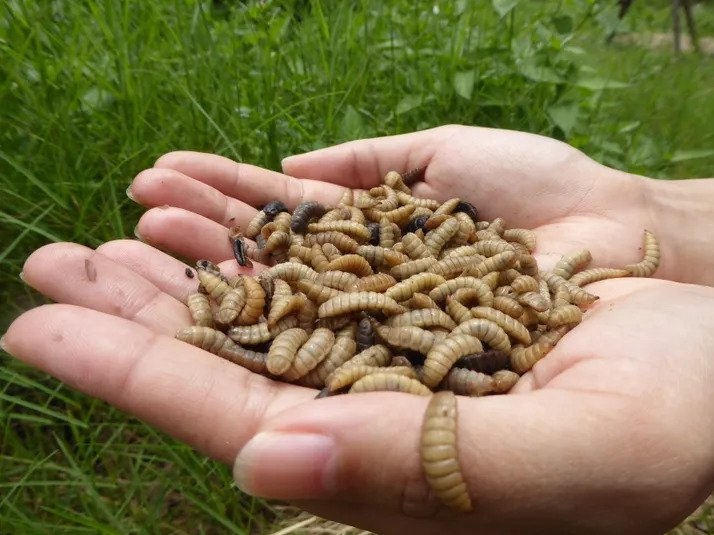
Insect meal could potentially make aquafeeds more\r\nsustainable and reduce reliance on fish meal © NutriTec
Though multiple trials have explored whether black soldier\r\nfly larvae meal (BSFM) is a suitable fish meal replacement, the results between\r\nstudies haven’t always been congruent. Researchers haven’t been able to\r\nestablish the optimum inclusion level or digestibility of BSFM in aquafeeds.
The study
This study wanted to determine the apparent nutrient\r\ndigestibility and nutrient content of BSFM as a feed ingredient in low fish\r\nmeal aquafeed. It also wanted to establish the ideal inclusion level to support\r\ngrowth performance in salmon parr.
Atlantic salmon parr were housed in 16 tanks and randomly\r\nassigned control or experimental diets. The control diet was a commercially\r\navailable salmon feed with fish meal as the central source of protein. The\r\nexperimental diets had lower concentrations of fish meal. They contained 70\r\npercent control diet, and 30 percent test ingredient (BSFM, corn protein or soy\r\nprotein). The salmon were fed diets with increasing levels of BSFM – 0.0g BSFM\r\nper kg feed, 100.0g BSFM per kg feed, 200.0g BSFM per kg and 300.0g BSFM per\r\nfeed. The researchers measured growth indicators and nutrient uptake at various\r\nintervals during the trial.
Results
Initial results from the trial showed that all the\r\nexperimental diets were readily accepted by the fish – meaning that there\r\nweren’t any palatability issues with the feed pellets. Apparent digestibility\r\ncoefficients and gross energy were highest in BSFM when compared to the corn,\r\nsoy and control diets. No other statistically significant differences were detected\r\nby the researchers.
Nutrient indicators like crude lipid digestibility and\r\nmineral digestibility was highest in BSFM when compared to the other protein\r\nsources. The research suggests that insect meal performed well across all\r\nindicators, while plant-based proteins had a more mixed performance.
In terms of growth performance, researchers noted that\r\nsalmon fed a BSFM diet supplemented at 200g per kg feed had the best results.\r\nWeight gain, feed conversion ratios and overall body weight were highest in\r\nthis experimental group. However, the results indicate that\r\nover-supplementation of insect meal can have negative effects – salmon fed 300g\r\nBSFM per kg feed showed reduced growth rates and poorer feed conversion ratios.
Key takeaways
The results of this study show that BSFM was slightly more\r\ndigestible than corn or soy protein, indicating that it might be a more\r\nsuitable diet supplement in reduce fish meal aquafeeds. Including 200g BSFM per\r\nkg feed showed enhanced growth when compared to the control diet, but\r\nresearchers noted that the diets still need to be supplemented with the key\r\nmicronutrients lysine and methionine. If BSFM levels increased beyond 200g per\r\nkg feed, the positive effect on growth was lost.
The researchers note that though these results are\r\npromising, more research is needed on the growth substrate for black soldier\r\nflies. The substrates heavily influence the nutritional value of the insect\r\nmeal. Since this element of the supply chain is in its infancy, black soldier\r\nfly meal cannot fully replace fish meal. Insect meal remains a supplementary\r\nprotein source for Atlantic salmon.
Read\r\nthe full research article in the journal Aquaculture.
Source: The Fish Site
\r\n\r\n\r\n\r\n\r\n\r\n\r\n\r\n\r\n\r\n\r\n\r\n\r\n\r\n\r\n\r\n\r\n\r\n\r\n\r\n\r\n\r\n\r\n\r\n\r\n\r\n\r\n\r\n\r\n\r\n\r\n\r\n\r\n\r\n\r\n\r\n\r\n\r\n

Ditulis oleh
Tim Minapoli
Kontributor
Pakar di bidang akuakultur dengan pengalaman lebih dari 15 tahun. Aktif berkontribusi dalam pengembangan industri perikanan Indonesia.