

Algorithm makers and data scientists rally solutions for\r\nfarmers, even when they’re not able to be near the farmA worker at Cedar Crest Trout Farm in Ontario, Canada, tends\r\nto the company’s farm...
Algorithm makers and data scientists rally solutions for\r\nfarmers, even when they’re not able to be near the farm
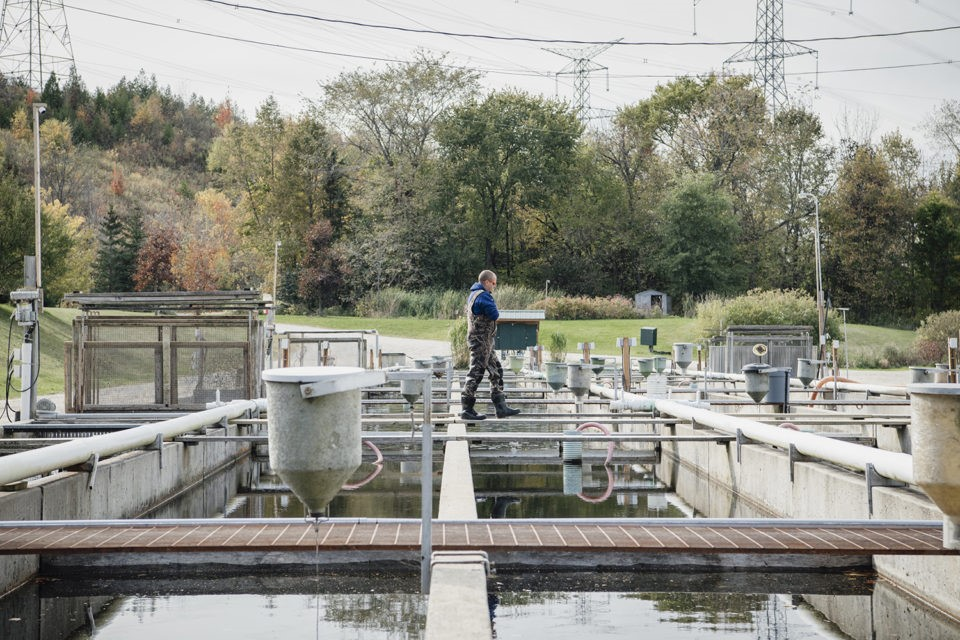
A worker at Cedar Crest Trout Farm in Ontario, Canada, tends\r\nto the company’s farm. Photo courtesy of Wittaya Aqua.
As the coronavirus pandemic continues to disrupt, can\r\ntechnology and artificial intelligence (AI) help aquaculture find the way\r\nforward?
Market disruption, reduced or suspended production and\r\ndeclining seafood demand are among the many impacts on aquaculture as COVID-19\r\ncarries on. Innovative companies, many of them still bearing the “startup”\r\nlabel, are offering support with a host of initiatives.
In India, full-stack aquaculture technology startup\r\nAquaconnect has launched a COVID-19 helpline for shrimp farmers. The company is\r\nproviding remote support on farm management and helping farmers navigate\r\nsupply, demand and logistics. It’s also joining forces with processors and\r\nexporters to put farmers in touch with those who are still buying shrimp.
“We’re aiming to provide complete assistance and information\r\nto farmers during this pandemic. We believe that our collaborative effort with\r\nother industry stakeholders will help them mitigate the challenges from the\r\ncountry-wide COVID-19 lockdown,” Aquaconnect CEO Rajamanohar Somasundaram\r\ntold The Advocate.
With many restaurants closed or with fewer customers\r\npracticing social distancing according to applicable health guidelines, sales\r\nin Japan are declining. Because seafood products are often more expensive,\r\ncustomers are cutting back discretionary spending or purchasing more\r\nnon-perishable foods.
In light of this, aquaculture technology provider Umitron is\r\nhelping fish farmers in Japan adjust to new market conditions. A crowdfunding\r\ncampaign with Akasaka Fisheries, a red sea bream farmer, is connecting\r\nconsumers directly with farmers to raise awareness about sustainable farming\r\nmethods. When Japan lifts its state of emergency, customers will be able to\r\nvisit restaurants serving Akasaka Fisheries products, watch videos and obtain\r\ninformation on the fish they’re eating. This will offer some relief to\r\nparticipating farmers and restaurants, said Andy Davison, product manager at\r\nUmitron.
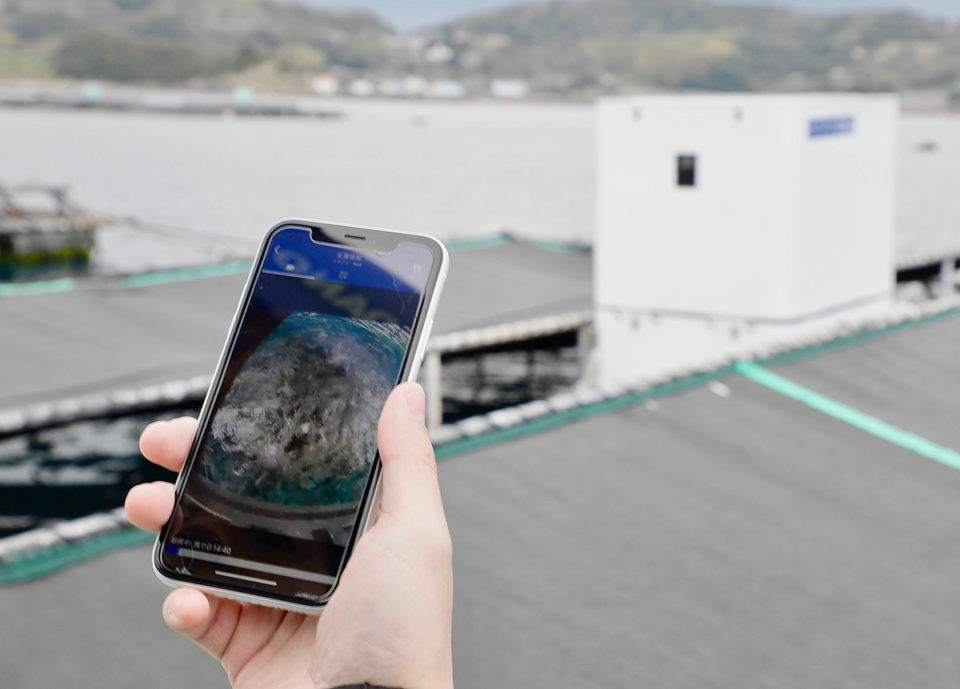
Mobile phone apps keep aquaculture workers connected to\r\ntheir operations, even if they can’t be physically at the farm. Photo courtesy\r\nof Umitron.
“We want to share farmers’ stories and open customers’ eyes\r\nto the hard work and dedication that goes into growing high-quality seafood.\r\nMaking customers aware of farmers’ struggles is the first step in generating\r\nmore help,” he said.
As more farmers stay at home to comply with social distancing\r\nregulations, Umitron’s automated smart feeder CELL is proving advantageous. The\r\ndevice collects data to optimize feeding and is remotely managed through a\r\ncloud-based application on a mobile device. This allows farmers to feed and\r\nmonitor their fish without being on their farm. Remote access to data,\r\nforecasting and integration with data logging hardware and automatic feeding\r\nsystems are likely to go a long way to help reduce farm dependency on human\r\nlabor.
Aquaculture may become even more data-driven and adopt\r\ntechnology which will benefit farmers and consumers by ensuring traceability\r\nand creating transparency.
“We’re happy that CELL can give farmers added flexibility\r\nduring this challenging time, even if some in-person work is still required during\r\na prolonged period of disruption such as this,” said Davison.
Canadian smart-farming company Wittaya Aqua is also helping\r\nto reduce the requirement for farmers to be on site as often. Its cloud-based\r\nBig Data platform – Wittaya AquaOp – works for multiple species by accurately\r\nforecasting growth trajectories and feed requirements. Farmers can make\r\ndecisions early to slow down production until markets rebound, while feeding\r\nstrategies help them reduce the amount they’re feeding their animals (thus reducing\r\ncosts spent on feed) and lengthen the growing period by slowing the growth of\r\ntheir animals (reducing the need to cull animals) until prices rebound.
“Our models and algorithms are accurate for long periods of\r\ntime with little input from farms,” said Evan Hall, cofounder of Wittaya Aqua.\r\n“As well as helping farms run as normal, we’re looking to partner with other\r\ncompanies that deliver smart-farming solutions to bring farms a more holistic\r\npackage.”
Difficulties in selling have left farmers with no choice but\r\nto delay harvests, which means that they’re sitting on stocks that cost money\r\nto keep with a lot of uncertainty about the future, said Flavio Corsin,\r\nAquaculture Program Director at IDH, the Sustainable Trade Initiative. But\r\ntechnology and AI can also model production versus prices so that advice can be\r\ngiven on the most profitable strategies such as when to harvest or what would\r\nhappen if a farmer waits. It can also provide information on how to reduce\r\ndisease risks, data on market needs and prices, and information for financial\r\ninstitutions so that they can provide financing to farms.
“Some of the companies we work with provide services to\r\nfarmers and value chain players and are well-connected in the aquaculture\r\nindustry. They’re now in a position to support farmers in finding markets in\r\nthese challenging times, or to swiftly transfer information from the government\r\nto farmers. This may increase the resilience not only of the farmers but also\r\nof the aquaculture industry itself,” said Corsin.
“With auditors unable to carry out on-site audits, now is\r\nthe time to reflect on how technology can support compliance,” said Juliette\r\nAlemany of VerifiK8. Photo courtesy of Verifik8.
Juliette Alemany is a data scientist and project manager at\r\nVerifiK8, a Bangkok-based consultancy that specializes in improving\r\nsupply-chain sustainability through technology. Although farmers in Thailand\r\nare unable to sell as many products as before, those who have adapted to\r\ntechnology will have an advantage, she said. In addition to identifying new,\r\ninternational sales channels by helping stakeholders improve their supply chain\r\nsustainability, VerifiK8’s web and mobile application supports traceability and\r\naudit readiness for certification. With a potential long-term effect on\r\nconsumer behavior and more awareness of responsibly produced food, Alemany\r\nbelieves that certification will play an increasing role in aquaculture, and\r\nfarms are likely to take swift action to achieve it, or a certain level of\r\ncompliance, to mitigate potential risks.
The coronavirus pandemic may not stop anytime soon. But it\r\ncould make aquaculture stakeholders reconsider a host of areas such as\r\nhard-to-predict risks and biosecurity. As new viruses commonly arise in\r\naquaculture in the same way that COVID-19 arose in the human population, the\r\npandemic should force farmers to come up with risk management and crisis plans.
Stakeholders may also realize the issues of disrupted supply\r\nchains, and the need to strengthen bonds between farms and processors, said\r\nAlemany.
“In Vietnam, we are seeing farmers afraid of market\r\nfluctuation and reluctant to stock,” she said. “This will lead to a shortage of\r\nshrimp and fish for processing plants, but each stakeholder must connect to go\r\nthrough the bad (and good) times. Connection and trust among farmers,\r\nprocessors and buyers is key. Hopefully the pandemic will improve the\r\nrelationship balance among supply chain stakeholders and support better\r\ncommunication through technology.”
\r\n\r\n\r\n\r\n\r\n\r\n\r\n\r\n\r\n\r\n\r\n\r\n\r\n\r\n\r\n\r\n\r\n\r\n\r\n\r\n\r\n\r\n\r\n\r\n\r\n\r\n\r\n\r\n\r\n\r\n\r\n\r\n\r\n\r\n\r\n\r\n\r\n\r\n\r\n\r\n\r\n\r\n\r\n\r\n\r\n\r\n
“Aquaculture may become even more data-driven and adopt\r\ntechnology which will benefit farmers and consumers by ensuring traceability\r\nand creating transparency,” said Corsin. “A better understanding of the risk\r\nfactors for disease and the need for biosecurity will help control disease, and\r\nwe may see an increasing reliance of the local market on local production.”
Source: Global Aquaculture Alliance

Ditulis oleh
Tim Minapoli
Kontributor
Pakar di bidang akuakultur dengan pengalaman lebih dari 15 tahun. Aktif berkontribusi dalam pengembangan industri perikanan Indonesia.