

Microalgae-based feeds could avoid depleting the wild fish\r\nthat farmed seafood consumes, steering aquaculture in a new direction, reports\r\nBonnie Waycott.Aquaculture has long positioned itself as...
Microalgae-based feeds could avoid depleting the wild fish\r\nthat farmed seafood consumes, steering aquaculture in a new direction, reports\r\nBonnie Waycott.
Aquaculture has long positioned itself as a promising and alternative to wild-caught seafood and is playing a major role in meeting\r\nconsumer demand – but the use of forage fish such as anchovies,\r\nherrings and sardines are still generating concern.
Cutting forage fish from the diets of farmed species is no\r\neasy task as they are a key food source containing much-needed fats – omega-3\r\ngenerally, but docosahexaenoic acid (DHA) and eicosapentaenoic acid (EPA) in\r\nparticular. But forage fish get these in the first place from the primary\r\nproducer of almost all long-chain omega-3s – marine microalgae. This has led\r\none company to bypass forage fish and turn to microalgae in order to produce a\r\nfishmeal and fish oil alternative.
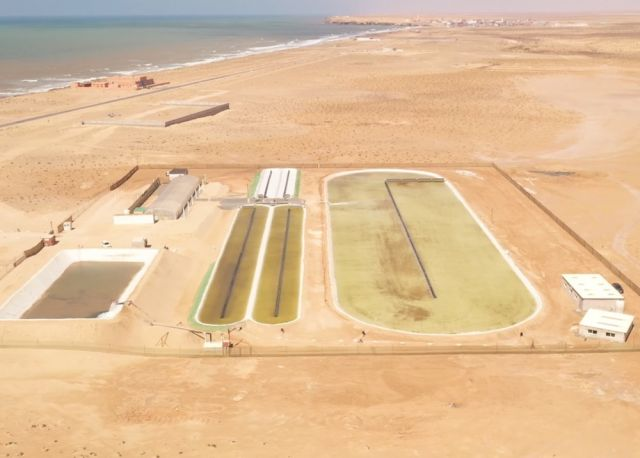
Established in 2013 by Dr. Raffael Jovine and Keith Coleman,\r\nSuSeWi built its first small-scale pond in South Africa. In 2015, it began\r\nworking in Morocco, which has good climatic growth conditions, deep and\r\naccessible nutrient-rich water, and is close to European aquaculture markets.\r\nIn 2017, it received equity investment and a grant of over £400,000 from\r\nInnovate the UK to develop technology to analyze, select and grow microalgae in\r\nMorocco. At the end of the following year, SuSeWi announced the completion of\r\nits pilot plant in Morocco. Measuring 8000m2 in area and 4000m3 in\r\nvolume, it operates the world's largest, single algae raceway pond using\r\npatented technologies.
"The idea behind SuSeWi came about after the Virgin\r\nEarth Challenge, which challenged scientists to find a way of capturing and\r\nstoring a billion tonnes of carbon," said CEO Keith Coleman.
"Raffael, our chief scientist, had studied the\r\nphenomenon of carbon capture with algae and invented a way of growing it on a\r\nhuge scale. This involved inducing it to grow exponentially as it would in the\r\nsea. He thought about how algae grew in nature and found a way to copy that.\r\nThe method of natural growth is key to SuSeWi's unique ability to grow algae at\r\nscale. We also thought hard about what you can do with microalgae.”
Having recognized its different uses, including biofuel,\r\nbioenergy, cement, oil and plastic production, Jovine and Coleman realized that\r\nmicroalgae could have significant impacts on aquaculture.
"We went through a lot of different markets and looked\r\nat all the algae markets out there," he said.
"We also looked at those which were structurally\r\nattractive, or where the demand for algae-based products far exceeded supply\r\nand where algae had a solution to a very pressing world need. The answer was\r\naquaculture. The industry may be growing, but it still needs forage fish to\r\nfeed its own fish."
"Microalgae is already the natural food of fish fry in\r\nhatcheries, so we felt confident that our products would find support in the\r\nmarket. Microalgae is already being used, there is a demand for more of it and we\r\nwanted to go after a single, very large market segment. The fish feed market\r\nwas the obvious answer."
SuSeWi works with two main algae strains - Chaetoceros and Thalassiosira.\r\nA chain-forming diatom, Chaetoceros has a fast growth rate, high\r\nprotein content and high EPA and DHA, while Thalassiosira is a\r\nfree-floating single-celled algae with a high lipid content and intermediate\r\ngrowth rate. Local algae species in Morocco are selected by SuSeWi's\r\nscientists, who then study factors such as protein content, cell, nutrient\r\nvalues, growth rate and ease of harvest before choosing which species to work\r\nwith.
SuSeWi's technology replicates the natural system, using\r\nonly seawater, carbon dioxide from the air and energy from sunlight for the\r\npumps and operations.
"We create the conditions for exponential growth for\r\nthe algae first in the laboratory, then in our controlled greenhouse and\r\nfinally in large, outdoor raceway ponds where we replicate natural algal bloom\r\nconditions," he explained.
After harvesting, the last step is a drying process and the end result of a powder product for the salmon and trout market – a highly nutrient-rich additive that aids growth and survival.
"With support from Innovate UK, we've run feed trials\r\nin conjunction with Plymouth Marine Laboratory. Our results have been\r\nspectacular. The question before we began was how close we could get to\r\nfishmeal in terms of performance. We out-performed fishmeal! The salmon and\r\ntrout accepted the diets readily, with no adverse effects on behavior, intake\r\nor gut health. They displayed higher specific growth rates and better feed\r\nconversion ratios compared to the control diet, which was an industry-standard\r\nfishmeal-based feed."
In their efforts to develop a microalgae feed, Jovine and\r\nColeman also made sure that they understood exactly what salmon and trout want\r\nto eat and their protein and nutrient profiles, before matching their algae to\r\nthose profiles.
"We don't start with algae before looking for a\r\nmarket," Keith Coleman said. "We start at the market and then look\r\nfor the algae. We can do this because our system is incredibly productive and\r\nflexible, so much so that we have been developing the algae species we grow\r\nbased on market demand."
Jovine and Coleman believe that from now on, the ingredient will\r\nplay an increasingly important role in seafood production.
"Algae is generally about 20 times more efficient than\r\nland-based plants in capturing and storing carbon, and our product, therefore,\r\nperforms better than other alternative proteins in terms of its carbon\r\nfootprint. Aquaculture is under immense pressure to include low marine content\r\nfeed, in particular, no fish content, and we are perfectly qualified to address\r\nthis. We offer a highly sustainable source of feed, and we're attracting a fair\r\namount of interest from a range of players. Microalgae also appeal to\r\ncustomers who are looking for sustainable, healthy, non-fish-fed fish, while\r\nretailers are pushing very hard for that kind of product on their\r\nshelves."
SuSeWi plans to work further on fine-tuning its feed recipes\r\nin a way that balances the nutritional needs of farmed fish. It's also looking\r\nat how to scale up its production system by engaging with engineering firms and\r\nundertaking R&D on the product side with potential customers. Some key components\r\nof SuSeWi's approach are flexibility and the ability to grow multiple classes\r\nof algae in parallel for a variety of customers.
Microalgae-based feeds mark the beginning of a significant\r\nchange in how fish are farmed -- one that relies much less on the ocean's\r\nresources and enhances the sustainability of salmon and trout farming. As\r\nresearch into microalgae continues, companies such as SuSeWi will have even\r\nmore to offer in creating a sustainable future for aquaculture.
\r\n\r\n\r\n\r\n\r\n\r\n\r\n\r\n\r\n\r\n\r\n\r\n\r\n\r\n\r\n\r\n\r\n\r\n\r\n\r\n\r\n\r\n\r\n\r\n\r\n\r\n\r\n\r\n\r\n\r\n\r\n\r\n\r\n\r\n\r\n\r\n\r\n\r\n\r\n\r\n\r\n\r\n
Source: Worldfishing

Ditulis oleh
Tim Minapoli
Kontributor
Pakar di bidang akuakultur dengan pengalaman lebih dari 15 tahun. Aktif berkontribusi dalam pengembangan industri perikanan Indonesia.