

The control and control of blue-green algae is an important\r\nsolution in aquaculture, in many cases it can determine the success or failure\r\nof an entire crop.Blue-green algae (Cyanobacteria) ...
The control and control of blue-green algae is an important\r\nsolution in aquaculture, in many cases it can determine the success or failure\r\nof an entire crop.
Blue-green algae (Cyanobacteria) - as we often call\r\nthem - are actually photosynthetic bacteria that have photosynthesis\r\nand they are more closely related to bacteria than algae.The growth rate of\r\nblue-green algae is slower than other algae. At temperatures greater than\r\n25 ° C, most blue-green algae grow at maximum growth\r\nrates. Unlike other algae that feed on the food chain in the food chain,\r\nblue-green algae are not attacked by zooplankton but are attacked by bacteria\r\nand viruses, algae's ability to recover themselves. Lam is also higher than\r\nother algae, therefore, although it has a slow growth rate, it is difficult to\r\ndestroy and grow more sustainably.
Also read: Algae Detection System Aims to Help Aquaculture Bloom
Among autotrophs, blue-green algae is considered the most\r\nprimitive group. Their fossil record was discovered about 3.8 billion\r\nyears ago. They are arranged immediately after the bacteria, especially with\r\nother groups because in addition to features such as no real nucleus, no\r\nsausage, only contain chlorophyll a, pigments in addition to protein nature\r\noften make them blue. they also do not have a sexual reproductive system, and\r\ndissociation is simple, single-cell or fibrous. Blue-green algae don't\r\nhave butterflies, they move mainly by sliding on the surface. Most are\r\nfound in fresh water, and in moist soils, a few species are found in saltwater\r\nenvironments.
First of all, we need to affirm: Blue-green algae is a toxic\r\nalgae, not beneficial for aquaculture ponds. Blue-green algae is not a\r\nfood for animals, they thrive in the middle and at the end of the breeding\r\ncycle, when animal waste accumulates and food waste makes algae thrive like a a\r\nthick layer of varnish will cover the pond surface, when algae thrive, it will\r\ncause oxygen depletion at night depending on the density of algae, contributing\r\nto the suffocation of aquatic animals due to lack of oxygen. In addition\r\nto causing the above conditions, they can also produce toxins that cause\r\ndisease in shrimp, fish, especially filtered fish such as white sesame, sesame\r\nflower and even humans if ingested.
Also read: Making Algae Can Get Expensive. Innovations Aim to Bring Costs Down
Nitrogen (N) and phosphorus (P) are important factors in\r\nalgae growth, and the N: P = 7: 1 ratio is essential for algae\r\ngrowth. Both of these elements are present in the pond through organic\r\ndecomposition, but phosphorus content is lower and more necessary. Both\r\nnitrogen and phosphorus are found in shrimp and fish feeds; Therefore,\r\noverfeeding often causes algae to grow dense, causing lack of oxygen. The\r\ncomposition of algae species grown in ponds depends on the N: P\r\nratio. When the ratio of N: P is high, that is, the source of P in the\r\npond is low, green algae prevails, but if the ratio of N: P is low, the higher\r\nthe source of P, the blue-green algae will grow.
In high-density intensive ponds, especially with vannamei,\r\nthe feed is constantly provided, meaning that N and P sources are always\r\npresent in the pond. In addition, P in the diet is not fully absorbed due\r\nto the lack of Phytase enzyme in the digestive system of shrimp, so the amount\r\nof phosphorus released into the environment is very large. The problem is\r\nmore serious, if the feed is left over and is not well controlled. In most\r\ncases, blue-green algae will develop later, especially in the dry season when\r\nthe water temperature is suitable for maximum blue-green algae\r\ngrowth. Therefore, adding Phytase enzyme to daily diet is also an\r\neffective solution to prevent blue-green algae.
Blue-green algae are divided into two types: filamentous\r\nalgae and granular blue-green algae; The common granular blue-green algae\r\nis Microcystic sp ...; Common filamentous algae such as: Nostoc sp, Anabaena sp, Oscillatoria sp\r\n...
Control of blue-green\r\nalgae in grow-out ponds
How to recognize when ponds have blue-green algae: Use\r\nSecchi plate to measure the transparency of water, if pond is less than 30cm,\r\nit is a warning of pond water being excess nutrients, algae grow too\r\nthick. As blue-green algae grow in a dense density and the tiny particles\r\ncan be seen on the surface of the water with the naked eye, pond water will be\r\nblue, turquoise, green, scaly on the surface of the water and have a foul\r\nodor. The scorching sun is blue and blue, often floating in the water and\r\ndrifting towards the wind.
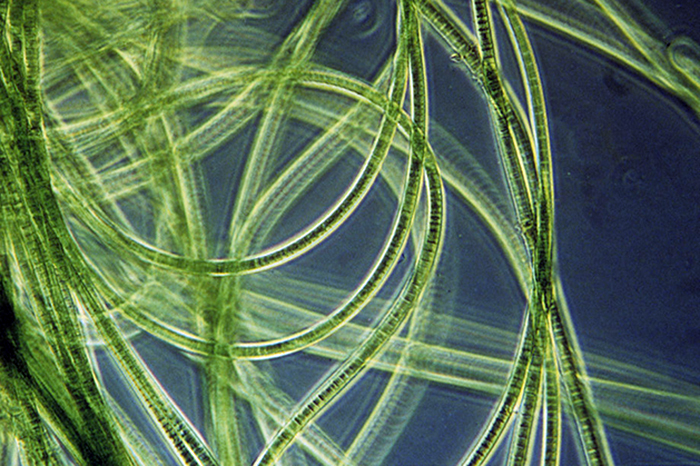
Figure 1: Magnified filamentous cyanobacteria. Photo:\r\nbotnam.com
When identifying ponds with the presence of blue-green algae\r\nand they are growing quite strongly, we need to come up with solutions to\r\ncontrol and control blue-green algae in time, if not handled promptly, the\r\nconsequences will be very high. big, sometimes damage a farming. There are\r\nmany different solutions to control blue-green algae, physical / mechanical\r\nsolutions, chemical and biological solutions. However, each method has\r\ndifferent advantages and disadvantages. Except measures for biological and\r\nphysical measures to chemistry often results in dead algae mass causing\r\nfluctuations in water quality, seriously affecting the pond, we would like to be presented Introduce some of the most\r\neffective solutions to this problem:
Physical / mechanical\r\nsolution
Decreased feeding, or discontinued feeding 02-03 meals.
For water exchange: You can change at least 30% of the water\r\nin the pond, changing within 02 to 03 days, once a day. This can help\r\nlower nutrient concentrations in the pond and reduce algal density.
Aeration enhancer is also used as a mechanical approach to\r\nalgae control. Adding oxygen to the pond bottom can stimulate phosphorus\r\nto bond and be absorbed into the sediment of the pond. This prevents\r\nphosphorus from being available in the water for use and growth. This\r\nmethod is more suitable when controlling planktonic algae such as blue-green\r\nalgae.
Also read: Is Fresh Algae or Powdered Algae Better for Shrimp Seed?
In addition, using a water blower not only provides oxygen\r\nfor the growth of microorganisms, they also have the effect of creating a flow,\r\ncollecting accumulated organic compounds to easily remove them, releasing toxic\r\ngases and avoid stratification of water sources.
In our opinion, this solution is only temporary, not\r\nlasting, it only reduces the density of algae in the pond and algae will\r\nre-emerge (including blue-green algae) when appropriate conditions.
Chemical solution
First, farmers proceed to reduce feeding, or stop feeding\r\n02-03 meals.
When algae growth is detected, use chemicals to treat as\r\nfollows: BKC (Benzalkonium Chloride) at a dose of 1 liter / 1,000m 3 of water\r\nor Clear-80 at a dose of 1.5 liters / 1,000m 3 of water. Use at\r\n09-10am, running aeration continuously.
Or maybe use Coptrol (Australian product) is a product in\r\nthe form of organic copper, used to kill algae according to the latest\r\ntechnology and has a very good effect. Friendly products, easy to\r\nuse. First, determine the required amount of each pond, then mix with\r\nwater in the ratio 1:10 - 20 (01 liter of Coptrol for 10 - 20 liters of\r\nwater). Dosage of 01 - 1.5 liters Coptrol / 1,000m 3 of water. Spray\r\nsolution evenly on the surface of shrimp pond. Use sprayer / sprayer or\r\nagricultural sprayer to spray directly onto the pond surface. Note that\r\nCoptrol should not be used in the case of hardness (CaCO 3 ) of water\r\nbelow 50 ppm and when the water temperature is below 16 oC. In addition,\r\nmany algae die will lose oxygen in the water, this will affect the health of\r\nshrimp and fish. Therefore, it is necessary to kill algae slowly, it is\r\nbest to divide the lake / pond into 2-3 times to kill and each removal about 10\r\ndays apart. Aerators need to be fully operated during this period to\r\nensure there is enough oxygen to supply the pond.
Also read: Algae oil producer Veramaris opens $200m Nebraska plant
As we have mentioned, this solution still has some\r\nshortcomings, chemical agents often lead to the result of mass death of algae\r\ncausing water quality fluctuations, seriously affecting animal health.\r\nfeed. In addition, the use of chemicals to kill algae in shrimp ponds if\r\nnot calculated carefully can also directly affect shrimp farming, chemical\r\nresidues, releasing harmful toxins, damaging the bottom. ponds and kill all beneficial\r\nalgae.
Biological solution:\r\nThis is the safest and most effective solution.
Facing the danger that algae growth is too strong, causing\r\nhuge losses for farmers, we researched and proposed the solution of using\r\nprobiotics to safely and effectively reduce the density of algae. The\r\nhandling measures are as follows:
- When detecting algae in the overgrown pond, farmers need\r\nto reduce feeding or stop feeding from 02 to 03 meals;
- Use probiotics such as Pond Plus of Bayer Company with a\r\ndosage of 200g / 1,000m 2 . Beat at night with strong aeration;
- The next day using BZT probiotics made in the US with a\r\ndose of 100 g / 1,000m 2 or PonDtox of Bayer Company with a dose of\r\n200g / 1,000m 2 to treat pond bottom environment and toxic gas.
- In the process, using minerals to beat shrimp to help\r\nshock, increase resistance when the environment changes.
This solution has a very high safety, helps stabilize the\r\nenvironment, does not affect the health of farmed shrimp; We have used it\r\nmany times in the unit's ponds; In addition, it also guides some shrimp\r\nfarmers in the province, the results are very satisfactory, limiting the damage\r\ncaused by the algae growth that is so strong in commercial shrimp farming.
\r\n\r\n\r\n\r\n\r\n\r\n\r\n\r\n\r\n\r\n\r\n\r\n\r\n\r\n\r\n\r\n\r\n\r\n\r\n\r\n\r\n\r\n\r\n\r\n\r\n\r\n\r\n\r\n\r\n\r\n\r\n\r\n\r\n\r\n\r\n\r\n\r\n\r\n\r\n\r\n\r\n\r\n\r\n\r\n\r\n\r\n\r\n\r\n\r\n\r\n\r\n\r\n\r\n\r\n\r\n\r\n\r\n\r\n
Above, are the solutions used to control and control\r\nblue-green algae, a species of algae that is not beneficial in aquaculture in\r\ngeneral and shrimp farming in particular. Of the above solutions,\r\nbiological solution is the most optimal solution as we have analyzed\r\nabove. We wish you a successful shrimp farming.
Source : tepbac.com

Ditulis oleh
Tim Minapoli
Kontributor
Pakar di bidang akuakultur dengan pengalaman lebih dari 15 tahun. Aktif berkontribusi dalam pengembangan industri perikanan Indonesia.