

The following tips are designed to help small-scale\r\naquaculture operators, particularly in Asia and Africa, reduce their\r\nenvironmental impacts and embrace operational sustainability.The aquacult...
The following tips are designed to help small-scale\r\naquaculture operators, particularly in Asia and Africa, reduce their\r\nenvironmental impacts and embrace operational sustainability.
The aquaculture sector continues to grow rapidly across the\r\nglobe – but its environmental impacts are growing as well. From farmed salmon\r\ndisplacing indigenous salmon and other fish to tonnes of aquaculture sludge\r\nquietly blanketing and degrading coral reefs and other natural habitats,\r\nold-school aquaculture has become a boom-and-bust venture.
Fortunately, many of today’s forward-looking aquaculture\r\noperators have the technology, the knowhow and the heart to take increasing\r\nresponsibility for reducing the environmental impacts of their businesses.
Globally, most aquaculture operations take place in\r\nSoutheast Asia, often using small ponds or cage systems managed by smallholder\r\nfamilies or local companies. Aquaculture in Africa is similar, though not yet\r\nas intensive. Both Africa and Southeast Asia are characterised by their\r\nincredible levels of biodiversity and unique biomes – making it doubly\r\nimportant to limit the impacts of local aquaculture activities.
This month, we interview Kyra Hoevenaars, who heads the\r\nconsulting department at the AquaBioTech Group. She is an expert in\r\nsustainable aquaculture and recently worked on a training programme on good\r\naquaculture practices for the ASEAN region and WorldFish. Along with Jonas\r\nWiza Ng’ambi, Hoevenaars also recently authored a guide, Better management\r\npractices manual for smallholders farming tilapia in pond-based systems in\r\nZambia, for CGIAR, an initiative led by WorldFish.
Together they offer six tips which have not only helped to\r\nimprove the environmental sustainability of numerous aquaculture operations,\r\nbut have also been shown – perhaps more surprisingly – to improve their\r\nfinancial performance too, creating a win-win situation for both people and\r\nnature.
1. Choose the right species
As discussed in one of our recent articles on invasive\r\nspecies, invasive non-native species (INNS) are plants and animals which do not\r\nnaturally occur in a specific location and can spread quickly enough to rob\r\nnative species of resources. These can eventually overtake and replace native\r\nspecies, or hybridise with them.
This has already happened in many countries, with fish such\r\nas the highly adaptable tilapia displacing native freshwater species across the\r\ntropics. In colder climates, non-native salmon have repeatedly escaped their\r\npens and are displacing native salmon populations. One of the few comprehensive\r\nstudies on this indicates that, in the United States alone, escaped exotic fish\r\ncause almost $5.4 billion in economic losses each year. Investigations in other\r\nregions paint similar pictures.
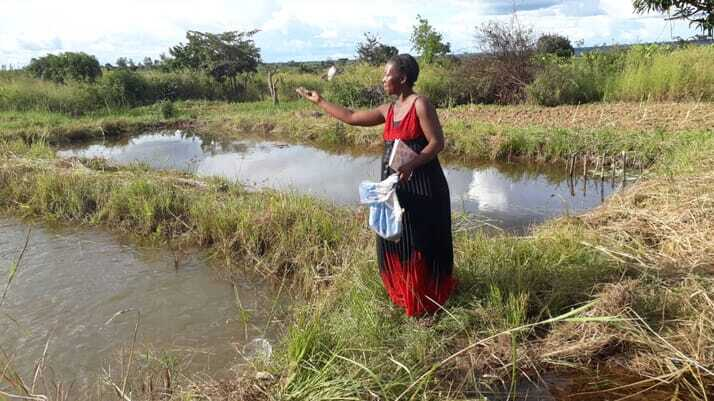
Kyra Hoevenaars recently trained tilapia producers in Zambia\r\nin how to practice more sustainable farming methods
© Kyra Hoevenaars
On the other hand, native species often perform better,\r\nhaving developed traits and habits best-suited to local ecosystems. Local\r\ndemand is often higher as people from a specific region prefer familiar and\r\ntraditionally consumed species. This gives farmers the opportunity to fetch\r\nhigher prices and a very real incentive to choose native species over exotic\r\nones. As Hoevenaars explains: “In Zambia, the Fisheries Act states that tilapia\r\nspecies can only be cultured if this species is present in receiving waters\r\nonly. In the BMP [best management practices] manual, we took this a step\r\nfurther and recommend that farmers stock only native species.”
2. Select a suitable farm site
When selecting a good site for a new farm, environmentally\r\nsensitive areas like swamps, coral reefs or mangrove forest should be avoided.\r\nEstablishing a farm would have severe consequences on local biodiversity if,\r\nfor example, mangrove forests or wetlands were cleared and converted into fish\r\nponds. Farm effluents would also eventually have a considerable negative\r\nimpact. Excessive nutrients via the influx of farm effluents would result in\r\neutrophication, making waters murky, blotting out sunlight and negatively\r\naffecting the growth of plants, corals and the area’s other denizens.
Another benefit of avoiding these areas is that swamps are\r\nhighly prone to flooding and coastal mangrove areas are infested with\r\nmosquitoes – a serious health risk for farm workers.
“Looking at the example of Zambia, many farms are located in\r\nso called ‘dambo’ areas, which are located in low-lying swamps, often below\r\nflood level. Here ponds are not drainable since water continuously flows in\r\nfrom underground. These areas are very prone to flooding, so these are not\r\nideal sites for fish farming,” Hoevenaars explains.
When selecting sites for marine cages, unless you have the\r\ncapital available to buy top-of-the-range equipment, any area that is exposed\r\nand vulnerable to big storms should be avoided since storms can repeatedly\r\nbatter and destroy expensive and hard-to-repair pens and cages. Instead, a\r\nsheltered area that is protected from high waves should be selected.
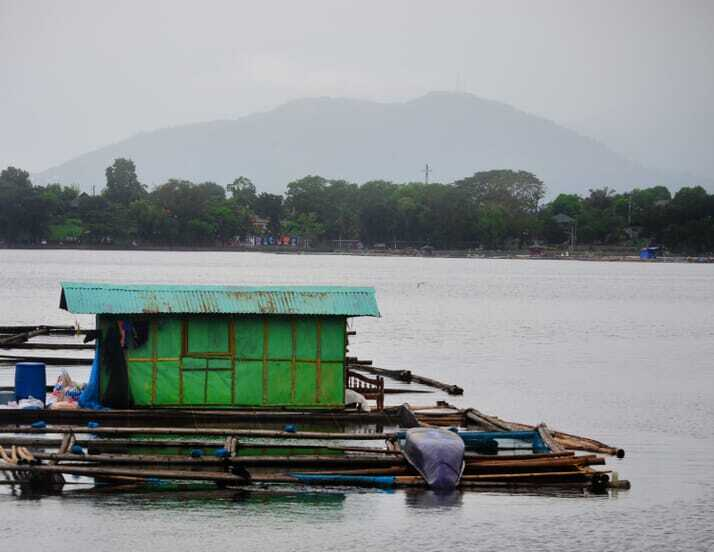
A typical freshwater cage farm in the Laguna area of the\r\nPhilippines
© Gregg Yan
3. Farm design and layout
Most traditional fish farms, especially pond farms, directly\r\nrelease their untreated wastewater into the environment surrounding their\r\nfarms. This is a serious concern, not just for the natural environment, but\r\nalso for surrounding communities which often use the water from public canals\r\nfor drinking, bathing and washing utensils. Neighbouring fish farms are also\r\nthreatened, as potential pathogens will spread swiftly and easily this way.
It is thus beneficial to design pond operations which treat\r\nand reuse this water. This can be done by allocating several extra ponds for\r\nwater treatment. For example, a settling pond allows solids to collect at the\r\npond bed. Filter feeders like bivalves or plants like mangroves can then clean\r\nthe water, while wood chips can remove excess nitrates. Finally, chemicals can\r\nthen be added to kill off pathogens if needed. Discharged wastewater should go\r\nthrough a similar treatment before disposal.
Another solution which can be integrated into the previous\r\nrecommendation is to use a biofloc\r\nsystem where waste materials like uneaten feeds and faeces are\r\nconverted to feed fish and shrimp, thereby reducing waste output while driving\r\ndown feed costs and enhancing farm productivity by up to 20 percent.
Besides improving environmental sustainability, embracing\r\nthese practices reduces water usage and minimises the potential spread of\r\npathogens, as the biosecurity of the farm is improved. Fewer disease outbreaks\r\nhugely improve the financial performance of farms. Careful planning and proper\r\nfarm design will pay long-term dividends for both farmers and the environment.
4. Manage feeding practices
Feeds contribute the largest share of waste in and around\r\nfish farms. When using trash fish or low-quality pellets, a great deal of feeds\r\nwill be ignored by the fish. These will sink to the bottom, causing the water\r\nquality to deteriorate. When released, these effluents also degrade the water quality\r\nof the surrounding area.
Similarly, when using low-grade feed pellets with\r\nexcessively high protein content, high levels of unused nutrients end up in the\r\nfaeces of the fish, which pollutes the water they live in. It is thus\r\nrecommended to use only high-quality pellets specifically designed for your\r\nchosen fish species. Besides creating less pollution, high-quality food results\r\nin better growth rates and improved health, again increasing farm performance.\r\nRemember that when it comes to fish feeding, trash in means trash out.
According to Hoevenaars, a lot of small-scale farmers in\r\nAfrica and Asia still use single ingredients such as rice bran or even kitchen\r\nwaste to feed their fish. Fortunately, in Zambia, there are efforts to\r\ndistribute quality pellet feeds to these farmers, and the governments of\r\ncountries in Southeast Asia are providing training in good aquaculture\r\npractices to encourage the use of quality pellet feeds in the sector.
Feeding practices play an equally crucial role in reducing\r\npollution. Farmers often overfeed their stock to try to ensure they grow well,\r\nbut usually only end up wasting money and polluting culture water.
All this weakens the immune systems of farmed fish,\r\nincreasing mortalities or reducing growth rates. By sticking with good feeding\r\npractices, excessive waste can be avoided, while water quality plus the health\r\nof farmed fish can be optimised.
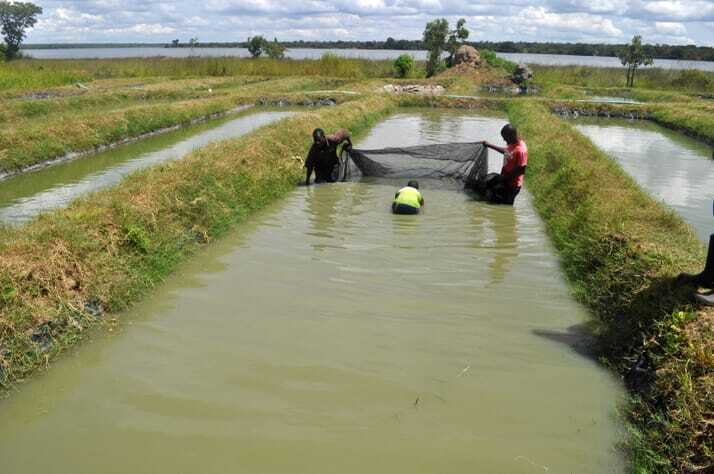
A typical small-scale tilapia farm in Zambia
© Kyra Hoevenaars
5. Minimise chemicals and veterinary drugs
Many farmers use chemicals for pond preparation –\r\neradicating predators and snails – and to maintain water-quality parameters.\r\nVeterinary drugs are sometimes used to keep fish healthy or to treat ailing\r\nbatches.
The reality is that most of these chemicals end up in the\r\nculture water. When farm effluents are released, these potentially deadly\r\nchemicals and veterinary drugs can end up in the natural environment\r\nsurrounding the farm. Think about it: if they were designed to kill snails and\r\npests in ponds, then they will obviously do the same in streams and lakes.
With the right farm knowledge and the use readily available\r\nnatural alternatives, many of these chemical treatments become unnecessary.\r\nFurthermore, when treating sick fish, it is far better to conduct treatments in\r\na separate, quarantined environment where chemicals are not released into the\r\nnatural environment.
“The guide for smallholders in Zambia recommends the\r\nfollowing measures to keep fish healthy and thereby reduce the need for\r\nveterinary medicines: stock healthy seed, use clean water, avoid stress\r\n(appropriate stocking densities, regular feeding and careful handling) and\r\nensure regular sampling and observations to check for signs of diseases,”\r\nexplains Hoevenaars.
6. Plant native vegetation
Finally, planting trees around your farm is always a good\r\nidea. Trees provide shade, reduce the impacts of wind and can provide an extra\r\nsource of food for people, fish, birds and other animals.
However it should also be noted that for biosecurity\r\npurposes the pond and directly adjacent areas should be kept clear of\r\nvegetation, as aquatic weeds provide shelter for vectors and predators and\r\nsince weeds on the pond dykes and dense vegetation near the pond will be hiding\r\nplaces for predators and other animals.
Remember that when planting trees or other vegetation, you\r\nshould try to use local species or strains that are native to your area. These\r\nwill be greatly appreciated by native and migratory birds, plus local bats,\r\ninsects and other lifeforms which can enhance your area’s biodiversity and\r\nproductivity. An old adage goes that the best time to plant a tree was\r\nyesterday, but the next best time is today.
Conclusions
\r\n\r\n\r\n\r\n\r\n\r\n\r\n\r\n\r\n\r\n\r\n\r\n\r\n\r\n\r\n\r\n\r\n\r\n\r\n\r\n\r\n\r\n\r\n\r\n\r\n\r\n\r\n\r\n\r\n\r\n\r\n\r\n\r\n\r\n\r\n\r\n\r\n\r\n\r\n\r\n\r\n\r\n\r\n\r\n\r\n\r\n\r\n\r\n\r\n\r\n\r\n\r\n\r\n\r\n\r\n\r\n\r\n\r\n\r\n\r\n\r\n\r\n\r\n\r\n\r\n\r\n\r\n\r\n\r\n\r\n\r\n\r\n\r\n\r\n\r\n\r\n\r\n\r\n\r\n\r\n\r\n\r\n\r\n\r\n\r\n\r\n\r\n\r\n
Through these six tips, we hope to help today’s generation\r\nof forward-thinking fish farmers produce more seafood sustainably. Knowing\r\nyou’re doing your part to alleviate food security while protecting the\r\nenvironment? Now that’s good for both the gut andthe heart.
Source : The Fish Site

Ditulis oleh
Tim Minapoli
Kontributor
Pakar di bidang akuakultur dengan pengalaman lebih dari 15 tahun. Aktif berkontribusi dalam pengembangan industri perikanan Indonesia.