

Soybean meal is one of the most\r\nsuitable alternatives to substitute for fishmeal in aquatic animal feeds due to\r\nits high protein content, good balance of essential amino acids (EAA) and lower\r\...
Soybean meal is one of the most\r\nsuitable alternatives to substitute for fishmeal in aquatic animal feeds due to\r\nits high protein content, good balance of essential amino acids (EAA) and lower\r\ncost. Soy protein concentrate (SPC) – made by moving a portion of the\r\ncarbohydrates (sugars) from dehulled and defatted soy flakes through aqueous\r\nethanol – has similar content of crude proteins and essential amino acids\r\ncompared to fishmeal, along with lower anti-nutritional factors.
Several studies have assessed the influence of SPC on fish\r\nduring the past 20 years, and results showed that different species have\r\nunequal levels of tolerance for SPC. Research has shown that SPC can\r\neffectively replace fishmeal as a protein source in the diet of some\r\ncommercially important fishes like Atlantic salmon, rainbow trout and pompano,\r\nwhile other species only tolerate some levels of SPC.
The pearl gentian grouper – a hybrid species (Epinephelus\r\nlanceolatus ♂ × E.\r\nfuscoguttatus ♀) – is\r\nan important commercial fish that grows rapidly, has strong disease resistance\r\nand is highly nutritious. It is widely cultured in China using land-based and\r\nsea-cage techniques and is mainly fed with formulated pellet diets. As a\r\ntypical carnivorous species, pearl gentian grouper requires high protein and is\r\nheavily dependent on high levels of fishmeal in its diet to meet its protein\r\nrequirement, resulting in higher production costs. It is still unknown whether\r\nit is possible to replace fishmeal with SPC for pearl gentian grouper.
This article – adapted and summarized from the original\r\npublication – reports on a study of the effects of fishmeal\r\nreplacement by soy protein concentrate on the growth performance, apparent\r\ndigestibility and retention of protein and amino acid in juvenile pearl gentian\r\ngroupers.
This work was supported by the Natural Science Foundation of\r\nHainan province (No. 20163074 and No. 20163071), Major Science and Technology\r\nProjects in Hainan Province from Science and Technology Department of Hainan\r\nProvince government, China (No. ZDKJ2016009), Hainan Key Laboratory for\r\nConservation and Utilization of Tropical Marine Fishery Resources and Sanya Key\r\nlaboratory of seawater aquaculture research (No. L1507). Thanks to National\r\nFeed Engineering Technology Research Center (Beijing, China) and Beijing\r\nLongkefangzhou Bio-Engineering Technology Co., Ltd. (Beijing, China) for their\r\nhelp to detect the anti-nutrition factors in SPC and experimental diets.
Study setup
Pearl gentian grouper were purchased from a commercial\r\nhatchery (Hainan, China). Before the trial, fish were stocked in an indoor\r\nrecirculating aquaculture system at the Hainan Key Laboratory for Conservation\r\nand Utilization of Tropical Marine Fishery Resources (Hainan Tropical Ocean\r\nUniversity, Sanya, China) for two weeks, and fed a commercial diet (Nisshin\r\nFlour Milling Co., Ltd., Japan) twice daily to satiation.
The fish (8.00 grams ± 0.10) were randomly distributed in 18\r\ntanks – 500 liters each tank, 50 fish per tank – in an indoor seawater\r\nrecirculating system and each diet assigned tanks in triplicate. The fish were\r\nfed twice a day, and feed intake of each diet and mortality of the fish were\r\nrecorded in each tank. Six isonitrogenous and isocaloric diets (46 percent\r\ncrude protein, 18 MJ/kg gross energy) were formulated and used in the study. In\r\nthese diets, SPC replaced 0 to 75 percent of fishmeal protein (SPC0, SPC15,\r\nSPC30, SPC45, SPC60, and SPC75).
After feeding the fish with diet in each tank for 30\r\nminutes, the uneaten diet was siphoned out and dried overnight at 50 degrees-C\r\nbefore being weighed to avoid any contamination with feces. And the weight of\r\nthe uneaten diet was subtracted to calculate the daily feed intake in each\r\ntank. Feces were also collected from each tank daily for 30 days (from day 12\r\nto day 42 of the feeding trial), for lab analyses.
Water quality in the tanks was monitored daily and\r\nmaintained at a temperature of 29.2 ± 0.4 degrees-C; dissolved oxygen at 7.10 ±\r\n0.2 mg/L; salinity at 25.8 ± 0.5‰; pH at 7.2 ± 0.2; and total ammonia nitrogen\r\nat 0.3 ± 0.2 mg/L.
For detailed information on the experimental design and diet\r\nformulations; feeding trial; sample collection and calculation formula for\r\ngrowth performance; and biochemical and statistical analyses, refer to the\r\noriginal publication.
Results and discussion
Final survival of juvenile pearl gentian grouper was\r\nsignificantly affected based on the concentration of dietary SPC. Fish survival\r\nwas higher in groups SPC15, SPC30 and SPC45 (from 94 to 96 percent), compared\r\nto SPC60 and SPC75. The body weight gain (BWG), weight gain rate (WGR),\r\nspecific growth rate (SGR) and protein efficiency ratio (PER) increased in fish\r\nfed with diet SPC15, but gradually decreased with further increase of SPC\r\nconcentrations. Conversely, the feed conversion ratio (FCR) values\r\nsignificantly decreased in groups SPC15, SPC30 and SPC45, but increased in the\r\nSPC75 group, suggesting that SPC15, SPC30 and SPC45 had a significantly higher FCR.
The daily feed intake (DFI) was significantly higher in SPC0\r\ncompared to the groups treated with SPC, suggesting there was a significant\r\neffect of dietary SPC on fish DFI. The hepatosomatic index (HSI; ratio of liver\r\nweight to total body weight – a measure of the energy reserves of an animal,\r\nespecially in fish) of fish was significantly higher in group SPC0 compared to\r\nSPC30 and SPC75, but had no significant differences with SPC15, SPC45 and\r\nSPC60. Based on regression models of BWG corresponding to SPC replacement\r\nlevels (Fig. 1), the optimal SPC replacement level was 11.71 percent. However,\r\nbased on SGR and dietary SPC replacement levels, the optimal level was 14.41\r\npercent (Fig. 2).
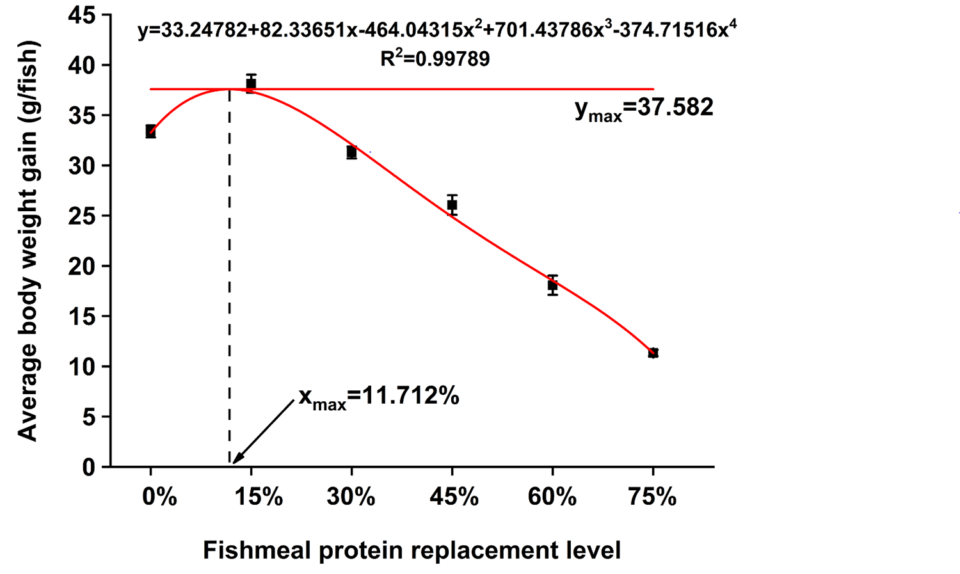
Fig. 1: Regression model for average body weight gain\r\n(y-axis) in response to fishmeal protein replacement level (x-axis) by SPC.
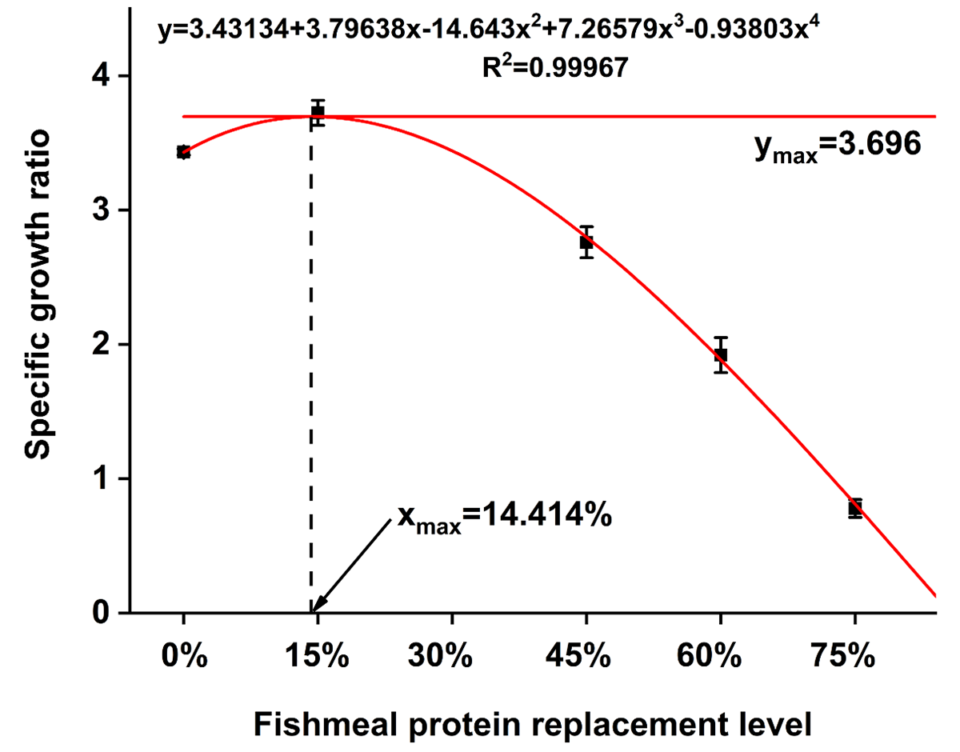
Fig. 2: Regression model for specific growth rate in\r\nresponse to fishmeal protein replaced by SPC.
Regarding the approximate composition of the whole body and\r\nmuscle of the groupers, in the dorsal muscle the moisture and protein content\r\nwere affected based on the concentration of dietary SPC, while other\r\ncompositions were not influenced. There was no significant difference in the\r\ncrude protein of the dorsal muscle in fish fed with SPC0, SPC15 and SPC30 diet.\r\nHowever, those values were significantly higher compared to fish fed with\r\nSPC45, SPC60 and SPC75, with the increasing dietary SPC concentration. The\r\nmoisture of the dorsal muscle showed an opposite trend.
For whole body, the approximate components showed\r\nsignificant differences. The moisture content gradually increased with\r\nincreasing SPC concentration and reached its maximum value in fish fed with the\r\nSPC75 diet. The fish fed with diets from SPC30 to SPC75 had significantly\r\nhigher whole-body moisture than for groups SPC0 and SPC15. The crude ash showed\r\nthe opposite result. Crude protein content of the whole body in groups SPC30\r\nand SPC45 was significantly higher among all the SPC treatments and decreased\r\nin groups SPC60 and SPC75.
In our study, fish fed the SPC15 inclusion diet had a\r\nrelatively better growth performance, and other treatments showed a gradual\r\ndecrease with increasing SPC concentration. Plant proteins can be used in many\r\nfish diets for the partial or total replacement of fishmeal, as an option to\r\nreduce production cost. Among the plant proteins, soy products are\r\nnutritionally superior ingredients of feeds for aquatic animals. Several studies\r\nhave reported that when dietary SPC inclusion was below 60 percent, a\r\nsatisfactory growth and feed utilization was obtained for a number of species.\r\nFurther increases of SPC inclusion in the diet led to lower diet utilization\r\nand higher mortality.
Some reports argued that lower growth performance may be\r\nrelated to a decrease in feed intake rather than nutritional imbalance or\r\ndeficiency. This was suggested because plant proteins are usually less\r\npalatable to fish than fishery ingredients. In our study, when fish were fed\r\ndiets with high levels of replacement of fishmeal with SPC, a reduction in DFI\r\nwas observed, which could cause reduced growth. We noticed that high SPC\r\ninclusion (above 60 percent) caused reduction in diet utilization, as reflected\r\nby an increase in FCR in our work. similar results have been reported for other\r\nfish species.
In our study, along with the growth performance of fish, the\r\ncrude protein levels in muscle of fish fed a diet with 45 to 75 percent SPC\r\nreplacement were also significantly decreased. And the whole-body protein of\r\nfish fed with a diet with 60 to 75 percent SPC replacement had significantly\r\nlower values. This could have been caused by possibly deficient levels of the\r\namino acids methionine and lysine in the SPC-based diet and an imbalance of\r\nessential amino acids. The addition of feed attractants and amino acid\r\nsupplementation are suggested strategies for further research.
Perspectives
\r\n\r\n\r\n\r\n\r\n\r\n\r\n\r\n\r\n\r\n\r\n\r\n\r\n\r\n\r\n\r\n\r\n\r\n\r\n\r\n\r\n\r\n\r\n\r\n\r\n\r\n\r\n\r\n\r\n\r\n\r\n\r\n\r\n\r\n\r\n\r\n\r\n\r\n\r\n\r\n\r\n\r\n\r\n\r\n\r\n\r\n
Our results demonstrated that juvenile pearl gentian grouper\r\nhave limited tolerance for SPC. The maximum level of SPC substitution for\r\nfishmeal in the fish diet, according to weight gain and specific growth rate,\r\nwas estimated to be 11 to 14 percent. However, the 30 percent SPC replacement\r\ndid show a positive influence on protein and amino acid retention. Therefore,\r\nwe suggest that SPC replacement of fishmeal for juvenile pearl gentian grouper\r\nshould not be more than 30 percent.
Source: Global Aquaculture Alliance

Ditulis oleh
Tim Minapoli
Kontributor
Pakar di bidang akuakultur dengan pengalaman lebih dari 15 tahun. Aktif berkontribusi dalam pengembangan industri perikanan Indonesia.