

Results of this study showed the potential of these Pseudovibrio\r\ndenitrificans isolates from the marine sponge Aplysina gerardogreeni to\r\ncontrol emerging Vibrio spp...
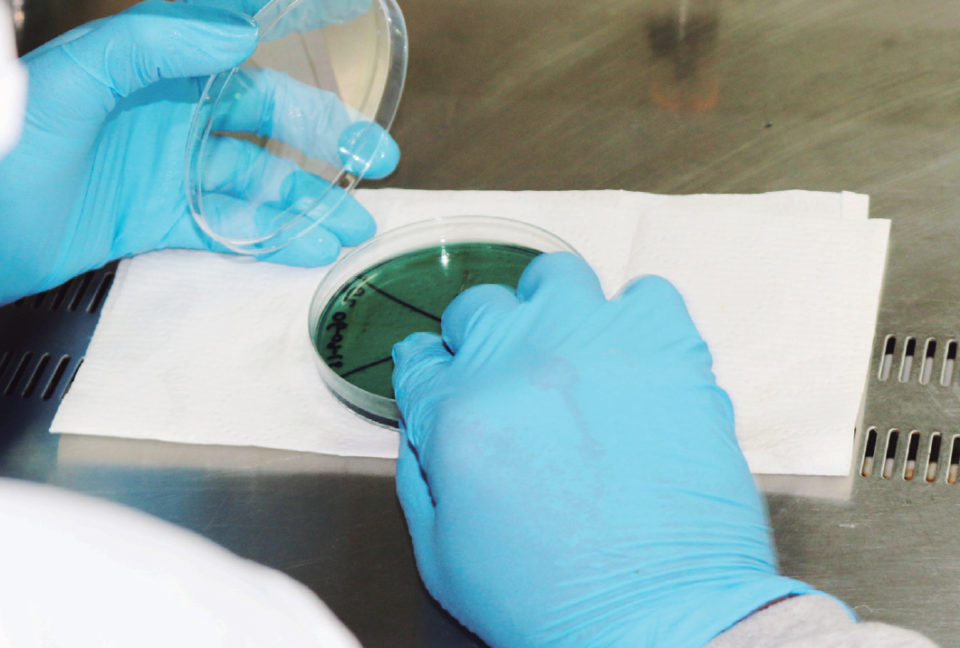
Results of this study showed the potential of these Pseudovibrio\r\ndenitrificans isolates from the marine sponge Aplysina gerardogreeni to\r\ncontrol emerging Vibrio spp. in shrimp aquaculture.
Several Vibrio spp. have been associated with\r\nshrimp mortality and causing massive economic losses in countries that produce\r\nfarmed shrimp. The most serious disease caused by Vibrio is Acute\r\nHepatopancreatic Necrosis Disease (AHPND), and several Vibrio species have been\r\ndetermined to be involved, all of which commonly carry a 70 kbp plasmid (pVA1)\r\nthat contains the PirA and PirB toxin genes.
The very limited efficiency of antibiotics and disinfectants\r\nto control these Vibrio spp. has led to a growing interest in the use\r\nof probiotics as epidemiological control tools. The use of probiotics is a\r\ncommon practice in current shrimp aquaculture. Namely, there are two main modes\r\nof action of probiotics – competitive exclusion and immunomodulation.\r\nProbiotics occupy and colonize the digestive tract, reducing the colonizer’s\r\nability to colonize.
It is well known that probiotics can modify the intestinal\r\nmicrobiota in shrimp. Through the secretion of antibacterial substances,\r\nprobiotics compete against pathogens, prevent their adhesion to the intestinal\r\nepithelium, compete for the necessary nutrients and produce antitoxic effects.\r\nThere are numerous commercial probiotics, mainly based on bacterial strains\r\nof Lactobacillus and Bacillus.
Regardless of their efficacy and possible benefits for\r\nshrimp, many of these bacteria are not typical of marine environments,\r\npresenting problems for cultivation in shrimp farming systems for Pacific white\r\nshrimp (Penaeus vannamei), where they must compete against Vibrio spp.\r\ntypical of the marine environment.
In the search for probiotic bacteria, typical of marine\r\nenvironments and capable of controlling Vibrio spp. of shrimp, it is\r\nessential to explore other bacterial genera typical of marine environments.\r\nSymbiotic bacteria from marine organisms could be ideal candidates, because\r\nthey are adapted to marine conditions and can thrive in adverse environments.\r\nIt is well known that sea sponges harbor very diverse microbial communities,\r\nbut only a small group of these symbiotic bacteria can be cultured. The group\r\nof bacteria that is most amenable to culture are in the genus Pseudovibrio,\r\nand its species have been isolated from several marine invertebrates, flat\r\nworms, sponges and tunicates.
Pseudovibrio strains have the genomic potential to produce\r\nsecondary metabolites and supply cofactors to the host. Among several molecules\r\nwith different biological activities, the molecules with the most active\r\nantimicrobial activity are tropodithietic acid (TDA), alkaloids and polyketides\r\nlike erythronolide.
Recently it was reported that low concentrations of TDA (0.5\r\nμg/mL) exhibited activity against two pathogenic coral Vibrios. Because of the\r\nproduction of new compounds and the versatility of their metabolites, the\r\nbiotechnological potential of the genus Pseudovibrio has been\r\nreported. Despite these properties, to date there are no reports on the use\r\nof Pseudovibrio spp. in shrimp aquaculture to control emerging\r\npathogenic Vibrio spp.
This article – adapted and summarized from Aquaculture\r\n(Ecuador) Issue 130, August 2019 – reports on a study\r\nto determine the probiotic capacity in shrimp culture of several isolates\r\nof P. denitrificans isolated from the marine sponge Aplysina\r\ngerardogreeni collected in the El Pelado Marine Protected Area (REMAPE),\r\nSanta Elena, Ecuador.
Forty-three isolates of Pseudovibrio were obtained\r\nand in vitro competitive exclusion assays against Vibrio spp. were\r\ncarried out. Most bioactive strains were validated by in vivo tests in the\r\nlaboratory and in shrimp ponds. This article presents evidence of the probiotic\r\nqualities of several P. denitrificans isolates, highlighting their\r\npotential as a useful tool to control emerging Vibrio spp. in\r\nshrimp aquaculture.
Study setup
A total of nine samples of the A. gerardogreeni sea\r\nsponge were collected by diving in four rocky habitats at different depths from\r\n10 to 30 meters in coastal waters of the Province from Santa Elena, Ecuador.\r\nSponge samples were transported to the National Center for Marine Research\r\n(Centro Nacional de Investigaciones Marinas, CENAIM).
In the laboratory, macroscopic endobionts and epibionts were\r\nremoved from sponge samples with scalpel and tweezers. Five grams of tissue\r\ntaken from different parts of the body were macerated and diluted in 45-mL of\r\nsterile natural seawater (NSW). Subsequently, the homogenized samples were\r\nserially diluted to 10-5 in NSW. One hundred (100) μl of dilutions 10-2 to\r\n10-5 were seeded in triplicate in Petri dishes containing Marine Agar 2216\r\n(MA) BD DifcoTM. Plates were incubated at 27 degrees-C for two days.\r\nSubsequently, different morphotypes were selected and purified by successive\r\nstripes on Petri dishes containing MA. Pseudovibrio strains were initially\r\nselected based on their morphological and biochemical characteristics.
Subsequently, the taxonomy of isolates exhibiting\r\nbioactivity was determined based on nucleotide sequences of the 16 rRNA gene.\r\nWith pure cultures of Pseudovibrio, aliquots were done in Luria-Bertani medium\r\nwith NSW and 20 percent glycerol and stored at minus-80 degrees-C for\r\nsubsequent tests.
For detailed information on the biochemical characterization\r\nof Pseudovibrio strains; in vitro evaluation of anti-Vibrio bioactivity;\r\ncompetitive exclusion test for punctual inoculation in agar; 16S rRNA gene\r\nsequencing amplification; safety assessment of P. denitrificans in\r\nthe survival of P. vannamei postlarvae; effect of P.\r\ndenitrificans on P. vannamei postlarvae exposed to Vibrio\r\npathogens; effect of P. denitrificans on the survival of postlarvae\r\nand juvenile P. vannamei by challenge test with V. campbelli and V.\r\nparahaemolyticus; effect of competitive exclusion of P. denitrificans against\r\nluminescent V. harveyi in naturally infected P. vannamei post larvae;\r\neffect of the application of Pseudovibrio in culture ponds of P. vannamei;\r\nbacterial biomass production; pool bioassay; and statistical analyzes, please\r\nrefer to the original publication.
Results and\r\ndiscussion
Commercial probiotics used in shrimp farming belong\r\npredominantly to the genera Lactobacillus and Bacillus. Although\r\nsome commercially used species are marine, most commercial probiotic bacteria\r\nare of terrestrial origin because they were initially formulated for other\r\nterrestrial animals. Although these bacterial formulations are proven effective\r\nfor the original target organisms, their efficiency may be compromised when\r\nenvironmental conditions are very different, as in the case of marine shrimp\r\ncrops. Penaeid shrimp are subject to high salinity and temperature ranges,\r\nwhich favors the growth of Vibrio spp.
The optimal range of salinity and temperature to\r\nculture P. vannamei is 20 to 35 ups and between 22 and 32 degrees-C.\r\nUsing metagenomics, Zhang et al. (2016), showed that salinity modifies the\r\nmicrobiota in shrimp, finding that the higher the salinity, the more dominant\r\nthe Vibrio are to the detriment of Lactobacillus, while Vezzulli et al.\r\n(2013), report that a temperature below 37 degrees-C negatively affects the\r\ngrowth of Lactobacillus.
Marine biodiscovery (the collection of samples of native\r\nbiological materials – e.g. plants, animals and other organisms – to test for\r\ncompounds that may have commercial applications, like new pharmaceuticals and\r\ninsecticides) is a promising alternative to isolate marine bacteria that\r\nfunction as effective probiotics for marine organisms that can be cultured.\r\nMarine invertebrates, particularly sponges, harbor great bacterial diversity.\r\nAmong the marine bacteria that can be cultured, the genus Pseudovibrio stands\r\nout, and in recent decades has been the subject of studies due to its\r\nversatility to produce bioactive molecules against Gram-negative and\r\nGram-positive bacteria.
In this study, we separated several isolates of P.\r\ndenitrificans which exhibit probiotic qualities for shrimp, due to their\r\nstrong anti-Vibrio bioactivity. These qualities were demonstrated in our\r\nexperiments, challenge tests in laboratories and in culture ponds.
Dominguez, Vibrios, Table 1
| \r\n Treatments \r\n | \r\n \r\n Stocking density (per square meter) \r\n | \r\n \r\n Average weight (g) \r\n | \r\n \r\n Survival (%) \r\n | \r\n \r\n Yield (kg/ha) \r\n | \r\n \r\n FCR \r\n | \r\n
| \r\n Ps-17 \r\n | \r\n \r\n 8 \r\n | \r\n \r\n 10.2±2.0 a \r\n | \r\n \r\n 79.2±5.3 a \r\n | \r\n \r\n 899.6±59.5 a \r\n | \r\n \r\n 0.99±0.16 a \r\n | \r\n
| \r\n Ps-18 \r\n | \r\n \r\n 8 \r\n | \r\n \r\n 10.8±3.4 a \r\n | \r\n \r\n 66.3±6.8 b \r\n | \r\n \r\n 753.4±77.2 b \r\n | \r\n \r\n 1.14±0.28 a \r\n | \r\n
| \r\n Control \r\n | \r\n \r\n 8 \r\n | \r\n \r\n 9.4±2.4 a \r\n | \r\n \r\n 63.0±6.7 b \r\n | \r\n \r\n 715.9±76.4 b \r\n | \r\n \r\n 1.35±0.32 a \r\n | \r\n
Table 1. Beneficial effect of Pseudovibrio strains on P.\r\nvannamei shrimp during a 108-day bioassay (duration of the production cycle).\r\nThe results are presented as average ± SD (n = 4). Different lowercase letters\r\nindicate significant differences (P <0.05).
We found bioactivity against V. parahaemolyticus, V.\r\ncampbellii, V. vulnificus and V. harveyi and against the highly\r\nvirulent pathogenic strain of V. parahaemolyticus BA94C2 positive for\r\nPirA / PirB, toxins associated with AHPND pathologies in shrimp culture. As far\r\nas we know, this is the first report that analyzes the anti-Vibrio potential of\r\nPseudovibrio against Vibrio spp. in shrimp. The antibacterial\r\nactivity of the genus Pseudovibrio has been mentioned in numerous studies,\r\nagainst Gram-positives and Gram-negative bacteria, such as E. coli,\r\nBacillus subtilis, Kluyveromyces marxianus, Salmonella enterica serotype\r\nTyphimurium, Staphylococcus aureus resistant to methicillin (MRSA)\r\nand Clostridium difficile.
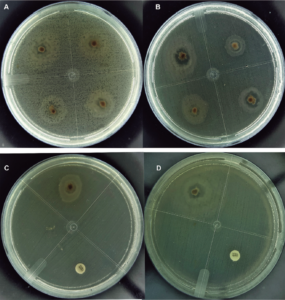
Fig. 1: Bioactivity of isolated Pseudovibrio against\r\npathogenic Vibrio. A) Pseudovibrio spp. against V. harveyi (E22).\r\nB) Pseudovibrio spp. against Vibrio campbellii (LM-2013).\r\nC) Pseudovibrio spp., against V. vulnificus (S2) and\r\noxytetracycline disc. D) Pseudovibrio spp. against V.\r\nparahaemolyticus (BA94C2) and oxytetracycline disc.
Recently, activity was reported against two Vibrio pathogens\r\nfound in corals, Vibrio coralliilyticus and Vibrio owensii. The\r\nantibacterial activity of Pseudovibrio strains has been associated with their\r\nmetabolome, sulfuric acid, and tropodithietic acid (TDA). TDA can kill or\r\ninhibit Vibrio spp. pathogens in fish larvae. In addition, salinity favors the\r\ngrowth of Pseudovibrio because it is a bacterium typical of marine\r\nenvironments, and our Pseudovibrio isolates had an optimal growth between 25 to\r\n31 degrees-C. These conditions favor their ability to compete against Vibrio spp.
A very important step in assessing probiotic characteristics\r\nis to rule out the safety of bacterial candidates. Our results corroborate the\r\nsafety of three Pseudovibrio isolates evaluated in zoea-1 shrimp\r\nlarvae. The microbiological analysis confirmed that the Pseudovibrio were\r\nassociated with zoea-1 without causing adverse effects. Several Pseudovibrio spp.\r\nhave been reported as symbionts (organisms living in symbiosis, any type of a\r\nclose and long-term biological interaction between two different biological\r\norganisms) of many marine benthic invertebrates, including shrimp. In addition,\r\nPseudovibrio is well equipped to survive in adverse environments where\r\nnutrients can fluctuate, such as shallow seawater, and can proliferate in\r\nultra-oligotrophic (low nutrient levels) marine waters.
This metabolic versatility of the genus favors its\r\nassociation with its invertebrate hosts and is beneficial or at least neutral,\r\nbecause most of them are commonly associated with healthy animals. After the\r\nsafety tests, the next step was to determine the effectiveness of P.\r\ndenitrificans against Vibrio spp. using in vivo tests.
To verify the effectiveness of P. denitrificans as\r\na probiotic, two challenge tests were performed using two highly virulent\r\nvibrios, V. campbellii and V. parahaemolyticus, resulting in a\r\nsignificant increase in the survival of challenged larvae and juveniles. In\r\naddition, the tests were conducted at the PL3 (3-day postlarvae) stage, which\r\nwas already naturally infected with V. harveyi, strongly indicating the\r\nability of P. denitrificans to compete and displace Vibrio spp.\r\npresent in shrimp postlarva cultures and improving PL survival.
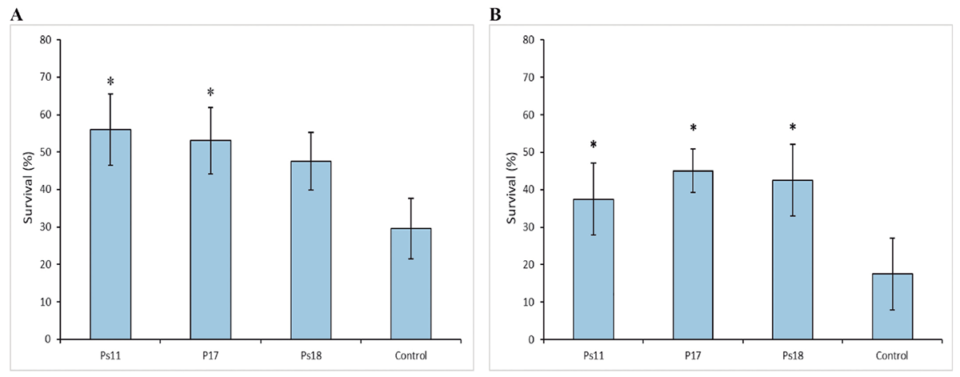
Fig. 2: A) Effect of the three isolates of Pseudovibrio on\r\nthe survival (72 hours post-exposure) of P. vannamei postlarvae\r\nchallenged with V. campbellii initially treated for five days with\r\nPseudovibrio. B) Effect of Pseudovibrio on the survival (72 hours\r\npost-exposure) of P. vannamei juveniles, challenged with V.\r\nparahaemolyticus initially treated for 10 days with Pseudovibrio. The\r\nerror bar represents the S.D. of the mean (n = 4). The asterisks (*) represent\r\nsignificantly different from the control (P <0.05, Dunnett’s).
This finding is very relevant, considering that bacteria of\r\nthe genus Vibrio are quite adapted to the culture environment of marine\r\norganisms. There were no significant differences in the survival of shrimp\r\nlarvae treated with Ps11, Ps17 and Ps18 when compared to the control group. The\r\nhigh mortality observed in the shrimp postlarvae in the control group was\r\nprobably related to the high load of luminescent V. harveyi present.
Luminescent species of Vibrio have been associated with\r\nsevere mortalities in shrimp farming, mainly in the nurseries in shrimp farms.\r\nThe pond test confirmed the beneficial effects of the application of P.\r\ndenitrificans, demonstrating its effectiveness to increase production,\r\nsurvival, average shrimp harvest weight and yields. The best production yield\r\nwas recorded with P. denitrificans isolate Ps17, compared to isolated\r\nPs18. This result indicates that the P. denitrificans isolates tested\r\nmay have different effects and, therefore, caution should be exercised when\r\nextrapolating the beneficial effect of P. denitrificans strains.
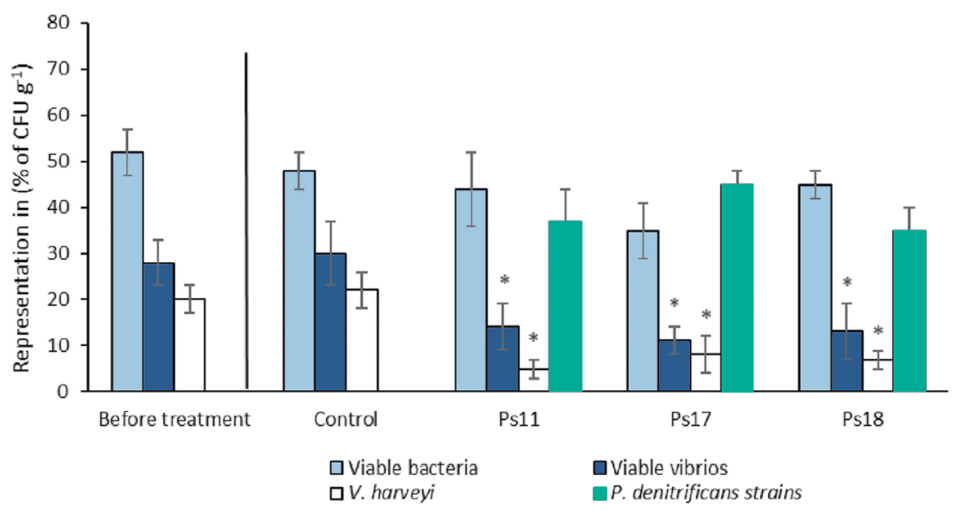
Fig. 3: Efficacy of P. denitrificans strains to colonize and\r\ndisplace total Vibrio and luminescent Vibrio in shrimp 48 hours after P.\r\ndenitrificans application. The error bar represents the S.D. of the mean\r\n(n = 3). The asterisks (*) represent significantly different from the control\r\n(P <0.05, Dunnett’s).
The variability in the resulting bioactivity obtained from\r\ndifferent isolates indicates the need to carry out similar studies using\r\nseveral isolates. In our study, we used nine sponge samples collected in\r\ndifferent places to increase the possibility of obtaining a large genetic set\r\nof bacteria. Similar results have been found in other bacteria. Particularly,\r\nthe strain (ILI) of V. algynoliticus functions as a probiotic for shrimp,\r\nwhile other strains of the same species have been reported as pathogenic.\r\nSimilarly, Sonnenschein et al. (2018), reports toxicity of different strains\r\nof Roseobacter against microalgae.
Perspectives
Marine biodiscovery is a promising alternative to isolate\r\nmarine bacteria that can be used as effective probiotics for cultured marine\r\norganisms. To identify Pseudovibrio spp. that could be highly\r\nbioactive against the pathogenic Vibrio spp. of shrimp, several\r\nsamples of different morphotypes of the sponge A. gerardogreeni were\r\ncollected. From these, 43 isolates were obtained including three isolates –\r\ncoded as Ps11, Ps17 and Ps18 – that showed the highest bioactivity\r\nagainst Vibrio spp. that are highly pathogenic to shrimp.
The anti-Vibrio bioactivity demonstrated by in vitro tests\r\nwas confirmed by the beneficial effects observed in the challenge tests, the\r\nnaturally infected larvae and in the shrimp culture ponds. The results of our\r\nstudy indicate which Pseudovibrio can be used as a biological control for Vibrio spp.\r\nin shrimp culture. More studies are needed to evaluate practical concentrations\r\non a commercial scale.
\r\n\r\n\r\n\r\n\r\n\r\n\r\n\r\n\r\n\r\n\r\n\r\n\r\n\r\n\r\n\r\n\r\n\r\n\r\n\r\n\r\n\r\n\r\n\r\n\r\n\r\n\r\n\r\n\r\n\r\n\r\n\r\n\r\n\r\n\r\n\r\n\r\n\r\n\r\n\r\n\r\n\r\n\r\n\r\n\r\n\r\n\r\n\r\n\r\n\r\n\r\n\r\n\r\n\r\n\r\n\r\n\r\n\r\n\r\n\r\n\r\n\r\n\r\n\r\n\r\n\r\n\r\n\r\n\r\n\r\n\r\n\r\n
Source : Global Aquaculture Alliance

Ditulis oleh
Tim Minapoli
Kontributor
Pakar di bidang akuakultur dengan pengalaman lebih dari 15 tahun. Aktif berkontribusi dalam pengembangan industri perikanan Indonesia.