

Seafood from wild-catch and aquaculture is the largest\r\nanimal protein industry in the world. Wild-catch tonnage has been stable since\r\n1990 at around 90 million tons, so aquaculture essentially a...
Seafood from wild-catch and aquaculture is the largest\r\nanimal protein industry in the world. Wild-catch tonnage has been stable since\r\n1990 at around 90 million tons, so aquaculture essentially accounts for the\r\ngrowth since (Fig. 1). Aquaculture has grown faster than any animal protein\r\nsector at approx. 7 percent compound annual growth rate over the past two\r\ndecades, compared to about 4 percent for poultry. Feed is a major cost in\r\nlivestock production, and protein ingredients are the main cost of aquafeeds.
Efficient feed – and particularly protein conversion – is\r\nessential to manage production costs and improve the sustainability of\r\naquaculture. Generally, aquacultured species have relatively lower feed conversion\r\nratios (FCRs) of 1.1 to 1.6 kg of feed per kg of edible seafood, compared to\r\n1.4 to 1.8 for poultry, 2.6 to 4.4 for pork, and 3.5 to 9 for beef.\r\nConsequently, aquaculture contributes to a more sustainable animal protein\r\nindustry, and single cell protein (SCP) is ready to play a major role in its\r\nfuture of aquaculture.
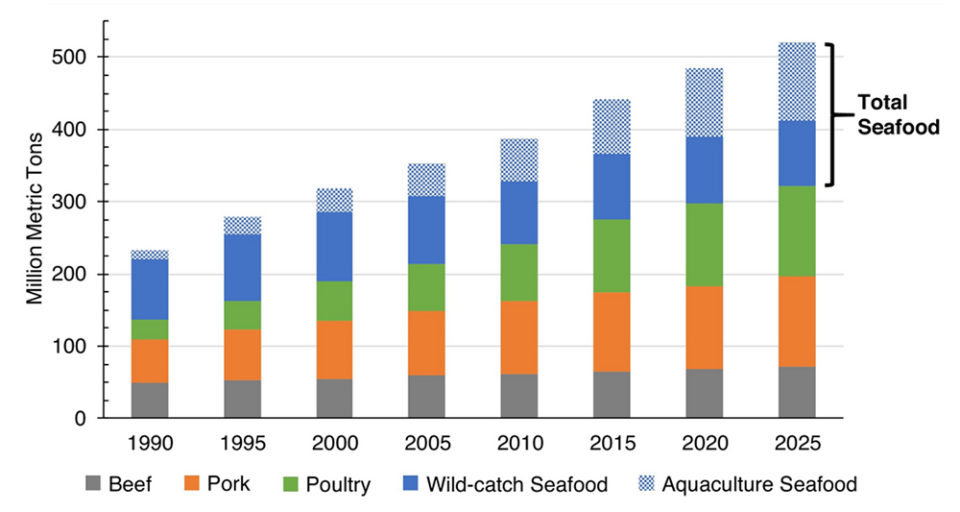
Fig. 1: Growth of the aquaculture industry and the potential\r\nfishmeal shortage. Total animal protein production in million metric tons from\r\n1990 to 2025. Adapted from the original article.
Even with diminishing inclusion of fishmeal in aquaculture\r\nfeeds (Fig. 2), an estimated shortage ranging from 0.4 to 1.32 million metric\r\ntons could occur by 2050. Plant-based ingredients can be refined to improve\r\ncompatibility with aquaculture diets, for example, by removing\r\nanti-nutritionals like phytic acid [the major storage form of phosphorous in\r\nnuts, cereals, legumes and oil seeds], but this increases cost and most\r\nsuccesses so far have come with species for which we have the most nutritional\r\nknowledge, for example, salmonids.
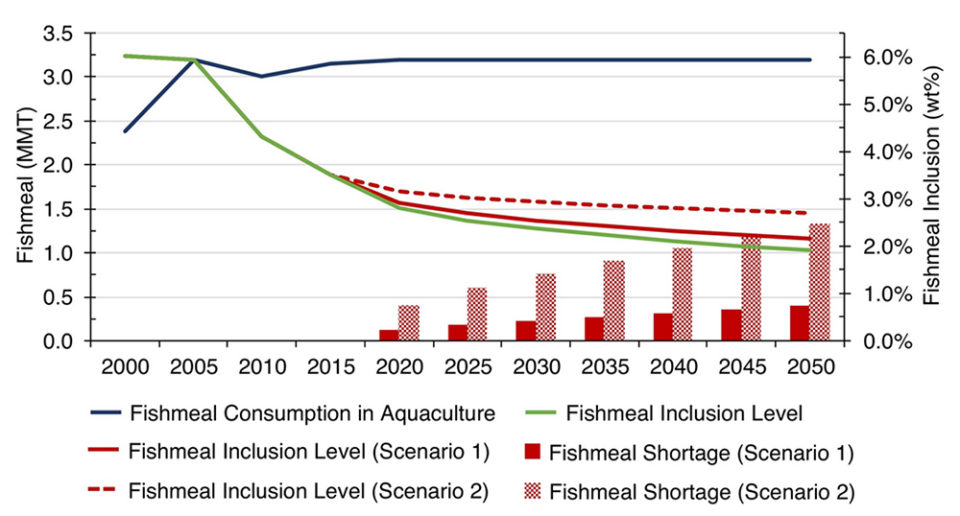
Fig. 2: Fishmeal consumption for aquaculture applications\r\nthrough 2015 and projected consumption through 2050 is presented (blue line).\r\nAverage fishmeal inclusion (green line) from known data through 2015 and\r\nprojected growth of aquaculture through 2050 with the assumed flat supply of\r\nfishmeal. Inclusion is calculated by dividing the fishmeal consumption (blue\r\nline) by total feed, which is calculated by multiplying aquaculture output\r\n(Fig. 1) by an average feed conversion ratio (FCR) of 1.2. Two alternative\r\nscenarios, in which fishmeal inclusion levels do not achieve targeted\r\nreductions, are considered: Scenario 1 (solid red) and Scenario 2 (dashed red).\r\nScenario 1 assumes only 85 percent of the reduction target is met, and Scenario\r\n2 assume only 50 percent of the reduction target is met. Adapted from original\r\narticle.
Consequently, there is demand for more suitable protein\r\ningredients that maintain feed performance, benefit aquaculture health and\r\nstabilize supply and economics during the industry expansion. SCP has the\r\npotential to deliver multiple solutions through a myriad of products and\r\nproduction approaches, but considerable research, development and particularly\r\nscale-up is still required.
This article – adapted and summarized from the original (Jones\r\net al., 2020. Recent advances in single cell protein use as a feed ingredient\r\nin aquaculture. Current Opinion in Biotechnology, Volume 61, February\r\n2020, Pages 189-197) reviews some potential sources of SCP products, and some\r\nrecent advances in their use as a feed ingredient in aquaculture.
SCP sources
SCP products can be made from different microbial sources,\r\nincluding microalgae, yeast and other fungi, and bacteria (Table 1). All are\r\nactively being investigated and commercialized by several major companies and\r\nexhibit unique advantages and challenges.
Jones, single-cell proteins, Table 1
| \r\n SCP sources \r\n | \r\n \r\n Protein content\r\n range (%) \r\n | \r\n \r\n Special\r\n characteristics \r\n | \r\n \r\n Specific organisms\r\n – examples \r\n | \r\n \r\n Challenges \r\n | \r\n
| \r\n Microalgae \r\n | \r\n \r\n 60 to 70 \r\n | \r\n \r\n Phototrophic growth \r\n | \r\n \r\n Chlorella vulgaris \r\n | \r\n \r\n Economical scale-up \r\n | \r\n
| \r\n Microalgae \r\n | \r\n \r\n 60 to 70 \r\n | \r\n \r\n Production of omega-3 fatty acids \r\n | \r\n \r\n Desmodesmus sp. \r\n | \r\n \r\n Cell disruption to release nutrients \r\n | \r\n
| \r\n Yeasts \r\n | \r\n \r\n 30 to 50 \r\n | \r\n \r\n Use of a variety of feedstocks \r\n | \r\n \r\n Saccharomyces cerevisiae \r\n | \r\n \r\n Improve protein and EAA \r\n | \r\n
| \r\n Yeasts \r\n | \r\n \r\n 30 to 50 \r\n | \r\n \r\n Production of vitamins and micronutrients \r\n | \r\n \r\n Candida utilis \r\n | \r\n \r\n EAA content \r\n | \r\n
| \r\n Bacteria \r\n | \r\n \r\n 50 to 80 \r\n | \r\n \r\n High protein content \r\n | \r\n \r\n Methylococcus capsulatus \r\n | \r\n \r\n Palatability issues \r\n | \r\n
| \r\n Bacteria \r\n | \r\n \r\n 50 to 80 \r\n | \r\n \r\n Growth on C1 substrates \r\n | \r\n \r\n Cupravidus nectar \r\n | \r\n \r\n – \r\n | \r\n
| \r\n Protists \r\n | \r\n \r\n 10 to 20 \r\n | \r\n \r\n Production of omega-3 fatty acids \r\n | \r\n \r\n Schizochytrium limacinum \r\n | \r\n \r\n Improve protein content \r\n | \r\n
Table 1. Sources for single cell proteins. Adapted from the\r\noriginal. C1: one carbon molecules like methane, carbon dioxide and others.\r\nEAA: essential amino acids.
SCP feeding trial results
To validate new products, extensive feeding trials are\r\nnecessary, and the aquaculture industry involves many species and production\r\nconditions. This article primarily focuses on species for which we have greater\r\ncommercial and nutritional knowledge, including Pacific white shrimp (Litopenaeus\r\nvannamei), Atlantic salmon (Salmo salar) and rainbow trout (Oncorhynchus mykiss).\r\nIn most trials, the goal was to evaluate growth and feed conversion when\r\nfishmeal is replaced by the SCP product, but trials also investigated broader\r\nnutritional effects.
Microalgae
A defatted Desmodesmus sp. SCP product and an\r\nalgal meal derived from Nanofrustulum and Tetraselmis has\r\nbeen commercially tested on salmon. In one study, defatted Desmodesmus sp.\r\nSCP could be included at up to 20 percent of the feed without any adverse\r\neffect on salmon growth or its final composition, and in another study, the\r\nalgal meal could be included at 10 percent without affecting salmon\r\nperformance.
For rainbow trout, a spirulina algal meal could be\r\nincorporated at 10 percent of the diet without an effect on performance. In\r\nanother trout study, a biomass of Scenedesmus almeriensis could\r\nreplace up to 40 percent of fishmeal in the diet, though growth was on the\r\nlower end of acceptable performance.
A study with L. vannamei shrimp evaluating\r\ndifferent ratios of spirulina (Arthrospira platensis), Nannochloropsis\r\nocultata and fishmeal determined that Nannochloropsis ocultata was\r\na poor fishmeal replacement ingredient.
Nutrient accessibility (i.e. digestibility) for algal meals\r\ncan be an issue because of the rigidity of their cell walls. To improve meal\r\ndigestibility, the walls can be disrupted by a variety of methods, including\r\nenzymatic (cellulases), chemical (organic solvents or acids), and physical and\r\nmechanical (bead milling, high-pressure homogenization or microfluidics).\r\nPhysical and mechanical methods are generally preferred, as enzymatic and\r\nchemical methods can impact intracellular nutrients.
In a recent study, a microfluidizer [technology used to\r\nreduce the size of suspensions and emulsions in an efficient way] was used on\r\na Chlorella vulgaris meal and then fed to salmon. The whole-cell meal\r\nand the cell-ruptured meal had the same nutrient and protein quality, but the\r\ncell-ruptured meal had improved digestibility over the whole-cell meal for\r\nEAAs, fats and carbohydrates. Interestingly, starch digestibility was actually\r\nhigher than that of the control diet.
Yeast and other fungi
Salmon and shrimp have been the major focus of recent yeast\r\nfeeding trials. For salmon, several different yeast meals have been tested,\r\nincluding from Saccharomyces cerevisiae, Candida utilisand K.\r\nmarxianus. S. cerevisiae was found to be a poor protein meal, while C.\r\nutilis and K. marxianus could replace up to 40 percent of the\r\nfishmeal in diets without effecting growth performance or nutrient retention.\r\nIn a follow-up study, the researchers investigated whether C. utilis could\r\novercome soybean meal induced enteritis, a common side effect in carnivorous\r\naquacultured species, but when fed a diet consisting of 40 percent soybean meal\r\nand up to 20 percent C. utilis meal (replacing wheat gluten and\r\nstarch), the fish still displayed signs of enteritis.
For L. vannamei shrimp, several S.\r\ncerevisiae products were successful in replacing fishmeal (from 15 to 24\r\npercent, depending on the product) or soybean meal (up to 24 percent) in shrimp\r\ndiets with no effect on growth performance. A commercial product was also\r\nsuccessful in replacing up to 20 percent of corn protein concentrate. And\r\nshrimp fed a diet of about 50 percent C. utilis had no adverse side\r\neffects, and actually displayed higher growth rates compared to a complete\r\nfishmeal diet.
So far, these studies indicate that C. utilis is a\r\nbetter SCP source than S. cerevisiae for salmon and shrimp diets.\r\nAnother fungus that has been tested as a SCP source (as well as unsaturated\r\nfatty acids, beta-glucan and mannane polymers) is Yarrowia lipolytica. The\r\nstrain was tested on shrimp and salmon and found to support increase fish\r\nweight as the control.
Bacteria
Several different methanotroph-based [methanotrophs are\r\nprokaryotes – unicellular organisms without a membrane-bound nucleus,\r\nmitochondria or any other membrane-bound organelle – that metabolize methane as\r\ntheir only source of carbon and energy] SCP products have been tested\r\nsuccessfully on Atlantic salmon. In one study, salmon fed a diet containing up\r\nto 36 percent bacterial protein meal (BPM) displayed a higher growth rate and\r\nfeed efficiency ratio than the control diet, though nutrient digestibility was\r\nreduced. In another study, the authors found that M. capsulatus SCP\r\ncan make up to 52 percent of the dietary protein in a salmon diet and 38\r\npercent in a trout diet with no adverse growth effects.
Interestingly, the inclusion of M. capsulatus SCP\r\nin a diet with soybean meal prevented the development of soybean meal-induced\r\nenteritis in salmon, suggesting further benefits of SCP products. Another test\r\ndetermined that a commercial product from Methylobacterium extorquenscould\r\nreplace 55 percent of fishmeal in salmon diets with no adverse side effects\r\nupon growth and could replace up to 10 percent of soybean meal in trout diets.
Shrimp have also been a key target for bacterial SCP.\r\nInclusion of a novel mixture of two purple, non-sulfur bacteria at 1 percent of\r\nthe diet produced modest growth improvements over the control, a Corynebacterium\r\nammoniagenes SCP could replace 10 to 20 percent and the commercial product\r\nfrom M. extorquens was able to completely replace fishmeal in shrimp\r\ndiets. A biofloc meal, prepared from biofloc grown on shrimp farm tanks, could\r\nreplace up to 30 percent of fishmeal in diets. And a commercial microbial\r\nbiomass mixture of bacteria and microalgae has been extensively tested on black\r\ntiger shrimp (Penaeus monodon). One study suggests it can overcome the growth\r\ndisadvantages when fishmeal and fish oil are removed from the shrimp diet, and\r\nanother shows improved growth rates when this mixture is included at 10 percent\r\nof the diet.
These studies are highly encouraging of the significant role\r\nof SCP in the growing aquaculture industry, as another high-quality protein\r\ningredient applicable across a wide range of species, and several studies\r\nsuggest additional health benefits to the cultured fish and shellfish.
Perspectives
A key challenge for the aquaculture industry is sourcing\r\nsustainable, renewable high-protein ingredients. The production of fishmeal\r\ncannot scale with the growth of the aquaculture industry without having\r\nprofound and lasting impacts on the health of the oceans, and often terrestrial\r\nplant meals lack the EAAs required by many aquaculture species and can contain\r\nantinutritional compounds, like phytic acid.
SCP-based protein meals have the potential to provide the\r\nindustry a sustainable, renewable feed ingredient to make up for the\r\ndeficiencies of plant-based meals and reduce the need for fishmeal in\r\naquafeeds. Long held as a promising technology, SCP meals are actually now\r\nbeing commercially produced by a number of companies and, even more promising,\r\nis the ever-increasing positive feeding trial data on important aquaculture\r\nspecies, including salmon, trout and shrimp. These data clearly show the\r\npositive effects of SCP inclusion in diets and their potential as true\r\ncommodity products.
\r\n\r\n\r\n\r\n\r\n\r\n\r\n\r\n\r\n\r\n\r\n\r\n\r\n\r\n\r\n\r\n\r\n\r\n\r\n\r\n\r\n\r\n\r\n\r\n\r\n\r\n\r\n\r\n\r\n\r\n\r\n\r\n\r\n\r\n\r\n\r\n\r\n\r\n\r\n\r\n\r\n\r\n\r\n\r\n\r\n\r\n\r\n\r\n\r\n\r\n\r\n\r\n\r\n\r\n\r\n\r\n\r\n\r\n\r\n\r\n\r\n\r\n\r\n\r\n\r\n\r\n
While there are still challenges in scale-up, SCP processing\r\nand the economics of a commodity product, the progress made in the past several\r\nyears to find new strains, develop new processes and successfully test on\r\nimportant commercial species is highly encouraging for SCP products.
Source: Global Aquaculture Alliance

Ditulis oleh
Tim Minapoli
Kontributor
Pakar di bidang akuakultur dengan pengalaman lebih dari 15 tahun. Aktif berkontribusi dalam pengembangan industri perikanan Indonesia.