

A sustainable fish farm floating off the shores of Singapore\r\ngives a glimpse of what it is like to produce seafood with less energy and\r\ncleaner water, as the Government aims to reach the goal of...
A sustainable fish farm floating off the shores of Singapore\r\ngives a glimpse of what it is like to produce seafood with less energy and\r\ncleaner water, as the Government aims to reach the goal of producing 30 per\r\ncent of the country’s nutritional needs by 2030.
Situated 5km away from Changi Point Ferry Terminal, the\r\nfacility called Eco-Ark looks to be one of the first floating\r\nclosed-containment fish farms in the world, its developer said.
Built and run by Singapore food producer Aquaculture Centre\r\nof Excellence Group, it uses patented technology to rear three types of fishes\r\nfor consumers here: Barramundi, red snapper and hybrid grouper.
Around 30 tonnes of fishes are housed in four cultivating\r\ntanks, each with a capacity of 475,000L, and they live in an environment where\r\na filter system works round the clock to minimise bacteria, pathogens and\r\nwaste.
Compared with fishes from coastal farms which are held in\r\nnet cages and submerged in the sea, they are not vulnerable to changes in water\r\ntemperatures, oxygen levels, bacteria levels, as well as oil spills, for\r\ninstance.
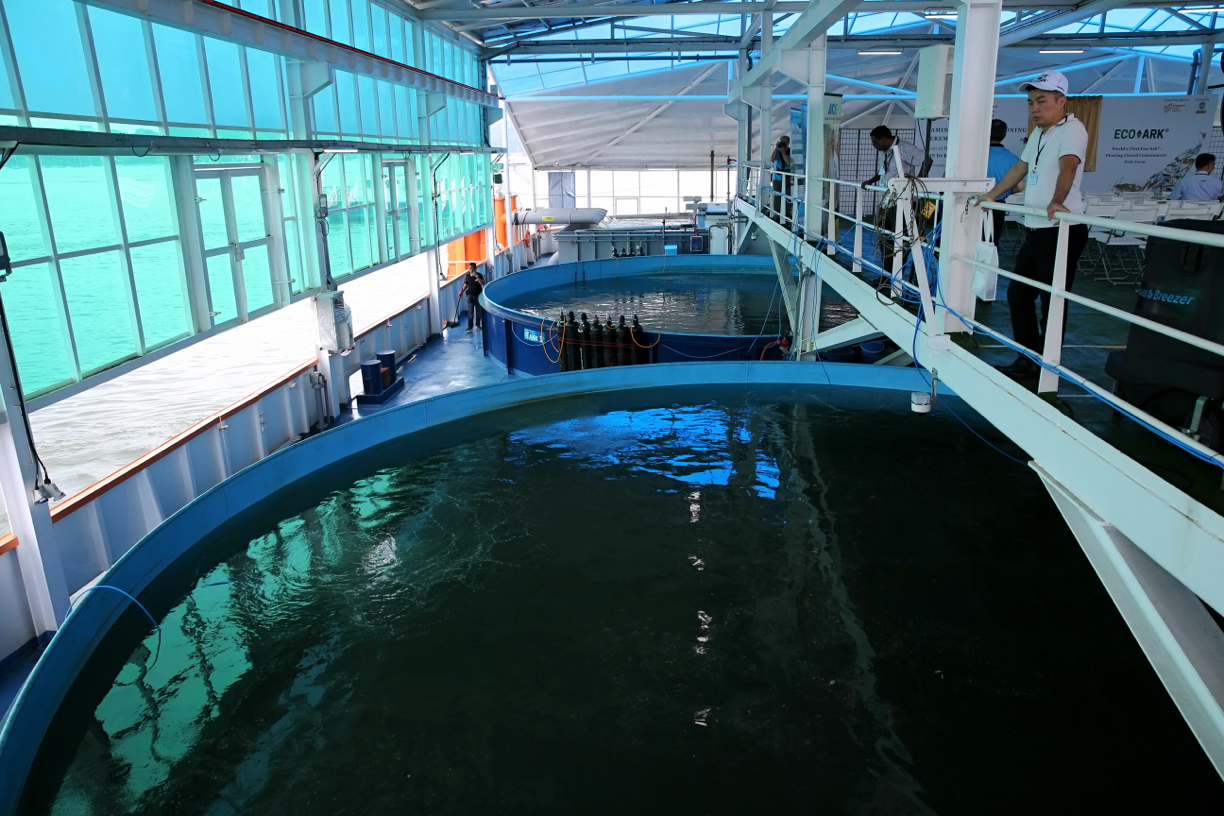
A view of the cultivation tanks where some 30 tonnes of\r\nfishes such as barramundi and red snapper are reared on the floating farm.
The Singapore Food Agency (SFA) said that there are 112\r\ncoastal fish farms here. Three of them, including Eco-Ark, are\r\nclosed-containment farms and 109 are traditional net farms.
These farms produced about 4,600 tonnes of fish last year,\r\naccounting for about 9 per cent of fish consumption in Singapore — 15kg of fish\r\nwas consumed per capita last year.
Eco-Ark, which cost S$4 million to set up and will be fully\r\noperational in three months, is set to generate a higher yield of fish within a\r\nsmaller space than other coastal farms.
It can produce 166 tonnes of fish a year — 20 times more\r\nthan the minimum production level set for each coastal farm by the authorities.
Yet it takes up just 1,400sqm of space — or one-fifth the\r\nsize of a football field — which is about 14 per cent of the area taken up by a\r\ncoastal fish farm with the same production capacity.
Speaking at the commissioning ceremony on Tuesday, Dr Koh\r\nPoh Koon, Senior Minister of State for Trade and Industry, said that Singapore\r\nneeds to tap technology and innovative solutions to meet its goal of increasing\r\nfood production locally.
Eco-Ark was built to achieve recommendations by SFA for\r\nfarms to adopt new technology that will increase the amount of fish production\r\nand reduce the environmental impact to sea waters, he added.
“(It) allows us to conduct fish farming in Singapore waters\r\nmore sustainably and this solution will be enticing and attractive to export to\r\nother parts of the world as well.”
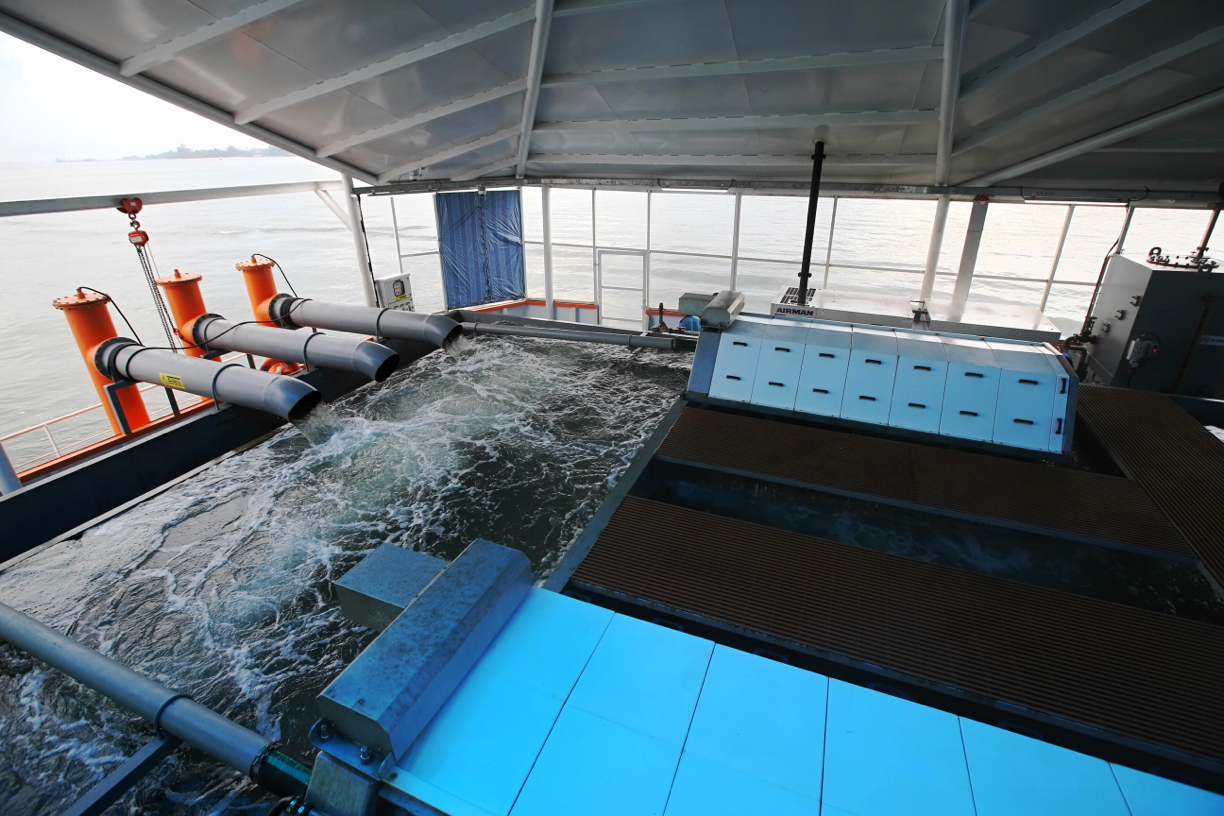
Water is pumped in from the sea and filtered on the Eco-Ark.
The farming process at Eco-Ark consumes less energy than\r\ncoastal farms or other closed-containment farms located on land.
For instance, every hour, there are three pumps each\r\nsupplying 750 cubic metres of sea water and running at 17 kilowatts an hour.\r\nThis is significantly lower than the land-based multi-tiered recirculation\r\naquaculture system — a form of closed-containment farm — which may use up to\r\n150 kilowatts an hour.
Mr Leow Ban Tat, chief executive officer of Aquaculture\r\nCentre of Excellence, attributed its efficient use of energy to patented\r\ntechnology which works on the differences in water pressure and gravity to pump\r\nwater into the tanks.
Once pumped in, the water is put through a filtration chamber\r\nto remove solid particles.
It then goes through a process where dissolved oxygen is\r\ninjected into the water. This makes it as clean and clear as waters in the\r\nocean, and also removes pathogens and germs.
When the water eventually reaches the cultivating tanks that\r\nhold the fish, the level of dissolved oxygen is adjusted to suit the type of\r\nfish being reared.
Mr Leow added that due to this “ozonation” process carrying\r\ndissolved oxygen, the waste water that is later discharged from the tanks into\r\nthe sea is also cleaner than when it was first pumped into the farm.
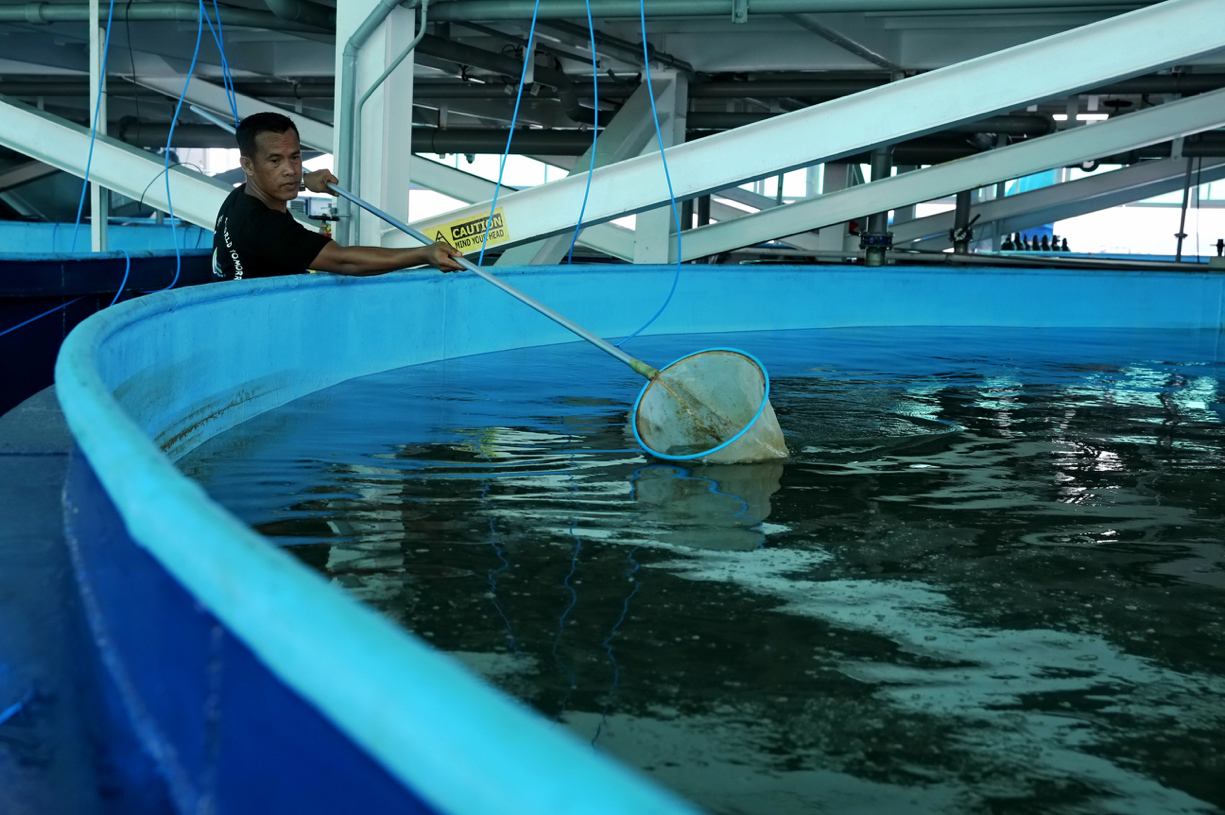
A worker cleaning the fish tank.
To reduce its use of energy, Eco-Ark — operating at 120\r\nkilowatts a day — acquires one-sixth of its energy through solar power, which\r\ntranslates into S$80 savings a day.
At maximum capacity, the solar panels can generate power at\r\n88 kilowatts an hour, Mr Leow said.
\r\n\r\n\r\n\r\n\r\n\r\n\r\n\r\n\r\n\r\n\r\n\r\n\r\n\r\n\r\n\r\n\r\n\r\n\r\n\r\n\r\n\r\n\r\n\r\n\r\n\r\n\r\n\r\n\r\n\r\n\r\n\r\n\r\n\r\n\r\n\r\n\r\n\r\n\r\n\r\n\r\n\r\n\r\n\r\n\r\n\r\n
While he did not specify a schedule, Mr Leow hopes to\r\neventually open two more Eco-Arks: One with eight tanks and another with 10\r\ntanks. He did not say where these would be, but his goal is to set up an\r\nEco-Ark farm in every country.
Source : TODAY

Ditulis oleh
Tim Minapoli
Kontributor
Pakar di bidang akuakultur dengan pengalaman lebih dari 15 tahun. Aktif berkontribusi dalam pengembangan industri perikanan Indonesia.