

Aquafeeds are typically cited as the biggest operating\r\nexpense in aquaculture. So the netting to keep fish in and predators and pests\r\nout may end up being overlooked.The industry is now paying m...
Aquafeeds are typically cited as the biggest operating\r\nexpense in aquaculture. So the netting to keep fish in and predators and pests\r\nout may end up being overlooked.
The industry is now paying more attention to net technology,\r\nsaid Vayu Garware, chairman and managing director of Garware Technical Fibres\r\nLtd. (GTFL) of Pune, Maharashtra, India.
“Nets are a small part of the overall cost but can\r\nsignificantly impact the bottom line,” he told The Advocate.
What’s more, innovations in net materials and technologies\r\npromise even bigger boost to the bottom line. Examples come from GTFL itself,\r\nwhich has become one of the leading suppliers of netting materials to the\r\nNorwegian farmed salmon sector.
The company gets a substantial portion of its revenues from\r\naquaculture, with its products found all over the world. According to Garware,\r\nGTFL’s latest nets are made of high-density polyethylene (HDPE), instead of the\r\nmore traditional nylon.
Also read: Teknologi Jaring UHMWPE Sekuat Baja
While acknowledging nylon is the stronger of the two\r\nmaterials in dry-state tests, “It’s not only about strength. It’s about the\r\nactual application in wet conditions,” Garware pointed out.
Nylon is hydrophilic, or water loving. So, when immersed,\r\nnylon readily absorbs water and undergoes accelerated breakdown. Thus, nylon\r\ngets weaker in water over time and nets made of it generally last only five\r\nyears, Garware said.
HDPE, in contrast, is hydrophobic, or water averse.\r\nTherefore, it doesn’t break down in water and suffers a minimal loss of\r\nstrength over a similar time frame.
The result of using the new hydrophobic material is nets\r\nlast longer. Garware noted that when cleaned in place there may be a doubling\r\nor more in net lifetime. HDPE also has better abrasion resistance of the two\r\nmaterials, an important advantage for fencing intended to keep predators out.
There are some drawbacks to HDPE. For instance, some\r\nformulations result in material that is less dense than water, which means it\r\nfloats. GTFL builds its nets on a marine steel core and adds a pattern of lead\r\nweights, which together overcome floatation issues and add strength.
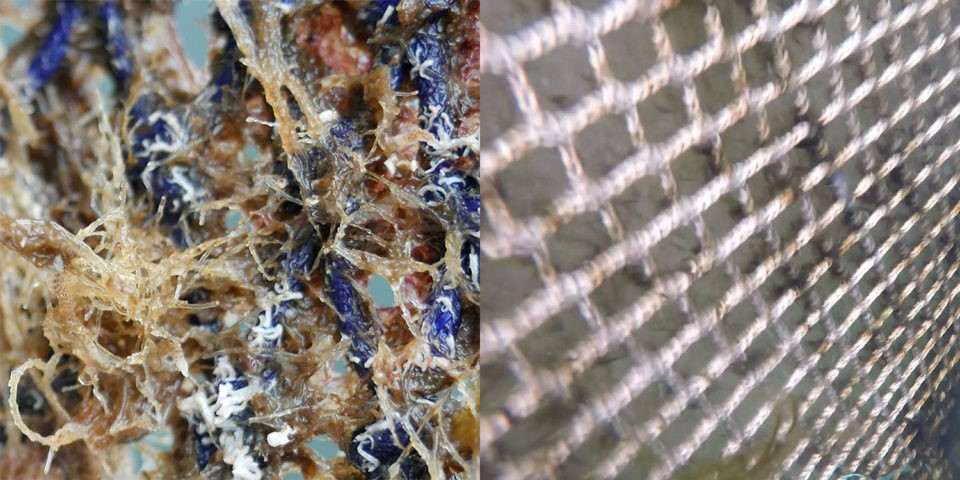
New aquaculture nets with copper ions (right) increase the\r\nmaterial density and reduce biofouling (left), the removal of which is costly\r\nand time consuming. The metallic particles lead to a continuous release of a\r\nsmall amount of copper ions into the water, reducing environmental harm. Photo\r\ncourtesy of Garware Technical Fibres Ltd.
The company’s latest innovation incorporates tiny metallic\r\ncopper particles within the net material. The process took four years to\r\ndevelop, according to Garware. Adding copper further increases the material\r\ndensity and brings another benefit: less biofouling. The metallic particles\r\nlead to a continuous release of a small amount of copper ions into the water.
“This delays fouling growth and therefore also delays any\r\nrequirement to clean. We are able to see at least a 50 percent reduction in\r\ncleaning cycles,” Garware said.
Traditionally, biofouling has been reduced through the\r\napplication of copper oxide paints. Such paints, though, tend to flake off and\r\nend up on as sediment on the seafloor, becoming an environmental hazard. The\r\ncopper ions released by GTFL’s new products do not produce such a sediment, and\r\nthe small amount of copper released suppresses biofouling without harming the\r\nenvironment, according to Garware.
Another netting-related innovation also addresses the\r\nbiofouling problem, with Aqua Robotics of Harstad, Norway, automating the\r\napplication of elbow grease. The company’s robot sits above the water and\r\ntravels around the cage structure, moving a submerged brushing system that\r\nscrubs the net inside and out from top to bottom.
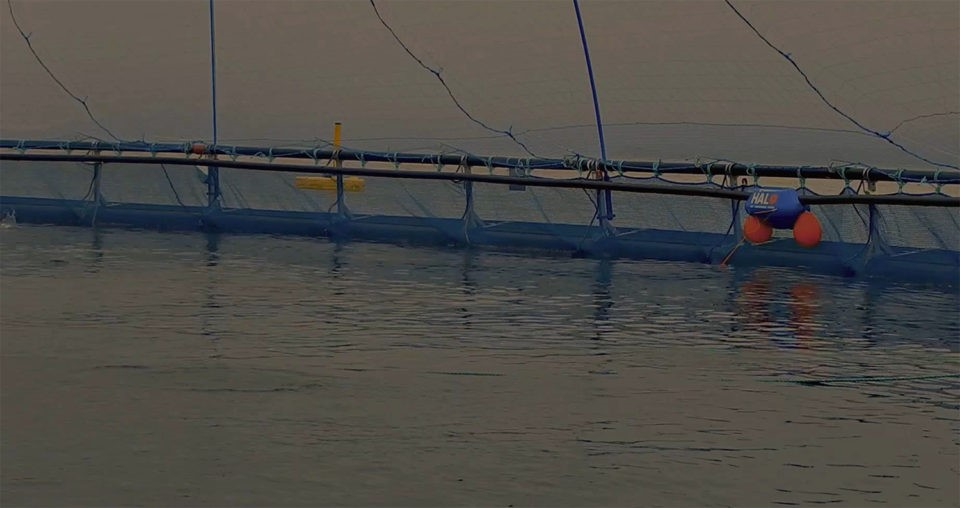
Norwegian company Aqua Robotics developed a robot that sits\r\nabove the water and travels around the cage structure, moving a submerged\r\nbrushing system that scrubs the net inside and out from top to bottom. Courtesy\r\nphoto.
The automated system does not work on nets that are already\r\nencrusted with marine life, said CEO Knut Molaug. “We start with a clean net\r\nand we prevent it from the biofouling. So, we maintain it clean.”
Besides copper oxide paint, today biofouling mitigation can\r\ninvolve cleaning a net with a high-pressure spray, which is labor-intensive,\r\nexpensive and stresses the fish inside. A high-pressure wash also interrupts\r\nfish feeding, another drawback.
Aqua Robotics’ robot avoids such problems. The parts of the\r\nnet near the surface, which see greater biofouling due to the presence of more\r\noxygen and light, are cleaned more often.
Also read: Top Copper Maker Wieland Sees End to Escapes, Will Improve Fish Health With Brass Mesh Cages
Molaug said that one surprising finding was how often\r\ncleaning needed to be done. The company’s latest robots, which are in the field\r\nin eight locations, clean continuously.
Aqua Robotics owns the systems and delivers a cleaning\r\nservice, with customers paying a fee. Discussing plans, Molaug said the company\r\nis ready to scale up operations.
In speaking of the future, GTFL’s Garware noted that the\r\ncompany has extensive ongoing research and development programs. Work is\r\nunderway on improved sea lice barriers, algal bloom shields and other material\r\ninnovations.
For instance, GTFL is working on ropes for moorings that\r\nhold netting in place. Results over a year and a half of testing indicate that\r\nmaterial improvements can significantly reduce the number of times that\r\nrestraining ropes must undergo retensioning. The benefit in terms of cost\r\nsavings depends on the location of the cage structure, but the company believes\r\nthe savings can be more than seven-fold what would be spent on a new rope.
Such a return shows that an investment in netting, related\r\ngear and net technology can pay off. This also is indicative of what GTFL\r\nstrives for, Garware said. “If we can give payback to customers in months, then\r\nwe are doing something the right way.”
\r\n\r\n\r\n\r\n\r\n\r\n\r\n\r\n\r\n\r\n\r\n\r\n\r\n\r\n\r\n\r\n\r\n\r\n\r\n\r\n\r\n\r\n\r\n\r\n\r\n\r\n\r\n\r\n\r\n\r\n\r\n\r\n\r\n\r\n\r\n\r\n\r\n\r\n\r\n\r\n\r\n\r\n\r\n\r\n\r\n\r\n\r\n\r\n
Source : Global Alliace Aquaculture

Ditulis oleh
Tim Minapoli
Kontributor
Pakar di bidang akuakultur dengan pengalaman lebih dari 15 tahun. Aktif berkontribusi dalam pengembangan industri perikanan Indonesia.