

The catalog of aquaculture feed ingredients that are used to\r\ncreate nutritious and cost-effective products, while conserving fishmeal and\r\nfish oil supplies have expanded in recent years. Many of...
The catalog of aquaculture feed ingredients that are used to\r\ncreate nutritious and cost-effective products, while conserving fishmeal and\r\nfish oil supplies have expanded in recent years. Many of these new\r\nalternative-ingredient innovations, however, face significant challenges in\r\nscaling production – think insect\r\nmeals and single-cell\r\nproteins – and as a result haven’t yet impacted the sector like\r\nterrestrial agriculture products have.
Might there be a faster timeline for barley protein\r\nconcentrate (BPC), sourced from an abundant and currently underutilized\r\ncrop? Montana\r\nMicrobial Products (MMP), which for now operates a pilot plant in\r\nMelrose, Montana, USA, is on the verge of commencing commercial-scale\r\nproduction of what is proving to be is a versatile product for farmed fish. In\r\nextensive feed trials over the past few years, BPC was shown to be a fully\r\ndigestible, high-protein feed ingredient for multiple species of fish, even at\r\nhigh inclusion levels.
Instead of building a new barley processing plant, company\r\nco-founder Clifford Bradley told the Advocate that the company is\r\npoised to soon announce technology-licensing partnerships with existing\r\nmanufacturers, one in North America and another in Europe.
Bradley is bullish on barley as a raw material because it\r\nhas virtually no downside. And he has the competition clearly identified.
“Barley fits all the sustainability criteria,” he said. “It\r\ngrows in places where it doesn’t compete with other food crops, in cold and\r\nwarm climates. In Montana, the field crops are wheat and barley. We’re not\r\nburning the Amazon to make more soybeans.”
Barley supplies are robust, at 156 million metric tons (MT)\r\nannually, according to the U.S. Department of Agriculture. Montana and the rest\r\nof the United States produce about 3 to 4 million MT of barley a year, but\r\nneighboring Canada produces more than 10 million MT and the European Union more\r\nthan 60 million MT. “We’re not likely to run out of barley,” Bradley stated.
And wherever barley is grown it needs little irrigation and\r\nvery little in the way of fertilizers and pesticides, so inputs are quite low\r\nin comparison to other field crops. Bradley also notes that barley is not\r\ngenetically modified and is “unlikely to be so anytime soon.”
Best of all, BPC would eventually end up on the low end of\r\nthe feed-ingredient price spectrum. Regular feed-grade barley is about $160 per\r\nton, said Bradley, and the high-protein strain of barley that’s perfect for\r\nmaking BPC is not in favor with the other major barley buyer out there: Brewers\r\nsay it makes beer cloudy so they prefer the low-protein, malting grade strain.\r\n“But it’s perfect for us,” said Bradley of the high-protein variety, which he\r\nhopes to procure on a contract basis with growers in Montana.
It takes five tons of barley to make one ton of BPC, which\r\nBradley envisions will sell for about $1,000 to $1,100 per ton. That’s\r\ncompetitive with soy protein concentrate, which aquafeed manufacturers have\r\nused successfully for decades. Fishmeal costs roughly $1,500 per ton.
For these reasons, feed manufacturers might soon go bonkers\r\nfor barley.
“New ingredient suppliers often come in [saying they want to\r\nbe priced at] 96 percent of fishmeal. These guys want a price they can make\r\nmoney on and that feed manufacturer can make money on,” explained renowned\r\nfish nutritionist Rick Barrows, who has been working with MMP ever since it\r\nturned its attention to aquaculture about seven or eight years ago. “As a feed\r\nformulator, it’s exciting to have another tool in the toolbox. I think they\r\ncould sell it all day long.”

Montana Microbial Products co-founders Cliff Bradley (left)\r\nand Bob Kearns.
Enzymatic\r\nfractionation
Barrows, who left the U.S. Department of Agriculture’s\r\nAgriculture Research Service in 2016 to start his own company, Aquatic Feed\r\nTechnologies have tried numerous ingredients in aquafeeds over the years and\r\nhas successfully developed diets for a range of fish species, trout, and salmon\r\nin particular. Salmonid species, he said, are sensitive to some soy products,\r\nwhich have a variety of compounds that can have a negative effect on growth and\r\nphysiology. Soy products have also been shown to cause diarrhea in salmonids,\r\nand while that’s not a major health concern for the fish, he added, it can be a messy problem for operations that use land-based tanks and recirculating\r\naquaculture systems (RAS), which re-use production water multiple times.
“Barley doesn’t cause diarrhea, which makes it suitable for\r\nRAS,” he said.
And once the barley is de-hulled, Barrows said it is fairly\r\neasy to work with, although he struggled with it personally in the past.
“I was once trying to make a barley protein concentrate and\r\nended up shooting barley all over the wall of my lab,” he said.
He eventually met with Bradley and his business partner Bob\r\nKearns over a barley beverage (beer) and was convinced that, with their\r\nmicrobiology (Bradley) and engineering (Kearns) backgrounds, they would stand a\r\nbetter chance as a team at coming up with a new solution for aquaculture.
They later applied for a patent and got it, with Barrows as\r\nthe lead investor, and started seeking out commercial partners for feeding\r\ntrials. Clear Springs Foods, a rainbow trout farmer in Idaho, was first to bite\r\nand commenced a trial with 375,000 trout on a diet with a BPC inclusion rate of\r\n30 percent. The fish showed no difference in feed conversion ratio (FCR),\r\ngrowth, taste, flesh quality or color when compared to fish raised on a\r\nconventional diet. Other trials showed that fish raised on diets including BPC\r\nhad improved energy retention and overall performance similar to fishmeal at\r\ninclusion rates of 22 percent. Bradley said that fish can be fed diets with up\r\nto 45 percent BPC, a “major commercial advantage” that is also good for\r\nsalmonids, which have specific digestibility needs.
“Everybody thinks of protein concentrate as the driver [for\r\nsalmonid feed ingredients], but one of the things that are equally important is\r\nlow fiber,” Bradley said. “Trout and salmon can’t digest fiber. Our [BPC] is\r\nless than 5 percent crude fiber, which is almost as important as the 60 percent\r\nprotein.”
That 60 percent mark is achieved through a proprietary\r\nprocess that Bradley dubbed “enzymatic fractionation.” Once the barley is\r\nhammered into flour it is mixed with water and treated with various enzymes,\r\ntemperatures and hold times. Much like ethanol is derived from corn, MMP\r\nconverts the starch but also beta-glucans and most of the fiber that’s left in\r\nthe barley. The protein comes through the process in an insoluble stage and is\r\nrecovered via centrifuge before being dried into powder form.
A coproduct of this now-separately patented manufacturing\r\nprocess has tremendous value, he added: “We make a lot of glucose. Big\r\nfermentation plants need a sugar source.”
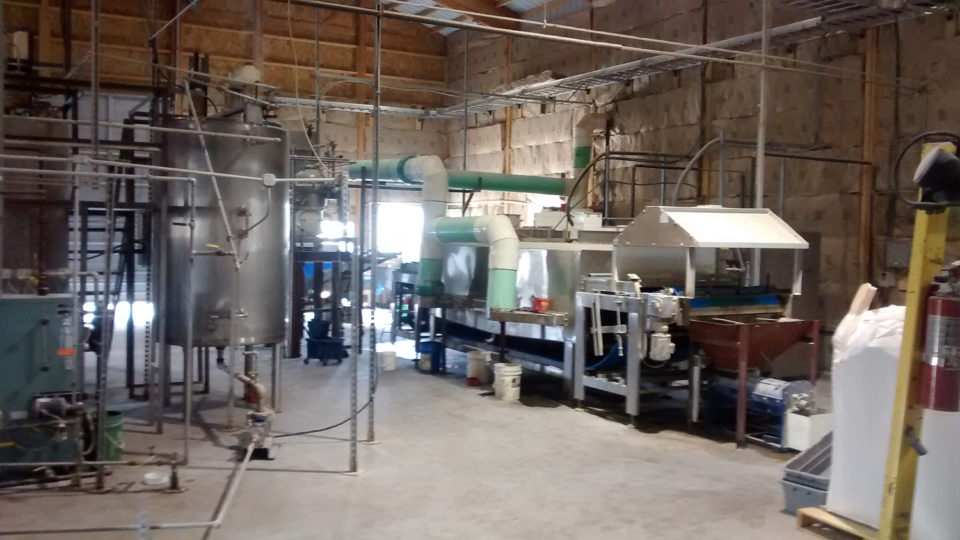
A look inside the Montana Microbial Products pilot plant in\r\nMelrose, Montana. Photo courtesy of MMP.
Barley business plans
Bradley and Kearns have educated themselves on the\r\naquaculture industry over the past five years and have learned about how to\r\napproach this business opportunity from credible and well-connected sources.\r\nAside from Barrows, who told the Advocate that he considers Bradley\r\nand Kearns good friends but is not receiving any financial benefit, Montana\r\nMicrobials entered the Fish\r\n2.0 Global Innovators Forum, where Bradley presented and won the “U.S.\r\nseafood” track, learning a lot about the business along the way.
“It’s been a pleasure to work with MMP over the past year,”\r\nsaid Monica Jain, Fish 2.0 executive director. “By using barley as the core\r\ningredient in fish feed, MMP offers a path to meet the demands of the growing\r\naquaculture marketplace – both in terms of volume and price. It’s exciting for\r\nus to see solutions needed for the sustainable seafood sector coming out of\r\nplaces like Montana, demonstrating how growing the sustainable seafood the marketplace can improve economies in landlocked as well as coastal\r\ncommunities.”
MMP is also part of the most recent cohort of Hatch,\r\nthe international aquaculture business accelerator. Bradley said he learned a\r\nlot about shrimp production and where he got connected with a manufacturer that\r\nmay soon license MMP’s technology. He also said he was learned that shrimp feed\r\nis produced with high inclusion rates of fishmeal, up to 30 percent, which he\r\nsaid was an eye-opener.
Carsten Krome, CEO of Hatch, which mentors companies through\r\nan intensive, eight-week program and provides seed funding in exchange for an\r\nequity stake said MMP is one of its “best performing” companies.
“Their product has massive potential and it has been tested\r\nin commercial trials with great results over the whole lifetime of the fish,”\r\nhe said. “The low input costs of barley being the cheapest crop out of all,\r\nalso helps.”
Krome pointed to the South American soy industry as one that\r\nneeds to be “challenged with more sustainable alternatives.”
“The barley protein is a perfect solution,” said Krome, who\r\ntypically works with startups and technology-focused companies. Montana\r\nMicrobial Products was founded in 2002, and Bradley and Kearns have worked\r\ntogether for about a quarter-century.
“Bob and Cliff are very good and experienced entrepreneurs,\r\nwhich, as always, is just as, if not more, important as the technology itself,”\r\nsaid Krome.
For MMP, getting to this point has taken time because of the\r\ncapital requirements for building an industrial plant have been prohibitive,\r\nhence the technology-licensing deals.
“If you need to raise $2 million, that’s gotten a lot\r\neasier” with mechanisms like online crowdsourcing platforms, Bradley said. “For\r\nthe most part, the capital requirements [of other Hatch participants] are a lot\r\nless than ours. If you’re going to build a 20,000-ton barley plant, you need\r\n$40 million. It’s an industrial plant, no way around it. That’s been difficult\r\nfor us.”
\r\n\r\n\r\n\r\n\r\n\r\n\r\n\r\n\r\n\r\n\r\n\r\n\r\n\r\n\r\n\r\n\r\n\r\n\r\n\r\n\r\n\r\n\r\n\r\n\r\n\r\n\r\n\r\n\r\n\r\n\r\n\r\n\r\n\r\n\r\n\r\n\r\n\r\n\r\n\r\n\r\n\r\n\r\n\r\n\r\n\r\n\r\n\r\n\r\n\r\n\r\n\r\n\r\n\r\n\r\n\r\n\r\n\r\n\r\n\r\n\r\n\r\n\r\n\r\n\r\n\r\n\r\n\r\n
Source: Global Aquaculture Alliance

Ditulis oleh
Tim Minapoli
Kontributor
Pakar di bidang akuakultur dengan pengalaman lebih dari 15 tahun. Aktif berkontribusi dalam pengembangan industri perikanan Indonesia.