

Aquaculture hatcheries seek less energy-intensive methods\r\nfor crucial feedstockWith high amounts of protein, vitamins, minerals and the\r\nessential fatty acids known as omega-3s, microalgae play a...
Aquaculture hatcheries seek less energy-intensive methods\r\nfor crucial feedstock
With high amounts of protein, vitamins, minerals and the\r\nessential fatty acids known as omega-3s, microalgae play a key nutritional role\r\nin larval shellfish culture. But they cost a lot to produce. The intensive\r\nrearing of bivalves like oysters, clams and scallops relies on the production\r\nof live algae, which is 30 percent of a hatchery’s operating costs.
“The cost price per kilogram of algae is too high because of\r\nthe demand for labor, water and energy,” said Sander Hazewinkel, founder, co-owner\r\nand chief commercial officer of Dutch firm LGem. “It’s currently around 300 to 900 euros. If it can be\r\nreduced to 100 euros or more, depending on the amount of algae required,\r\nthe bigger your operation is, the cheaper it will become to a certain point.”
Established in 2006, LGem designs and manufactures turnkey\r\nmicroalgae photobioreactors. After examining various algae production systems\r\n–from plastic bags and bubble columns to PVC tubes – the company launched\r\nGemTube, a glass tubular helix system that offers extreme durability and a more\r\nsimplified, cost-effective form of algae production.
LGem discovered that conventional production systems use a\r\nlot of power and aeration for circulation and to prevent biofouling and oxygen\r\nbuild-up. To address this, two of the company’s patented technologies –\r\nWavywind and Bubblebrush – were incorporated into the GemTube. Liquid and air\r\nrun through the tubes like waves, propelling the system and creating\r\ncirculation with limited energy.
Wavywind allows a stream of air to travel at twice the\r\nvelocity of the culture fluid. This creates eddies on the liquid surface and a\r\nstirring effect that gives a desired light-dark cycle below 1 hertz.\r\nBubblebrush produces a series of bubbles that accompanies the waves and keeps\r\nthe walls of the tubes clear without the need for fast pumping. This improves\r\nthe quality and productivity of algae culture.
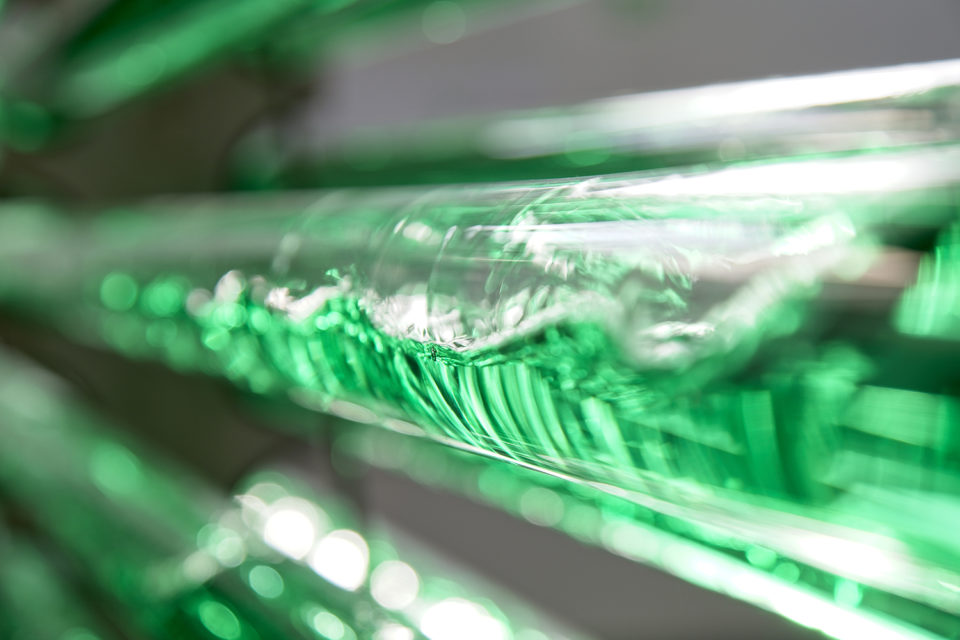
Major shellfish producers are considering the LGem system\r\nfor cost-effective algae production in their hatcheries. Photo courtesy of\r\nLGem.
“Air moving through the glass tubes removes oxygen and\r\nsupplies carbon dioxide evenly over the whole tubular helix at 100 watts per\r\n1,000 liters of culture, or one-tenth of the energy input of conventional\r\ntubular systems,” said Hazewinkel. “No centrifugal pumps are needed because the\r\nmoving air propels the entire system. This means that we can also operate our\r\nsystem with just an air source and without any moving parts. This is\r\nparticularly interesting for aquaculture because it often produces fragile\r\nspecies like Rhodomonas and Isochrysis. These perform very well\r\nin the GemTube.”
Meanwhile, research at Wageningen University in the\r\nNetherlands has highlighted differences in production costs per kilogram of\r\nalgal biomass depending on the systems used and whether artificial light was\r\nincorporated. The RAAQUA (Robust Algae cultivation in AQUAculture) project\r\nevaluated the cost price of microalgae production in hatcheries by comparing\r\nbubble-column systems with tubular photobioreactors under two scenarios:\r\nartificial light and sunlight with reactors located in a greenhouse.
Researcher Pieter Oostlander found that increasing light\r\nlevels and maintaining growth parameters at optimal values could reduce algae\r\nproduction costs.
“Scalable production systems are always more cost efficient\r\nfor aquaculture applications,” he said. “Artificial light is advised as it\r\nallows good control over all growth conditions. We were able to combine\r\ndetailed information about the effects of growth conditions (light and\r\ntemperature) on the efficiency of light use by the algae and calculate\r\noptimized conditions for cost efficient production in all reactor scenarios.”
“Hatcheries can reduce costs and produce algae on a larger\r\nscale by using scalable photobioreactors and knowing the impact of growth\r\nconditions on photosynthetic efficiency,” he said.
LGem’s GemTube has drawn the attention of U.S. firm Taylor\r\nShellfish,\r\nwhich uses bags and tanks to produce liquid algae including Isochrysis, Chaetoceros, Pavlova and Tetraselmis for\r\nshellfish feed. About 130 to 150,000 litres is harvested each day from a\r\ncombination of static and flow through tanks as well as over 200 bags.
“We usually have seven or eight species in our system to\r\nbring in all essential elements for our shellfish,” said Taylor Shellfish\r\nResearch Director Benoit Eudeline. “Our system’s overall flexibility, diversity\r\nand consistency are huge and even if some species stopped growing, we have others\r\nthat would offer more or less the same lipid profile so there is no impact on\r\nshellfish growth.”
Eudeline believes that the GemTube could make Taylor’s algae\r\nproduction more efficient in terms of increasing light availability, decreasing\r\ncontamination issues and using relatively little space. It can also be operated\r\nin highly controlled conditions and designed and optimized in accordance with\r\nthe algae strain of choice.
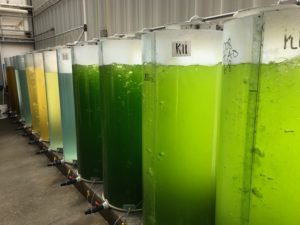
Shellfish\r\ngrowers often produce their own algae for larval shellfish feed. Photo by James\r\nWright.
However, high costs must be considered, he said.
“Replacing our system completely can be a tough proposition\r\nas it requires a lot of money,” he said. “It has to make sense and we have to\r\nmake our production as cost efficient as possible but that’s only one aspect of\r\nthe whole story. You might have a system that makes algae production more cost\r\nefficient but if it isn’t flexible or you cannot ensure continuous production\r\nor add different species, it becomes much more costly.”
Eudeline says that the key is to determine how\r\nphotobioreactors like the GemTube could fit into existing production systems.\r\nWith system construction and operation, space, equipment and labor all\r\nsignificant costs in algae production, incorporating something new like the\r\nGemTube could be worthwhile, especially if there are less steps and labor.
“Integrating such a system and producing a consistent supply\r\nof algae is extremely important,” he said. “Saving money is one thing but\r\nthat’s very small compared to consistent and reliable production.”
Jessica Harvey, scallop hatchery technician at the National\r\nMarine Aquarium in Plymouth, UK, agrees. To ease the pressure from commercial\r\nscallop fishing, Harvey and her team produce viable king scallop (Pecten\r\nmaximus) seed. A combination of conical flasks and bag culture is their primary\r\nmethod of producing algae, a food source for scallop broodstock as well as\r\njuvenile fish and other shellfish.
“We produce flagellates and diatoms at different cell sizes\r\nto ensure suitability for different life stages,” said Harvey. “We produce\r\nlarge volumes of live algae for feed with minimal maintenance and culture a\r\nvariety of species within a small area.”
The GemTube is likely to be a future consideration, she\r\nsaid, if the scale of her hatchery’s operation grows. In the meantime, she\r\nbelieves that algae production costs can be reduced as follows.
\r\n\r\n\r\n\r\n\r\n\r\n\r\n\r\n\r\n\r\n\r\n\r\n\r\n\r\n\r\n\r\n\r\n\r\n\r\n\r\n\r\n\r\n\r\n\r\n\r\n\r\n\r\n\r\n\r\n\r\n\r\n\r\n\r\n\r\n\r\n\r\n\r\n\r\n\r\n\r\n\r\n\r\n\r\n\r\n\r\n\r\n
“It’s important to establish connections with algae\r\nsuppliers or local producers of stocks so if you were to require some at short\r\nnotice, you have a higher chance of doing so,” she said. “Investing in training\r\nfor technicians regarding common issues and how to mitigate them, such as\r\nbiosecurity, can also help.”
Source: Global Aquaculture Alliance

Ditulis oleh
Tim Minapoli
Kontributor
Pakar di bidang akuakultur dengan pengalaman lebih dari 15 tahun. Aktif berkontribusi dalam pengembangan industri perikanan Indonesia.