

Trials with tilapia in Thailand show that diets containing\r\nL-selenomethionine increase performance and provide high protection against\r\npathogenic pressureIn intensive animal production, high dai...
Trials with tilapia in Thailand show that diets containing\r\nL-selenomethionine increase performance and provide high protection against\r\npathogenic pressure
In intensive animal production, high daily weight gain and\r\nhigh feed efficiency are essential. However, high performance is associated\r\nwith increased levels of stress.
Stress – such as from high stocking density, pathogenic\r\npressure and temperature – is associated with enhanced levels of reactive\r\noxygen species (ROS) and linked to sub-optimal antioxidant status. Selenium\r\n(Se), in this respect, is a very important essential trace element as it is a\r\nvital component of selenoenzymes (eg glutathione peroxidase, GPx) which play a\r\nrole in reducing ROS and to maintain a healthy antioxidant status. A disruption\r\nof this steady state causes tissue damage due to interaction of ROS with\r\nlipids, proteins and DNA. These negative interactions reduce their metabolic\r\nactivity.
In order to maintain this steady state a continuous as well\r\nas optimal selenium supply is essential. However, this can be difficult to\r\nachieve when uptake from the diet is impaired when stress is present. At that\r\nmoment selenium is in high demand, to produce selenoenzymes and combat ROS.\r\nSelenium storage inside the animal, in that respect, would be beneficial. This\r\narticle provides an overview of the scientific literature on the beneficial\r\neffects seen with the addition of L-selenomethionine to the diet and this\r\nfocussed on salmon, trout and tilapia. Results from a recent trial on tilapia\r\nconducted in Thailand are discussed.
Maintaining an optimal selenium steady state: a nutritional\r\nsolution
Selenium can be added to the diet in either inorganic or\r\norganic forms (Figure 1). The advantage of using organic selenium\r\n(L-selenomethionine, L-SeMet) over inorganic sources (eg sodium selenite or\r\nselenate) is its ability to be incorporated directly, without conversion, into\r\ngeneral body proteins as a methionine source. L-selenomethionine is the only\r\nselenium compound that has this ability. The incorporated selenium, in the form\r\nof L-selenomethionine, acts as a storage of selenium in the animal. This stored\r\nselenium ensures optimal supply, even during stressful periods.
If necessary, the stored selenium gets metabolised to\r\nselenide (H2Se) then to de novoselenocysteine (SeCys). This molecule will\r\nbe incorporated, as the active site, in selenoproteins. Other selenium\r\ncompounds, such as SeCys and sodium selenite, are not storable but will be\r\nmetabolised to de novo SeCys. These compounds will be quickly\r\nexcreted when intake is in excess. L-selenomethionine will only be metabolised\r\nto selenide when there is a need. This form is therefore less prone to\r\nexcretion and toxicity reactions (Rayman, 2004).
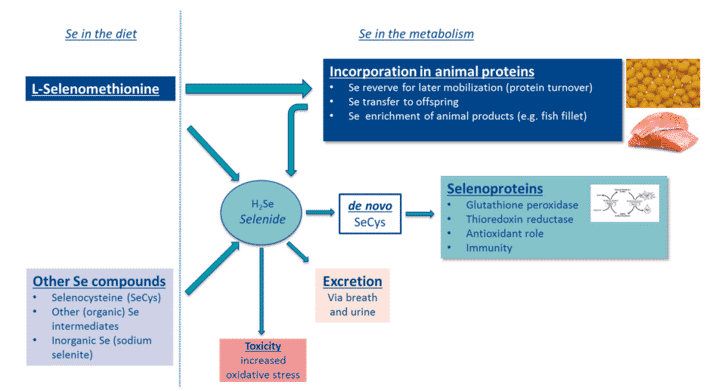
Figure 1
The metabolism of L-selenomethionine and other selenium\r\ncompounds © Adapted from Rayman, 2004; and Combs, 2001
Aquatic protein challenge: a case for L-selenomethionine
Traditionally, fishmeal was the preferred protein sources in\r\naquatic feeds. Due to limited availability, pressure on wild fish stocks and\r\nvariable prices there is an interest in alternative, sustainable protein\r\nsources. Plant meals, for example, are suitable alternatives in the growing\r\nglobal aquaculture industry. However, replacing marine ingredients in fish feed\r\nwith plant sources changes the nutrient composition of the feed. Selenium\r\nconcentration of fillets is reported to be highly impacted by high levels of\r\nsubstitution, reducing the added value of fish consumption (Lundebye et al.\r\n2017; Betancor et al. 2016).
Although selenium levels are decreasing within the fish, the\r\ndemand for selenium to protect against (oxidative) stress remains. Stressors\r\n(eg environmental, metabolic) are an important issue for the productivity and\r\nprofitability of fish farms. These stressors may cause increased oxidative\r\ndamage to lipids, proteins and DNA and increased mineral mobilisation from\r\ntissues and their subsequent excretion. High stress may therefore lead to\r\nincreased mineral requirement. L-selenomethionine is established to be a highly\r\navailable selenium source leading to higher selenium deposition compared to inorganic\r\nselenium sources (Figure 2). It can therefore counteract selenium depletion\r\ncaused by plant-based diets.
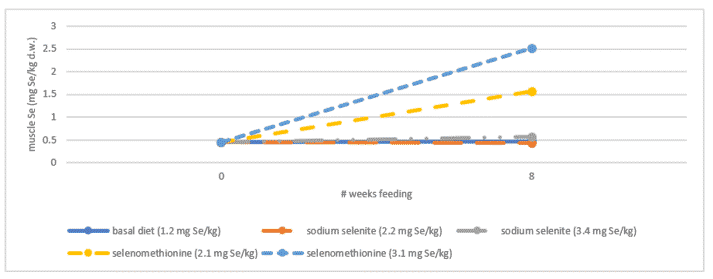
Figure 2
Selenium concentrations in muscle (mg Se/kg dry weight) of\r\nAtlantic salmon fed a fishmeal-based diet supplemented with sodium selenite or\r\nselenomethionine at levels of 1 and 2 mg Se/kg feed, respectively, for 8 weeks. ©\r\nLorentzen et al, 1993
Control stress and win
Dietary selenomethionine supplementation is known to offer a\r\nway to reduce performance loss under stress, such as crowding conditions\r\n(Küçükbay et al. 2008). A recent study, performed at the Mahasarakham\r\nUniversity, Thailand, showed increased performance and high protection against\r\npathogenic pressure. A total of 735 Nile tilapia (initial weight 13.52±0.5g)\r\nwere fed one of seven experimental diets (in triplicate) in fibreglass tanks\r\nfor eight weeks. Organic Se (L-selenomethionine, SeMet; Excential Selenium\r\n4000, Orffa Additives BV) and inorganic Se (sodium selenite, Na2SeO3) were each\r\nadded to the basal diet at 1, 3, and 5mg Se/kg. The basal diet (28 percent\r\ncrude protein), without Se supplementation, was used as a control.
The final Se concentration of the basal diet was 0.68mg\r\nSe/kg. Organic and inorganic Se supplemented diets contained 1.78, 3.53 and\r\n4.90mg Se/kg and 1.75, 3.49 and 5.30mg Se/kg, respectively. Fish were fed at\r\n5.0 percent of their body weight twice a day. Parameters were assessed at the\r\nend of the rearing period. After eight weeks, 20 fish from each treatment were\r\nchallenged with intraperitoneal injection of the virulent Streptococcus agalactiae serotype\r\nIII at 1x10⁷ CFU/mL. The cumulative mortality was observed for 21 days and\r\nthe relative percent survival (RPS) was calculated.
Table 1 shows that weight gain (WG) of fish fed SeMet at 1mg\r\nSe/kg was significantly higher than that of fish fed basal diet (p<0.05).\r\nLymphocytes were significantly (p<0.05) higher in fish fed SeMet (1mg Se/kg)\r\ncompared to fish fed basal diet. Alanine transaminase (ALT), aspartate\r\ntransaminase (AST), creatinine, blood urea nitrogen (BUN), albumin, globulin\r\nand total protein were not significantly influenced by dietary Se\r\nsupplementation.
Increasing dietary Se level, particularly in the form of\r\nSeMet, led to a decrease in serum cholesterol concentrations. Interestingly,\r\nthe innate immune response (eg lysozyme, catalase, myeloperoxidase, superoxide\r\ndismutase and glutathione peroxidase) activity was significantly (p<0.05)\r\nincreased with Se supplementation compared to the basal diet group, especially\r\nfor fish fed SeMet (1 and 3mg/Se kg). Malondialdehyde (MDA) in fish serum, on\r\nthe other hand, was decreased numerically for all supplementation levels. Fish\r\nfed SeMet (1mg Se/kg) showed the highest RPS after the challenge with S.\r\nagalactiae.
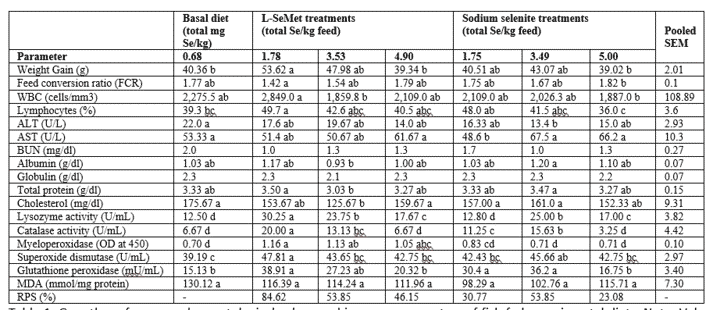
Table 1
Growth performance, haematological values and immune\r\nparameters of fish fed experimental diets. Note: Values show mean, pooled SEM,\r\nn = 90; S= L-SeMet (Excential Selenium 4000) and sodium selenite (Na2SeO3),\r\nL=level of selenium supplementation. Values in the same row with different\r\nletters differ significantly (p < 0.05). White blood cells (WBC), alanine\r\ntransaminase (ALT), aspartate transaminase (AST), blood urea nitrogen (BUN),\r\nmalondialdehyde (MDA), relative percent survival (RPS).
Conclusions
L-selenomethionine (Excential Selenium 4000) was tested and\r\nvalidated by independent researchers around the world in peer-reviewed\r\npublications (eg Berntssen et al. 2018; Silva et al. 2019) and proven\r\nto be effective in increasing the selenium and antioxidant status of fish, even\r\nunder challenging conditions. This will result in improved performance and\r\nimmune function. Very high levels of L-selenomethionine (5 mg Se/kg feed) do\r\nnot appear to have negative effects on performance nor on immune parameters.
\r\n\r\n\r\n\r\n\r\n\r\n\r\n\r\n\r\n\r\n\r\n\r\n\r\n\r\n\r\n\r\n
L-selenomethionine therefore has a good application in fish\r\ndiets when fish are kept under stressful conditions or in any diets where\r\nfishmeal is replaced by plant meals. L-selenomethionine helps to maintain\r\nselenium concentration in fish fillets and therefore contributes to the\r\npositive healthy image of fish consumption for humans.
Source: The Fish Site

Ditulis oleh
Tim Minapoli
Kontributor
Pakar di bidang akuakultur dengan pengalaman lebih dari 15 tahun. Aktif berkontribusi dalam pengembangan industri perikanan Indonesia.