

Black tiger shrimp larvae, consuming large amounts of\r\nmicroalgae or algae, will \"grow as fast as blow\" and repel disease?Tiger shrimp is one of the main species raised in Southeast\r\nAsia. ...
Black tiger shrimp larvae, consuming large amounts of\r\nmicroalgae or algae, will "grow as fast as blow" and repel disease?
Tiger shrimp is one of the main species raised in Southeast\r\nAsia. However, like other aquatic species, black tiger shrimp also have to\r\nstruggle against the disadvantages caused by diseases, weather and difficult\r\nseed supply. Shrimp seed is the first and most important link in the black\r\ntiger shrimp farming system, the seed is sensitive to even the smallest changes\r\nin the water environment. For a long time, hatcheries have known how to\r\nuse algae or fresh algae powder at low cost to contribute to the growth and\r\ndisease resistance of shrimp larvae. Although the effectiveness of algae\r\nis indisputable, they can also adversely affect the quality of the aquatic\r\nenvironment.
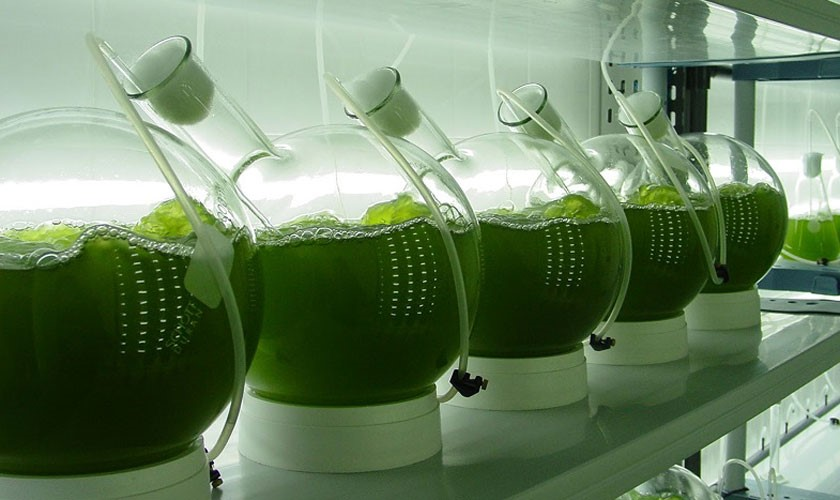
Algae, along with plankton, are a valuable source of primary\r\nfood for shrimp larvae. In particular, fresh microalgae are a sustainable\r\nfood source, providing a lot of nutrition. Shrimp larvae using algae show\r\nremarkable growth, improved digestive intensity, and immune defense mechanisms\r\nare enhanced even when the shrimp are in the smallest stages.
Some of the most popular fresh algae species today are Chaetoceros ,\r\nwhich are small-sized, medium-sized larval mouths, promote high growth, greatly\r\nimprove survival, high nutritional content, and are easy to raise.\r\nimplant. Thalassiosira , another species of algae, has a higher\r\nnutrient content. In powder form, Spirulinahave abundant protein\r\ncontent being used the most in hatcheries. But powdered algae cannot\r\ncompletely replace fresh algae, due to the absence of beneficial\r\nmicroorganisms. Microalgae for shrimp larvae contain a large amount of\r\nbacteria, but there have been no reports assessing the influence of them on\r\nshrimp larvae. Therefore, this study analyzes the abundance as well as the\r\nbenefits and disadvantages of bacterial strains for black tiger shrimp larvae,\r\nrather than the environment in which shrimp live.
Black tiger shrimp of the same size are collected at a\r\nhatchery in China. For this study, two species of fresh algae Chaetoceros\r\nmuelleri and Thalassiosira weissflogii were cultured in the\r\nlaboratory together with Spirulina algae powder. Divide the number of\r\nlarvae into 3 equal groups, each group corresponding to each different species\r\nof algae. Designations are A ( Chaetoceros muelleri algae ),\r\nB ( Thalassiosira weissflogii ) and C ( Spirulina algae\r\npowder)). And of course, to check the difference in the effect of algae\r\nwith shrimp, the water quality indicators and daily care for the groups are the\r\nsame. Feeding algae combined with artificial feed for larvae from Zoea to\r\nPostlarvae stage and then start evaluating results. When shrimp increase\r\nat a regular stage, water samples are taken to check the indicators and\r\nbacterial strains present, shrimp samples are used to assess growth rate and\r\nshape metamorphosis through larval stages. DNA testing and statistical\r\nanalysis to get the final results.
Results of water quality analysis showed that the\r\nconcentration of NH 3 in group C during the PL period was the\r\nhighest. Meanwhile, NO 2 concentration is highest in C\r\ngroup when shrimp is in Mysis stage. And the density of Vibrio in\r\ngroup A during PL period is the most abundant according to the\r\nassessment. The rate of metamorphosis of shape, survival rate of larvae\r\nand activity of digestive enzymes in groups A and B was significantly higher\r\nthan group C at all stages. The diversity of bacterial strains decreases\r\nfrom Zoea to PL, group C has much lower density than groups A and B.
The intestinal flora is important for the health, metabolism\r\nand ability to activate the immune system of shrimp. Feeding will change\r\nthe structure of this system, thereby directly affecting shrimp\r\nhealth. When fed with fresh algae supplement, the survival rate and growth\r\nrate of larvae were also much higher than when feeding only algae\r\npowder. Because fresh algae has changed the microbiota in the\r\nlarvae. As for Spirulina powder , the survival rate begins\r\nto decrease when the larvae are just reaching the Zoea stage. In addition,\r\nthe proportion of bacteria in the intestinal tract is also greatly reduced, so\r\nthe ability of larvae to digest and immune function also becomes seriously\r\nimpaired.
Microbacteriaceae, Pseudoalteromonas, Rhodobacteraceae are\r\nthe most common bacteria on the structure of all 3 groups of algae. And\r\nhas been shown to be beneficial for the growth and development of black tiger\r\nshrimp, stimulating the activity of digestive enzymes in the intestinal tract,\r\nand competing to destroy harmful bacteria that cause disease in shrimp.
Fresh microalgae in addition to promoting growth and\r\nsurvival for shrimp are also used as potential prebiotics to promote the\r\nregulation of the intestinal microflora. While algae powder in the\r\nproduction process has been destroyed into cell walls, it loses its\r\nwater-soluble properties and becomes much less nutritious than fresh\r\nalgae. It is noteworthy that due to the gradual adaptation from the plant\r\nto animal diet, the activity of digestive enzymes is gradually lower, which can\r\nbe explained by not consuming too much energy to assimilate food.\r\nagain. Fresh microalgae have also been shown to purify water and inhibit\r\nharmful bacteria in the environment.
For most aquatic animals, additional bacteria that enter the\r\ngastrointestinal tract and outside the environment have beneficial or harmful\r\neffects on the microbiological structure in the host body. At different\r\nstages, dominance also belongs to different species of bacteria. Shrimp in\r\nthe larval stage, Photobacterium predominate, while Vibrio is mainly\r\nwhen the shrimp are one month of age and older and this ratio of Vibrio is\r\nincreasing with the age of the shrimp. In addition, in different\r\nenvironments, the structure of this microbial community is also different.
\r\n\r\n\r\n\r\n\r\n\r\n\r\n\r\n\r\n\r\n\r\n\r\n\r\n\r\n\r\n\r\n\r\n\r\n\r\n\r\n
In summary, this study has shown that the two species of\r\nalgae T. weissflogii and C. muelleri significantly improved\r\nthe survival and metamorphosis rates of larvae. Also stimulates the\r\nactivity of digestive enzymes and the diversity of the microbial community on\r\nthe body of black tiger shrimp. NH 3 and NO 2 also\r\nsignificantly reduced the toxicity when feeding the fresh algae, so it can be\r\nconcluded that these two algae are suitable for black tiger shrimp larval\r\nrearing systems. The feeding of different types of algae can affect the\r\nchange of microbial community in larvae, thereby affecting the development and\r\nhealth status of giant tiger shrimp larvae.
Source: Tepbac

Ditulis oleh
Tim Minapoli
Kontributor
Pakar di bidang akuakultur dengan pengalaman lebih dari 15 tahun. Aktif berkontribusi dalam pengembangan industri perikanan Indonesia.