

A recent study showed that polyculture can improve the\r\ngrowth of Pacific white shrimp in the Biofloc system.Currently, vannamei shrimp ( Litopenaeus vannamei ) are the\r\nsubjec...
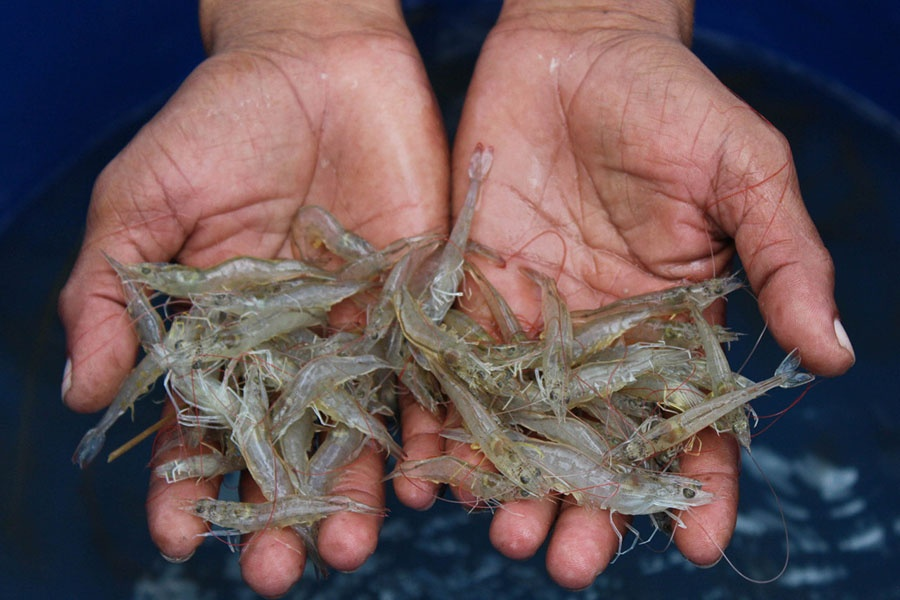
A recent study showed that polyculture can improve the\r\ngrowth of Pacific white shrimp in the Biofloc system.
Currently, vannamei shrimp ( Litopenaeus vannamei ) are the\r\nsubject of gradually replacing black tiger shrimp in intensive farming\r\nareas. However, in recent years, due to the impacts of climate change,\r\nenvironmental pollution has led to an increasingly difficult farming\r\nsituation. At the same time requires strict treatment of waste water\r\ndischarged into the environment to ensure not negatively affecting the\r\necosystem, so people tend to shift gradually to biofloc technology, a\r\nsustainable development model that both improves productivity and minimize\r\nwater change, ensure the environment.
Also read: Benefits When Farming Integrated Shrimp Seaweed
Biofloc technology is currently the leading technology\r\ncontributing to the production of vannamei shrimp in Vietnam and around the\r\nworld. However, shrimp / fish farming in the biofloc system may face some\r\nobstacles, especially the high concentration of solids produced. Excessive\r\naccumulation of suspended solids in water can reduce shrimp growth and\r\ntherefore these solid wastes need to be removed from the system. The\r\nremoved solids are waste products rich in nitrogen and phosphorus ... if not\r\nutilized it will cause waste as well as environmental pollution.
To solve these problems, a recent study by Manh N. Hoang et\r\nal. (2018) shows that Pacific white shrimp polyculture and mullet (Mugil cephalus ) are integrated in\r\na system. biofloc is a sustainable farming model and brings higher\r\nproductivity.
The biofloc system\r\nintegrates mullet and vannamei farming
This study aimed to evaluate the effectiveness of the\r\ndifferent stocking densities of the mullet (Mugil\r\ncephalus ) integrated with Pacific white shrimp (Litopenaeus vannamei), cultured for 75\r\ndays in the biofloc system.
Shrimp were reared at a density of 300 fish / tank and\r\nmullet were reared in 4 different densities: 0, 10, 20 and 30%\r\nbiomass. The initial weight is 0.5 and 1.5 g respectively for shrimp and\r\nfish. Shrimp were fed four times a day using commercial pellet feed.
Result
The results showed that at the density of 10% biomass for\r\nthe best shrimp growth performance corresponding to 0.14g / day and FCR of\r\n1.06, and the total biomass obtained after the experiment was higher than the\r\ntreatments. wake up.
The conversion rate of nutrients in integrated shrimp and\r\nmullet farming retains 30.41 - 40.32% of total nitrogen feed intake and 25.26 -\r\n33.54% of total phosphorus intake, a significant difference. told between\r\ntreatments.
At the end of the experiment, the mean values of water\r\nquality parameters were not significantly different (p> 0.05) between\r\ntreatments, except for TSS, TAN, NO 2 -N.
Also read: Evaluating Compensatory Growth in Pacific White Shrimp in a Biofloc System
The results indicate that mullet can be farmed with vannamei\r\nwith a stocking density of 10% of shrimp biomass to improve water quality,\r\noverall productivity and nutrient utilization efficiency. The addition of\r\nmullet to the biofloc system in shrimp ponds helps reduce nitrogen and\r\nphosphorus concentrations in the outlet water, thereby contributing to reducing\r\ncosts during the culture process.
\r\n\r\n\r\n\r\n\r\n\r\n\r\n\r\n\r\n\r\n\r\n\r\n\r\n\r\n\r\n\r\n\r\n\r\n\r\n\r\n\r\n\r\n\r\n\r\n
The model of shrimp and mullet farming in Vietnam has been\r\napplied and developed in various forms such as: raising mullet to make use of\r\nshrimp water, raising mullet in settling / filtering ponds or combining\r\nfarming. However, the integration of fish-shrimp farming in biofloc\r\nsystems is not much, so the results from the study provide basic information to\r\napply in practice to ensure biosecurity and reduce production costs in farming\r\nprocess.
Source : Tepbac

Ditulis oleh
Tim Minapoli
Kontributor
Pakar di bidang akuakultur dengan pengalaman lebih dari 15 tahun. Aktif berkontribusi dalam pengembangan industri perikanan Indonesia.