

Beta Hatch, the insect-growing startup looking to revolutionize\r\nthe animal feed business through its science and technology, has raised $3\r\nmillion as part of a new funding round.Founded in 2015 ...
Beta Hatch, the insect-growing startup looking to revolutionize\r\nthe animal feed business through its science and technology, has raised $3\r\nmillion as part of a new funding round.
Founded in 2015 by PhD entomologist Virginia Emery, the\r\ncompany has raised $5 million in total equity while also securing $4.6 million\r\nin state and federal funding.
The latest round was co-led by Cavallo Ventures, the venture\r\ncapital arm of Wilbur-Ellis, and early-stage venture firm Innova Memphis. Klein\r\nPrivate Equity Investment and Brighton Jones Investment Partners also\r\nparticipated.
Currently operating out of a facility in SeaTac, south of\r\nSeattle, Beta Hatch will use the cash to continue to innovate on its technology\r\nand also move its entire operation to Cashmere, Wash., next year.
That flagship facility will be the largest mealworm\r\nproduction facility for animal feed in North America, with the capacity to\r\nproduce a ton of insect protein per day. It’s scheduled to be operational in\r\nearly 2021 and will be partially powered by waste heat from a neighboring data\r\ncenter to reduce electrical needs.
Beta Hatch develops insect-rearing technology that converts\r\norganic waste directly into high-value proteins, oils and nutrients for poultry\r\nand aquaculture, enabling insects to cost-effectively meet the global scale of\r\ndemand for plant and animal nutrients.
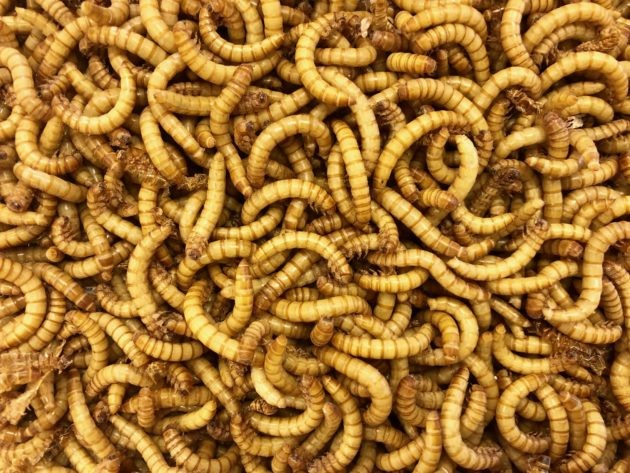
Mealworms are ideal food for chickens and farm-raised fish,\r\nand Beta Hatch raises lots of them. (GeekWire Photo / Kurt Schlosser)
Emery said insects have the potential to be the world’s most\r\nsustainable protein, and growing them — and Beta Hatch — has been both\r\nsatisfying and challenging.
“We have learned so much about the science of raising\r\ninsects, but we have also learned just how much more we need to understand to\r\noptimize our technology,” Emery told GeekWire. “This is the beginning of a new\r\ncrop, but given we took millennia to domesticate some of our other food\r\nspecies, we are working at light speed in relative terms.”
We have learned so much about the science of raising\r\ninsects, but we have also learned just how much more we need to understand to\r\noptimize our technology.
Beta Hatch currently employs 14 people and plans to bring on\r\n10-20 more in new roles once the Cashmere operation is complete.
The expanding startup has learned to work efficiently\r\ntogether, Emery said, and she’s been excited to pass off more of the hats she\r\nwears as CEO. She recently hired a VP of Business Development and VP of\r\nTechnology who can help the company continue to scale and excel.
And personal challenges over the past year have been part of\r\nthe experience as well. Emery was pregnant while raising venture capital, and\r\nhad her first child early this year just before the COVID-19 pandemic hit.
“I’ve been forced to become more efficient as a leader and\r\nto wrestle with a lot of tough issues around sexism and startups,” she said. “I\r\nthink with the pandemic shining a light on work-life balance challenges, more\r\npeople are recognizing a lot of the continued and systemic challenges for women\r\nleaders, so I am excited to blaze a path forward for other female\r\nentrepreneurs.”
\r\n\r\n\r\n\r\n\r\n\r\n\r\n\r\n\r\n\r\n\r\n\r\n\r\n\r\n\r\n\r\n\r\n\r\n\r\n\r\n\r\n\r\n\r\n\r\n\r\n\r\n\r\n\r\n
Along with the funding news, Beta Hatch has made significant\r\nscientific breakthroughs, as the company recently completed the first published\r\nassembly of the yellow mealworm genome. It will be published as part of an open\r\nsource article in the “Journal of Insects as Food and Feed” this summer and\r\nserve as a resource for furthering research on the mealworm and other\r\ncommercially relevant insect species.
Source: GreekWire

Ditulis oleh
Tim Minapoli
Kontributor
Pakar di bidang akuakultur dengan pengalaman lebih dari 15 tahun. Aktif berkontribusi dalam pengembangan industri perikanan Indonesia.