

Soaking for eight\r\nhours supports optimal shell peelingThis study showed that the optimum shell peeling time for freshly\r\nharvested Pacific white shrimp maintained in ice water for up to 24 hours ...
Soaking for eight\r\nhours supports optimal shell peeling
This study showed that the optimum shell peeling time for freshly\r\nharvested Pacific white shrimp maintained in ice water for up to 24 hours was\r\nafter 8 hours. Photo by Darryl Jory.
Shell removal, or shelling, is a crucial step during shrimp\r\nprocessing. However, in China shrimp are still shelled manually, even though\r\nsome mechanical shrimp peelers exist. But these have distinct disadvantages, as\r\nthe shrimp are delicate and are easily crushed in these machines. Moreover,\r\nboth the efficiency and the output of processed shrimp are low when utilizing\r\nmechanical shrimp peelers. Various alternative methods are available for\r\npeeling shrimp, including low-temperature shelling, ice-salt shelling,\r\nblanching shelling, high-pressure shelling and flash-freeze shelling.
Currently, placing shrimps on ice and/or in brine (typically\r\nNaCl or NaCl with phosphates) solution for several days is the most common\r\npractices to facilitate the separation of the edible meat from the shell in the\r\nshrimp industry. Various studies have reported that shrimp processed on ice can\r\nbe peeled more easily than those freshly caught. Other studies reported that\r\npre-treating the shrimp with low-temperature brine and ice salt made shell\r\npeeling easier. However, salt can easily penetrate into the shrimp and affect\r\nits quality.
Ice water pretreatment (soaking) before shelling involves\r\nkeeping freshly caught shrimp in ice water overnight, followed by shell\r\nremoval. The quality of the shrimp and the shelling times are closely related\r\nto how long the shrimp are soaked in ice water. Extended soaking time eases the\r\nremoval of the shrimp shells, but the overall quality of the shrimp is reduced.
This article – adapted and summarized from the original (Xu,\r\nN. et. al. 2019. Effect of ice water pretreatment on the quality of Pacific\r\nwhite shrimp, Litopenaeus vannamei.\r\nFood Science & Nutrition Volume 7(2): 645-655.) – reports on a study to\r\nevaluate the quality changes and shelling issues of Pacific white shrimp (Litopenaeus vannamei) freshly harvested\r\nfrom farms and stored in ice water for up to 24 hours.
This study was funded by the National Science and Technology\r\nSupport Plan (No. 2015BAD17B01), National Natural Science Foundation of China\r\n(No. 31471685), and an extension project (No. 2014‐5) from Shanghai Agriculture\r\nCommittee.
Study setup
Pacific white shrimp harvested from local ponds were\r\npurchased from an aquatic products market in Shanghai, China. The animals were\r\nsent to the laboratory (College of Food Science and Technology, Shanghai Ocean\r\nUniversity, Shanghai, China) within half an hour, while still alive. At the\r\nlab, dead and moribund shrimp were discarded, and the live animals were divided\r\ninto seven groups, each weighing around 550 grams. The first group was used as\r\na control group, and the shells were peeled and measured. Ice water was added\r\nto the remaining six groups.
Shrimp groups were processed by manually shelling every 4\r\nhours for the next 24 hours to determine shelling times and quality changes.\r\nFive people with experience in shelling shrimp manually peeled each 550-gram\r\ngroup of shrimp, and the weight of meat and the time required for the shells to\r\nbe removed were recorded. Meat samples were stored at minus-80 ± 1 degrees-C\r\nfor various lab analyses.
For detailed information on the experimental design; shrimp\r\ncollection and preparation; shrimp shelling times; sensory evaluations; ATP‐related\r\ncompounds and K values; shrimp color and texture measurements; and other tests\r\nand data processing, refer to the original publication.
Results and\r\ndiscussion
The time that was required to remove the shrimp shells\r\nreflected the degree of difficulty of the shelling process. Thus, a shorter\r\npeeling time signified less difficulty in removing the shell from the meat. Our\r\nresults show that the peeling time per 550-gram group of shrimp declined as the\r\nsoaking time was extended (Fig. 1). The fresh L. vannamei sample proved challenging to peel and required\r\n5.92 minutes.
After 4 hours of immersion in ice water, the shelling time\r\ndecreased significantly to 2.21 minutes. The shelling time ultimately dropped\r\nto 1.57 minutes after 24 hours of treatment. The results indicated that a\r\ndecrease in temperature during the processing of L. vannamei reduced the shelling time substantially. However,\r\nno significant differences in the shelling time were evident after treatment\r\nfor 4 hours.
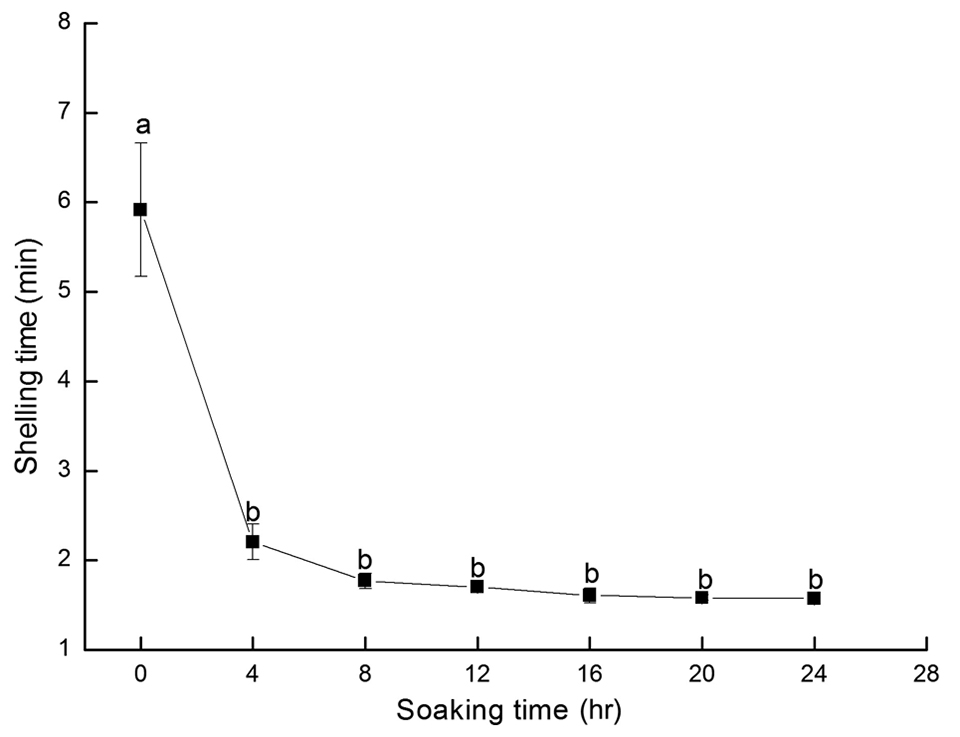
Fig. 1: Changes in the shelling time of L. vannamei shrimp treated with ice\r\nwater for up to 24 hours.
The shrimp yield reflects the output rate of shrimps after\r\nshelling. The control group was represented by 0 hours, and the shrimp yield\r\nwas 46.87 percent. Meat yield increased considerably with time, reaching 50.53\r\npercent after 20 hours of treatment. However, no significant difference was\r\napparent in the sample group after an 8-hour treatment (Fig. 2). This indicated\r\nthat the internal tissue cells of the shrimp body absorbed the external\r\nmoisture during the process of ice water treatment, resulting in an increase in\r\nthe total weight of the shrimp. The optimal treatment time was determined to be\r\n8 hours and was calculated by combining the shell peeling time and shrimp meat\r\nyield.
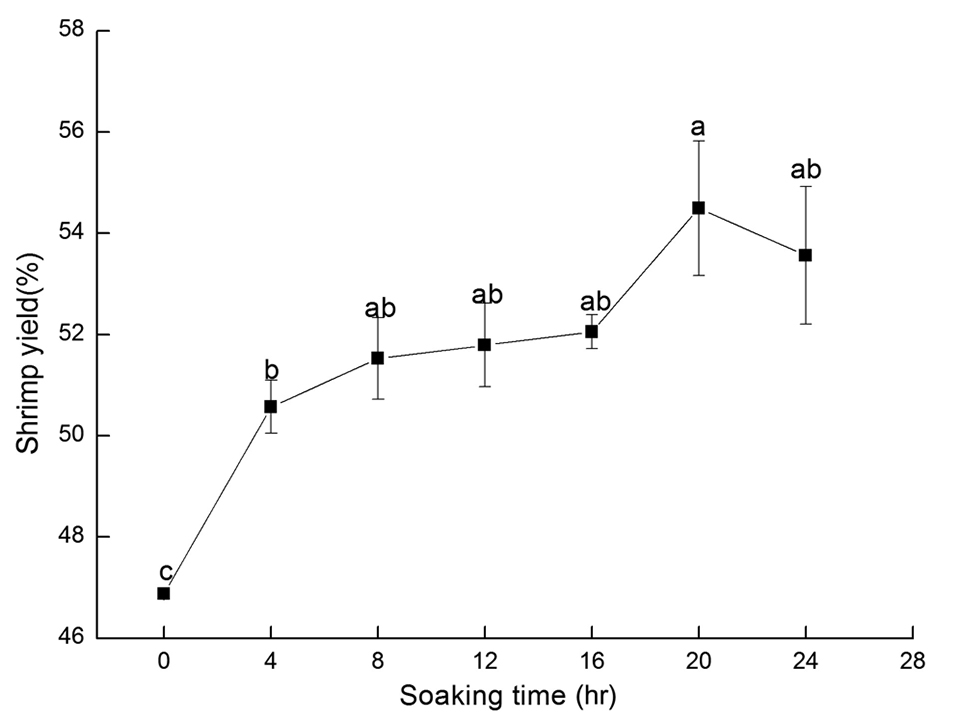
Fig. 2: Shrimp yield changes for L. vannamei shrimp vs. soaking times in slurry ice.
Regarding comparative sensory quality, our results showed\r\nthat L. vannamei shrimp\r\nkept in slurry ice maintained adequate quality, but texture, smell and color\r\nindexes decreased with increasing soaking times. Unpeeled shrimp with a\r\npretreatment time of 0 hours had the best quality, but its shelling was\r\nexceptionally difficult and scored the lowest on shelling time. A soaking time\r\nof between 4 and 8 hours resulted in easier peeling process, with 8 hours\r\nconsidered the optimal pretreatment time.
Hardness is a most critical textural attribute in meat or\r\nseafood. Our results showed that, with increasing ice water immersion time, the\r\nhardness of L. vannamei shrimp\r\nshowed an upward trend. There was a significant difference in the hardness of\r\nthe shrimp samples following immersion in ice water for 0, 4 and 24 hours,\r\nrespectively (Fig. 3). Shrimp samples continued to display signs of stiffness\r\nafter 24 hours, possibly due to the effect of the frigid water temperature on\r\nenzyme activity and protein degradation.
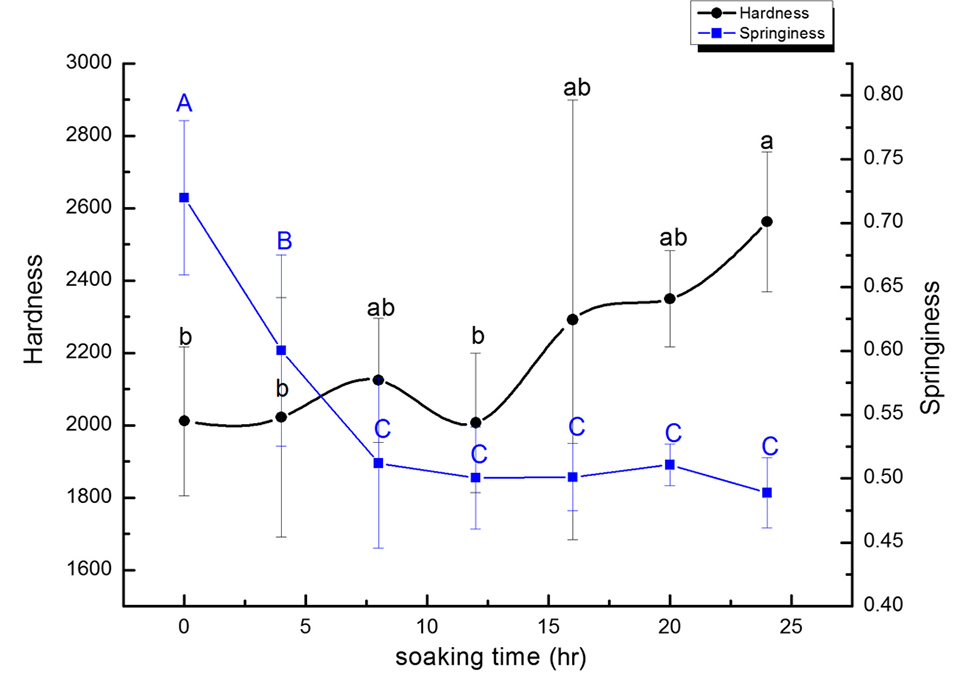
Fig. 3: Changes in hardness and springiness of fresh L. vannamei shrimp during the ice\r\nwater storage period.
Elasticity is another critical evaluation index to determine\r\nthe quality of texture. Elasticity is the ratio of height or volume of a\r\ndenatured sample to its pre-deformation height after removal of the deforming\r\nforces. The flexibility of the samples continued to decline throughout the\r\ntreatment period. Samples exhibited the ideal elasticity of 0.72 mm at 0 hours,\r\nfollowed by the 4-hour sample with an elasticity of 0.62 mm. It was evident\r\nthat the elasticity value fluctuations remained within a specific range after 4\r\nhours. Our hardness and elasticity measurements were consistent with those\r\nreported by several other similar studies.
Perspectives
\r\n\r\n\r\n\r\n\r\n\r\n\r\n\r\n\r\n\r\n\r\n\r\n\r\n\r\n\r\n\r\n\r\n\r\n\r\n\r\n\r\n\r\n\r\n\r\n\r\n\r\n\r\n\r\n\r\n\r\n\r\n\r\n\r\n\r\n\r\n\r\n\r\n\r\n\r\n\r\n\r\n\r\n\r\n\r\n
This study assessed changes in shelling time, shrimp yield,\r\nsensory indexes and several physical and chemical indicators (texture,\r\nchromatic aberration, TBA value, K value, and microstructure) for L. vannamei shrimp. Our results\r\nshowed that the optimum process condition was an ice water treatment (soaking)\r\nfor 8 hours, which can significantly simplify shell removal while maintaining\r\nproduct quality. But soaking time can limit meat yield and must be considered\r\nin the processing of shrimp.
Source: Global Alliance Aquaculture

Ditulis oleh
Tim Minapoli
Kontributor
Pakar di bidang akuakultur dengan pengalaman lebih dari 15 tahun. Aktif berkontribusi dalam pengembangan industri perikanan Indonesia.