

Oceans once teeming with life are being whittled away.\r\nLarger, predatory fish – salmon and tuna included – are now estimated to be at less than\r\n10% of their pre-industrial levels. Hist...
Oceans once teeming with life are being whittled away.\r\nLarger, predatory fish – salmon and tuna included – are now estimated to be at less than\r\n10% of their pre-industrial levels. Historical data from coastal\r\necosystems has indicated that the loss of these large, predatory fish — called\r\n“fishing down the food web” by an article in Scientific\r\nAmerican — can have severe consequences on the structure of these\r\necosystems. Aquatic predators high on the food chain keep prey populations in\r\ncheck. When they collapse, species lower on the food chain proliferate. Kelp\r\nforests, for example, are being threatened\r\nby a rise in herbivorous sea urchins. Kelp death en masse came\r\nafter natural sea urchin predators, including sea otters, decreased in population.
This disintegration of the ocean’s wildlife also corresponds\r\nwith market demands for seafood, which have risen at an exponential rate since the\r\nearly 1980s. When these larger, predatory fish are raised in aquaculture (fish\r\nfarms) they are often fed “forage fish”, including sardines and anchovies.\r\nThese forage fish are harvested from the oceans (to the tune of millions of\r\ntons per year), ground up, and used as feed for aquaculture, poultry, and other\r\nfarm-raised animals. They provide an ideal source of nutrition and contain oils\r\nlike EPA, DHA Omega-3, and ARA (arachidonic acid), an essential Omega-6.
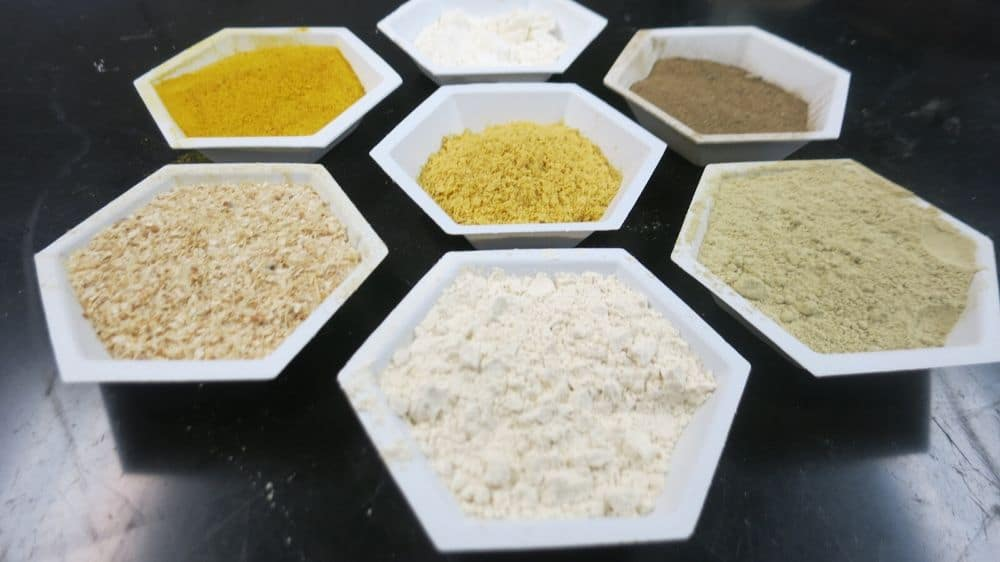
A variety of fish-free ingredients used in aquafeed. Credit:\r\nF3 Challenge/Rick Barrows
There are two significant problems with aquaculture in its\r\ncurrent form: the demand for seafood is rapidly growing (well over 50% of the world’s seafood is\r\nnow supplied from fish farms), while the global catch of forage fish has\r\nstagnated. Worse still, forage fish lie at the center of the ocean’s food\r\nchain. They sustain everything from seabirds to whales and dolphins, and their disappearance could have profound consequences for the oceanic ecosystem.
We need to find new ways to produce fishmeal and fish oils –\r\nwithout the fish – to keep pace with global seafood demand and address the\r\nglaring shortcomings of modern aquaculture.
From space to the oceans
Netherlands-based Veramaris, a joint venture\r\nof DSM and Evonik, has tackled an important\r\npart of this problem. They use a strain of microalgae, originally discovered in\r\nthe ocean, to produce the fish oils that salmon and tuna demand in a\r\nlaboratory, without the need for forage fish. Veramaris’ origin is also a bit\r\nof a surprise and begins with scientists keen on exploring the solar system.
“[The use of microalgae to produce oils] began in the early\r\n1980s as a project within the NASA organization,” says Øyvind Ihle, the Global\r\nMarketing & Communications Director at Veramaris. “[NASA] wanted to find a\r\nway to cultivate essential nutrients while in space for their missions. And\r\nwith microalgae, you could just bring along sugar and water, basically, and\r\nproduce compounds without any access to sunlight.”
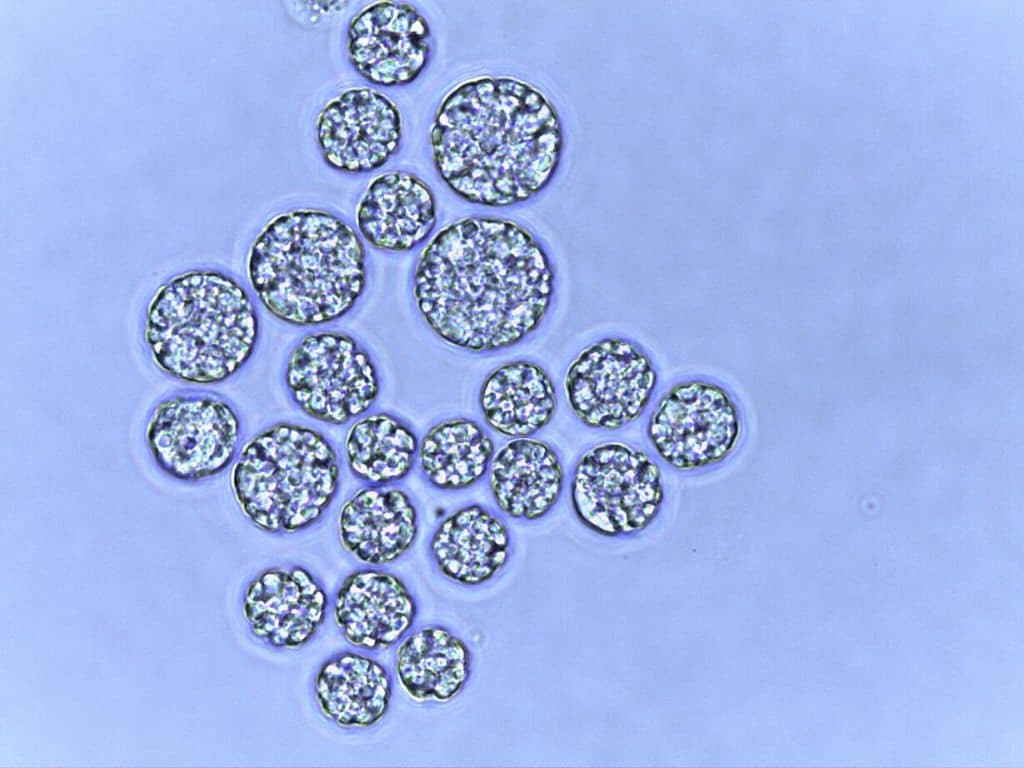
Marine microalgae of the strain Schizochytrium sp. Photo\r\ncourtesy of Veramaris.
Though the NASA project was a success, the project lost\r\nfunding and the amassed “library” of microalgae strains from the mission –\r\n6,500 total – were spun off to a private company by the NASA scientists. The\r\nstrains were eventually sold to DSM, a parent company of Veramaris.
Once acquired by DSM, the microalgae were put to work.\r\nAccording to Ihle, “[DSM] has been working on this algal strain ever since the\r\nacquisition and it has been used in commercial areas, predominantly in infant\r\nnutrition.”
The current strain of microalgae, which has not been\r\ngenetically modified, also produces EPA, DHA, and ARA. “That’s where Veramaris\r\ncomes in,” says CEO Karim Kurmaly. “We have a strain [of microalgae] and we’ve\r\ntaken it to scale. It produces all three [fatty acids required for\r\naquaculture], so you can produce marine oil without the fish.” Veramaris\r\nproduces its microalgae oil at a commercial\r\nfacility in Blair, Nebraska.
Changing the politics of eating fish
In October, Veramaris won the 2nd international a competition organized by Future of Fish Feed (F3), a collaboration\r\nbetween NGOs, researchers and private companies to “accelerate the commercialization\r\nof innovative, alternative aquaculture feed ingredients to replace wild-caught\r\nfish”. The $200,000 the prize was given to the competitor that sold the most “fish-free” oil\r\nwith a fatty acid profile that mimics that of forage fish. Veramaris sold an\r\nimpressive 770,000 kilograms, which were from their pilot batches.
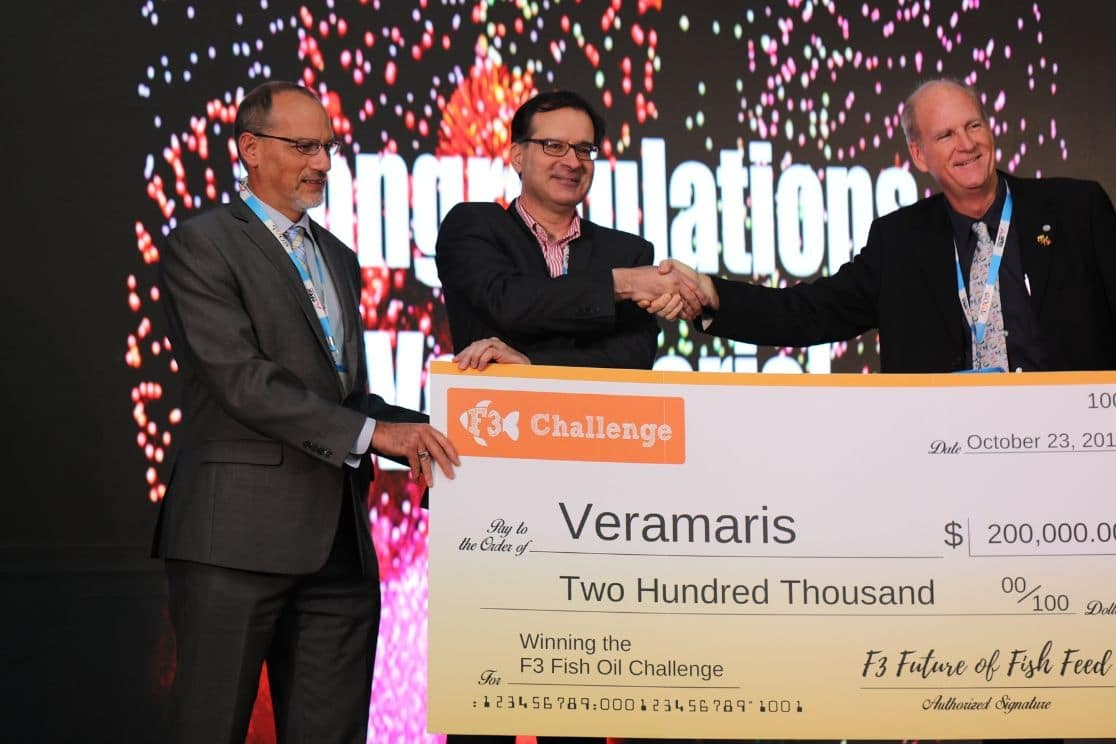
Michael Tlusty, F3-Judge and Associate Professor at the\r\nUniversity of Massachusetts (left), Karim Kurmaly CEO Veramaris (center), and\r\nKevin Fitzsimmons, Chair and Judge of the F3 Fish Oil Challenge (right). Photo\r\ncourtesy of Veramaris.
Despite their success in the F3 competition, Kurmaly knows\r\nthat a global shift towards sustainable aquaculture will not be possible\r\nwithout a parallel advancement in the policy. Aquaculture certification bodies need\r\nto act quickly to decrease our reliance on an already fragile ocean ecosystem,\r\nand innovative technologies will not be enough.
“We want to speak out to those certification bodies, and\r\ntell them that there are now alternative solutions to address our dependencies\r\non finite natural resources,” says Kurmaly. If the rest of the aquaculture\r\nindustry – fish farms, feed suppliers, and consumers – begin to harvest and\r\npurchase seafood that is raised on sustainable ingredients, we may be able to\r\nstave off an oceanic disaster.
Assuring the Future of Seafood
As aquafeed formulations are currently configured, the\r\nindustry depends heavily on nutrients in fishmeal and fish oil to raise higher\r\ntrophic, carnivorous species that rely on forage fish for sustenance (think\r\ncod, salmon, sturgeon, tuna, bass, perch, pompano, seabream, and eel) and also\r\ncrustaceans (shrimp). But fishmeal and fish oil are also used to feed\r\nomnivorous and vegetarian species like tilapia and carp, because of nutrients from\r\nthese sources speed growth and prevent disease. There are dozens of species raised in\r\naquaculture, many of which demand unique nutritional formulations.
If, all of a sudden, fishmeal and fish oil were to become\r\nunavailable, and fish-free formulations were not developed, then it might not be\r\npossible to aquaculture certain species. As a result, the F3 Team is concerned that feed company that wants to survive in the medium to long-term may also\r\nhave an interest in finding substitute ingredients because without forage fish\r\nsubstitutes, their product lines may shrink. Alternatively, feed companies that\r\nhave fish-free formulations may have an advantage in the aquaculture market,\r\nwhich is estimated to be worth\r\n$71.7 billion by 2025.
To spur this much-needed shift in aquaculture, F3 is working\r\non initiatives that extend far beyond their competitions. They offer resources\r\nthat make it easy for anyone – consumers, aquaculture experts, and entrepreneurs\r\n– to learn about sustainable ingredients, test “fish-free” products, and grow\r\ntheir business. The F3 Feed Innovation\r\nNetwork, for example, provides in-depth information on suppliers of\r\nsustainable aquaculture ingredients and detailed formulas for aquaculture feeds\r\nthat reduce or abolish the use of forage fish. This network is the real\r\nbread-and-butter of the F3 consortium, with the competitions serving as a\r\n“glossy banner” to attract the attention of seafood suppliers and consumers.
To raise awareness about sustainable aquaculture, F3\r\njudges choose competition topics based on academic studies. For example, a\r\nrecent study\r\nin Nature Sustainability predicted that fisheries could reach\r\nmaximum production capabilities in a mere seventeen years. The last\r\ncompetition, which ended in October 2019, sought to replace fish oil harvested\r\nfrom forage fish, an advancement that could extend this timeline dramatically.
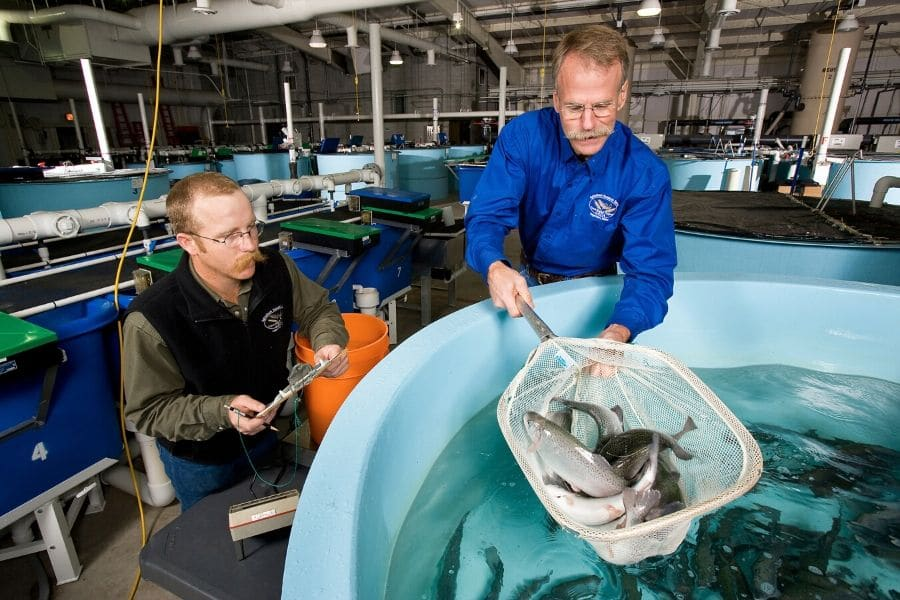
USDA Fish nutritionist Rick Barrows (right) captures trout\r\nfrom 6-foot-diameter tanks for technician Jason Frost to weigh and measure.\r\nThese trout were fed fishmeal-free, plant-based feed. Credit: Steve Ausmus\r\nUSDA/ARS
An ocean-friendly future demands more than just fish-free\r\noil
Unfortunately, Veramaris’ success in producing aquaculture\r\noils from microalgae only address part of the problem with aquaculture in its\r\ncurrent form – there are many other hurdles that need to be overcome. Take\r\ncrustaceans as an example; they consume a massive percentage of the total fish\r\nmeal and fish oil used in aquaculture annually. According to F3, crustaceans\r\n(like shrimps) “consume roughly 31% of global fishmeal production,” while other\r\ncarnivorous species, like salmonids, “consume around 23% of global fishmeal and\r\n60% of global fish oil.”
A “fish-free” feed formulated for Atlantic Salmon can’t be\r\nused to grow shrimp, either. Different species require varying levels of\r\nnutrients, which is why F3 emphasizes that multiple types of alternative\r\ningredients will be needed to replace forage fish in aquaculture. For example,\r\nshrimp feeds demand 35% wheat flour, 20% soybean meal, and 25% fishmeal, among\r\nother components, according to the Food\r\nand Agriculture Organization of the United Nations. Any replacement for\r\nthese feeds will also require an ideal balance of nutrient content in the form\r\nof proteins, omega-3s, and other lipids. Synthetic biology may be able to\r\nformulate these blends more sustainably and at a lower cost.
This year’s F3\r\nChallenge – Carnivore Edition calls for teams to create and sell\r\nfish-free feeds for these carnivorous species using sustainable sources. Teams\r\nare tasked with selling aquaculture feed for one of three categories:\r\nsalmonids, shrimps, or other carnivorous species, and the winner will be\r\nselected based on the most feed sold within each of these categories. Companies\r\nthat want to enter the competition should visit the competition website to learn\r\nmore and register.
\r\n\r\n\r\n\r\n\r\n\r\n\r\n\r\n\r\n\r\n\r\n\r\n\r\n\r\n\r\n\r\n\r\n\r\n\r\n\r\n\r\n\r\n\r\n\r\n\r\n\r\n\r\n\r\n\r\n\r\n\r\n\r\n\r\n\r\n\r\n\r\n\r\n\r\n\r\n\r\n\r\n\r\n\r\n\r\n\r\n\r\n\r\n\r\n\r\n\r\n\r\n\r\n\r\n\r\n\r\n\r\n\r\n\r\n\r\n\r\n\r\n\r\n
The F3 competitions have helped unleash dozens of innovative\r\nproducts have saved millions of tons of forage fish from being harvested from\r\nthe oceans, and are ensuring that a broad range of seafood remain available to\r\nconsumers, buffered against the shifting winds of forage fish availability. But\r\nfurther progress – and the full adoption of sustainable ingredients for\r\naquaculture – will demand intense collaboration across all levels of the\r\n“aquaculture chain”, from fisheries all the way down to individual consumers.\r\nVeramaris and F3 know this better than anyone.
Source: synbiobeta.com

Ditulis oleh
Tim Minapoli
Kontributor
Pakar di bidang akuakultur dengan pengalaman lebih dari 15 tahun. Aktif berkontribusi dalam pengembangan industri perikanan Indonesia.