

Diseases cost shrimp farmers around the world billions of\r\ndollars every year, while scaring off potential investors and posing risks to\r\nfarmers\' livelihoods.In Southeast Asia, more than 90 perc...
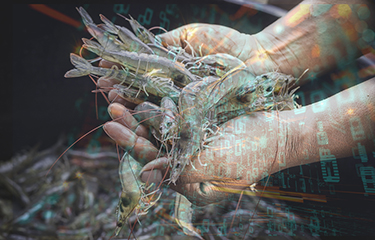
Diseases cost shrimp farmers around the world billions of\r\ndollars every year, while scaring off potential investors and posing risks to\r\nfarmers' livelihoods.
In Southeast Asia, more than 90 percent of shrimp farms have\r\nat least one dormant disease living in the water, such as white spot disease,\r\nwhite feces disease, and hepatopancreatic microsporidiosis (HPM), according to\r\nthe Sustainable Trade Initiative (IDH), a Dutch organization seeks to\r\naccelerate sustainable investments.
But reducing disease could help shrimp farmers attract\r\ninvestors. A new partnership between IDH and Indonesian aquaculture data\r\nservices provider JALA seeks to make shrimp farming more investor-friendly,\r\nenvironmentally sustainable, and profitable for farmers. By leveraging big\r\ndata, the project aims to pinpoint the causes of disease outbreaks, reduce\r\ntheir frequency, and improve the survival rates of farmed shrimp.
"Farmers need to adapt the way of farming due to\r\nvarious challenges that continuously update every month or week," JALA CEO\r\nLiris Maduningtyas told SeafoodSource. "Technologies help them in a way\r\nthat they can improve to mitigate most of the farming risks."
Two-thousand farmers use JALA’s in-water monitoring device\r\nto collect data about farming conditions, such as salinity, temperature, and\r\nacidity in 5,000 ponds across Southeast Asia. JALA analyzes the data to predict\r\nshrimp growth and optimize harvest timing, providing farm management tools and\r\ndecision support to farmers.
The technology is simple, easy to use, cheap, and has easily\r\nportable sensors — all of which matters for shrimp farmers using it on their\r\noperations in Indonesia.
Shrimp farmers currently don't know whether water quality\r\ncorrelates with certain diseases, but Maduningtyas believes that trends will\r\nbecome more visible as more farmers use JALA and provide more data. JALA and\r\nIDH has partnered with aquatic epidemiologists at the University of Prince\r\nEdward Island to analyze data to study how disease spreads through shrimp\r\npopulations and prevent outbreaks.
"The first question we need to answer is: What type of\r\ndata correlates with a certain type of disease? Then, the next question is how\r\nto project this," Maduningtyas said.
Outbreaks cut into income, cause inputs to be wasted,\r\nincrease water pollution, and lead to excessive antibiotic use. Greater survival\r\nmeans less wasted feed and more efficient use of natural resources, allowing\r\nshrimp farming to become more profitable. Knowing how disease spreads will\r\nallow shrimp farmers to better prevent it.
“Individual farmers have information limited to their own\r\nfarm, and it is almost impossible to tell if events in one cycle will happen in\r\nfuture cycles,” the University of Prince Edward Island's Krishna\r\nThakur said. “Epidemiology investigations applied to many farms and\r\nthrough multiple productions, cycles can help identify practices or conditions\r\nthat are related to disease occurrence, providing all participants with\r\ninformation for decisions that improve overall survival and productivity.”
Reducing disease risk will also make shrimp farming more\r\nappealing to investors, according to IDH Aquaculture Program Officer Lisa van\r\nWageningen.
"Disease occurrence threatens farmers' long-term\r\nbusiness. As a result, investors are reluctant to make long-term sustainable\r\ninvestments,” van Wageningen told SeafoodSource, adding that diseases have\r\ncascading ramifications. “Diseases do not only have negative economic\r\nconsequences for farmers. Diseases have negative environmental consequences,\r\ntoo, as they result in the waste of inputs and can potentially cause irresponsible\r\npractices such as the excessive use of antimicrobials.”
Perceptions that aquaculture is a risky sector have\r\nprevented investors from taking full advantage of its potential, van Wageningen\r\nsaid. IDH’s work to improve health management is intended to make the sector less\r\nrisky, and more investable and insurable. Other aquaculture sectors beyond\r\nshrimp would also benefit from better disease management since it’s a key\r\nissue, van Wageningen added.
To help investors grow more familiar with the sector, IDH\r\nhas published investment guidelines for shrimp culture in Indonesia\r\nthat describe how to mitigate risks. The organization is currently writing an\r\ninvestment framework that goes beyond Indonesia and shrimp and will apply to\r\nthe sector more broadly.
“The beauty of adopting a data-driven approach to\r\ncontrolling diseases is not only that risks for outbreaks can be reduced, but\r\nalso, that risks can be quantified and a track record can be established, hence\r\nmaking investors more comfortable in investing in those farms,” IDH Aquaculture\r\nProgram Director Flavio Corsin said in a statement. “Better management, less\r\ndiseases, and easier access to investment: Three birds with one stone.”
IDH sees major investment opportunities, since aquaculture\r\nis one of the world's fastest-growing food production systems. The growth of\r\nthe middle class in Asia and Africa portends a shift toward more protein-rich\r\ndiets, but because of a lack of available land for livestock and a need to\r\nlower greenhouse gas emissions, alternatives to land-based animal protein will\r\nbe needed.
\r\n\r\n\r\n\r\n\r\n\r\n\r\n\r\n\r\n\r\n\r\n\r\n\r\n\r\n\r\n\r\n\r\n\r\n\r\n\r\n\r\n\r\n\r\n\r\n\r\n\r\n\r\n\r\n\r\n\r\n\r\n\r\n
"The growth in available protein will have to come from\r\nefficient systems such as farmed fish,” van Wageningen said. “The aquaculture\r\nsector has a lower carbon footprint compared to other livestock sectors, and\r\nrequires less water, energy, feed, and fuel."
Source: Seafood Source

Ditulis oleh
Tim Minapoli
Kontributor
Pakar di bidang akuakultur dengan pengalaman lebih dari 15 tahun. Aktif berkontribusi dalam pengembangan industri perikanan Indonesia.