

Microbiome scientists at Nofima are working on uncovering\r\nthe complex cross-talk between the fish and its microbes and aim to improve the\r\nhealth of farmed fish.Microbiome: an organ\r\nin its own...
Microbiome scientists at Nofima are working on uncovering\r\nthe complex cross-talk between the fish and its microbes and aim to improve the\r\nhealth of farmed fish.
Microbiome: an organ\r\nin its own right
The hundreds of trillions of microbes that reside on and\r\nwithin animals, including fish, are collectively referred to as the microbiota.\r\nThese complex microbial communities, which interact with each other, the host\r\nand the host’s environment, are called the microbiome.
At Nofima, I work with a group of scientists who are collaborating\r\nto explore the influence of the microbiome, associated with its dietary effects\r\nin aquaculture. Currently, our research is focusing on investigating the\r\neffects of the microbiome on system performance.
Why should we study\r\nthe fish microbiome?
The highly complex and mixed microbial population which\r\nlives in the intestine of animals is known as the gut microbiota. A stable and\r\nresilient microbiome is linked to maintaining the overall health and well‐being\r\nof the host. Many efforts have already been directed to understand the\r\ninteractions between host and microbe, as well as between microbes themselves,\r\nin humans and other terrestrial animals. Now we know that gut microbiota plays\r\na crucial role in supporting the host’s intestinal stability as well as\r\nmetabolic and immune functions. As with humans and other animals, the gut\r\nmicrobial communities of lower vertebrates such as fish can also contribute to\r\nmaintaining the host organism’s immune equilibrium, digestion and nutrition.
The fish microbiota is diverse and includes protists,\r\nbacteria, archaea, fungi and viruses. It is shaped by several host-associated\r\nfactors – such as diet, age, geographical location, stress, genetics and drugs.\r\nAmong the microbial communities in a fish’s gut, bacteria are the most abundant\r\nand dominant microorganisms. They maintain an intimate relationship with the\r\ngut mucosa (the inner lining of the gastrointestinal tract) and impart\r\nsubstantial functions in a healthy individual – they co-exist to contribute,\r\namong many functions, to the production of vitamins, synthesis of amino acids\r\nand production of bacterial metabolites.
Nofima’s strategy to\r\ninvestigate the fish microbiome
Many aspects of fish microbiome research are still something\r\nof a black box, as researchers remain uncertain about how, when and where the\r\nfish acquires its microbiota. We need this information in order to maximise the\r\npotential of this new field in aquaculture. Microbiome research is inherently\r\ninterdisciplinary and Nofima has\r\na special advantage since its work ecompasses disciplines such as fish health,\r\nnutrition, genetics, production biology and food processing – all of which can\r\ncollaborate in opening up the black box.
The majority of previous studies have focused upon the\r\nstructure of the fish microbiome, providing little knowledge about the immense\r\nfunctional potential of the gut microbiome. At Nofima, some of our objectives\r\nare to understand and study how the microbiome cooperatively functions as\r\ncommunities in different rearing environments (eg its effect on biofilter\r\nactivity) and how it interacts with the host tissue (that is, its role in\r\nnutrient conversion, health and disease). Furthermore, we aim to pinpoint key\r\nfunctionalities of these microbes in the host, which could be of great value\r\nfor the future development of the aquaculture sector. In addition, fish\r\ndiseases are one of the largest challenges in aquaculture production, and, as a\r\nsector, when we commit to addressing them, our highest priority tends to be working\r\nto identify the single pathogenic microbe causing the disease. At Nofima, by\r\ncontrast, we challenge the status quo to identify the rest of the microbiota\r\nand determine if they can confer some resistance to the pathogen.
In the face of rapidly progressive deterioration of skin\r\nhealth, studies aim to get a deeper understanding of the role of the microbiome\r\nand the mechanisms of disease resistance. In recent years, dietary studies have\r\nshown that variation in microbiome composition is mainly driven by certain\r\nbacteria, but these types of bacteria are not always the same between studies.\r\nAt the same time, changes are also seen to occur in circumstances where there\r\nis a high level of connectivity to external microbiomes (eg contact with varied\r\nmicrobes from the surrounding water or from other fish living in the same\r\ntank). A limitation is that we have not yet measured absolute microbial cell\r\nnumbers in the intestine. Investigations into defining underlying mechanisms of\r\nhost-microbe interactions are currently being developed at Nofima.
In general, most anaerobic bacteria residing in the gut have\r\nincredible capacities for fermenting non-digestible complex substrates, and\r\nthis fermentation produces bacterial metabolites such as short-chain fatty\r\nacids (SCFAs) and gases. Acetate, butyrate and propionate are the major SCFAs\r\nthat are most widely studied. These SCFAs have been the focus of attention due\r\nto their well-documented beneficial effects on the health of the intestinal tract\r\nin humans and farmed animals. However, we have limited information on the\r\nfunctional aspects of these SCFAs in fish, even though this knowledge could\r\nhave applications in improving the health of the farmed fish species.
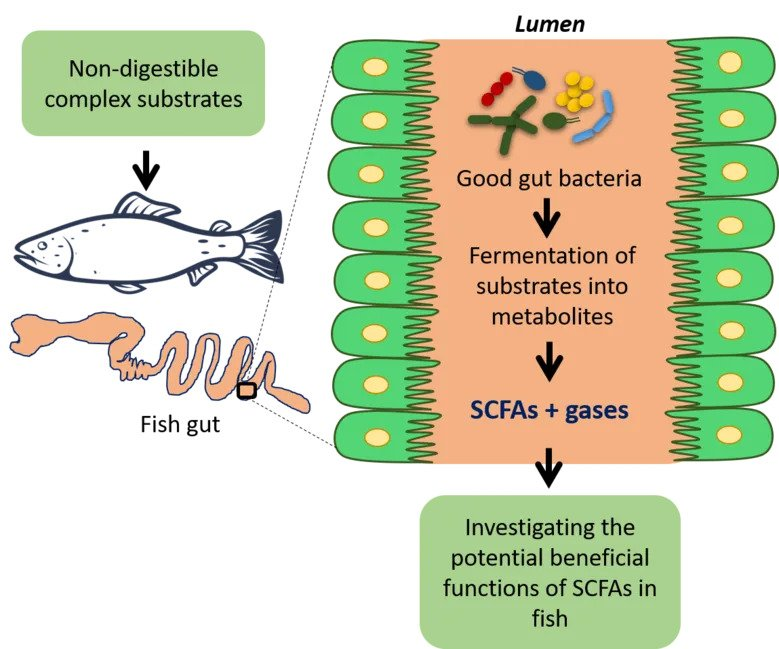
A graphic representation of the production of short-chain\r\nfatty acids (SCFAs) by the good microbes in the fish gut. Illustrated by Shruti\r\nGupta. The good or commensal microbes which live in the fish gut, ferment the\r\ncomplex substrates from the feed and produce bacterial metabolites and gases.\r\nMicrobiome scientists at Nofima are investigating the functional potential of\r\nmajor SCFAs in the fish gut and aim to produce a healthier fish
© Dr Shruti Gupta
Scientists at Nofima are working towards understanding the\r\ninterconnection between the fish and its gut microbes using new molecular\r\ntechniques such as next-generation sequencing and chromatography techniques\r\nsuch as gas chromatography. From our previous experiments, we have found that\r\nAtlantic salmon smolts, when transferred to the sea, alter their microbiome\r\ndepending on the season and location. Furthermore, our results suggest that the\r\nconcentration of major SCFAs modifies, depending on the dietary patterns. We\r\nare now working towards understanding the cross-talk between the major SCFAs\r\nand the fish.
We are also conducting one of the largest microbial surveys\r\nof the Atlantic salmon skin and gut microbiomes, contrasting different life\r\nstages of wild and farmed salmon across the northern hemisphere. The goal is to\r\ninvestigate what triggers the changes in microbiota and to determine which\r\nmicrobes are necessary for the health of the host and which ones are just along\r\nfor the ride. Research at Nofima is also focusing on the triggers and switches\r\nwhich influence the microbiota of farmed fish.
Furthermore, this year we hope to reveal new insights on the\r\ngut host-microbiota relationships from our prime researchers employed in\r\ngain-of-function dietary gut microbiome studies. The researchers will also\r\ncontinue to investigate how the act of feeding may influence microbiome\r\ncomposition and function through diverse mechanisms in both host and system\r\nperformance.
The key takeaways from our ongoing research are that one\r\nshould understand, that for every fish we feed today, we also feed trillions of\r\nother microorganisms. Therefore, to establish and maintain a healthy fish gut\r\nmicrobiome, a fundamental understanding of the diversity and compositional\r\nprofile of the fish-associated microbial communities and their impact on growth\r\nand health is essential.
\r\n\r\n\r\n\r\n\r\n\r\n\r\n\r\n\r\n\r\n\r\n\r\n\r\n\r\n\r\n\r\n\r\n\r\n\r\n\r\n\r\n\r\n\r\n\r\n\r\n\r\n\r\n\r\n\r\n\r\n\r\n\r\n\r\n\r\n\r\n\r\n\r\n\r\n\r\n\r\n
With the development of new sequencing technologies, the\r\nresearch on fish gut microbiota has expanded dramatically. Nevertheless,\r\ninformation regarding the functions of fish gut microbiota and the cross-talk\r\nbetween the bacterial metabolites and fish should be in the research spotlight,\r\nin order to develop effective strategies to keep pathogens at bay and to\r\nimprove the growth and health of farmed fish species.
Source: The Fish Site

Ditulis oleh
Tim Minapoli
Kontributor
Pakar di bidang akuakultur dengan pengalaman lebih dari 15 tahun. Aktif berkontribusi dalam pengembangan industri perikanan Indonesia.