

A recent research team of Nguyen Thi Ngoc Anh and colleagues\r\nat Can Tho University showed that fresh / dried green algae can use alternative\r\nfood source to partially feed commercial tilapia to r...
A recent research team of Nguyen Thi Ngoc Anh and colleagues\r\nat Can Tho University showed that fresh / dried green algae can use alternative\r\nfood source to partially feed commercial tilapia to reduce costs. in the\r\nbreeding process. In the Mekong Delta (Mekong Delta), Cladophoraceae green\r\nalgae is found year-round in brackish water bodies (extensive, improved\r\nextensive ponds, natural waters, waste water channels, etc.) in large\r\nquantities. and has high nutritional value.
In Vietnam, green algae is distributed in brackish water\r\nbodies of Quang Ninh, Thanh Hoa, Hai Phong, Ha Tinh, Ba Ria-Vung Tau and Kien\r\nGiang (Nguyen Van Tien, 2007). In the Mekong Delta, green algae occurs all\r\nyear round, often developing simultaneously with vermicelli, blue seaweed or\r\nalternating one after another in brackish water bodies, ponds, extensive ponds.
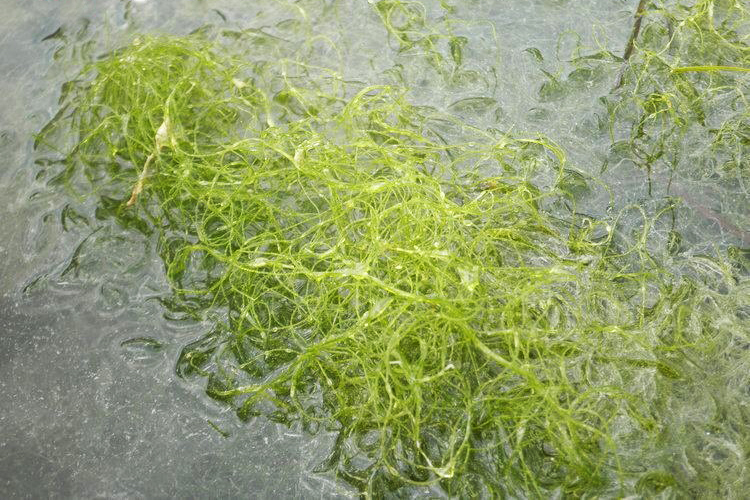
The nutrient content of green algae (Cladophoraceae) is rich\r\nin nutrients such as protein content, carbohydrates, astaxanthin, essential\r\namino acids, which are suitable food for plant-loving fish. Green algae is\r\nused as an alternative source of fishmeal in pellet feed for tilapia up to 50%\r\nand the ability to digest green algae protein reaches 93.9% (Appler and\r\nJauncey, 1983). Other research shows that the green seaweed protein\r\n(Cladophoraceae) can replace up to 30% of the fish meal protein in pellet feed\r\nfor gourami ( Osphronemus goramy ) seed (Nguyen Thi Ngoc\r\nAnh et al., 2014a) and 40% protein Soybean meal in vannamei diet ( Litopenaeus\r\nvannamei)) growth of shrimp was better than shrimp fed diets containing no\r\ngreen algae powder (Nguyen Thi Ngoc Anh et al., 2014b)
Replace part of your\r\ndiet with Green Seaweed for tilapia
The\r\nexperiment consisted of 7 treatments with 3 replications and randomly assigned,\r\nexperimental fish were fed alternately with pellets and fresh green or dried\r\ngreen algae with the frequency of feeding in the following treatments:
- Treatment 1: Food\r\nindustry every day (control food, TA)
- Treatment 2: Fresh\r\nblanket daily (RXT)
- Treatment 3: Dry blanket\r\nevery day (RXK)
- Treatment 4: 1 day of\r\nfresh blanket 1 day of pellet feed (1RXT_1TA)
- Treatment 5: 1 day dry\r\nblanket blanket 1 day pellet feed (1RXK_1TA)
- Treatment 6: 2 days of\r\nfresh blanket 1 day of pellet feed (2RXT_1TA)
- Treatment 7: 2 days of\r\ndry blanket blanket_1 days of pellet feed (2RXK_1TA)
Experimental fish were fed satisfactorily 2 times / day at\r\n8:00 and 17:00 hours. Green algae are cut into short pieces of 2-3 cm\r\nbefore feeding. Leftover feed and algae are checked and collected after 1\r\nhour of feeding. Ponds are exchanged once a week, about 30% of the water\r\nin the tank. The experiment period was conducted 60 days.
Result
After 60 days of culture, the survival rate of the fish is\r\nnot affected by the food, ranging from 93.3 to 98.3%. Growth rates of fish\r\nfed alternately 1 day fresh / dry green algae_1 days pellet feed did not\r\ndiffer.
\r\n\r\n\r\n\r\n\r\n\r\n\r\n\r\n\r\n\r\n\r\n\r\n\r\n\r\n\r\n\r\n\r\n\r\n\r\n\r\n\r\n\r\n\r\n\r\n\r\n\r\n\r\n\r\n\r\n\r\n\r\n\r\n
Applying alternately feeding green algae and food, the\r\namount of pellet feed can be reduced from 29.6% to 38.6% and the water quality\r\nis better than the control treatment.
Source : tepbac.com

Ditulis oleh
Tim Minapoli
Kontributor
Pakar di bidang akuakultur dengan pengalaman lebih dari 15 tahun. Aktif berkontribusi dalam pengembangan industri perikanan Indonesia.