

Research has shown that raising tilapia with yeast and in\r\nbiofloc environments has a significant growth effect.Tilapia is a species of salted and widely raised fish in\r\nmany countries around the ...
Research has shown that raising tilapia with yeast and in\r\nbiofloc environments has a significant growth effect.
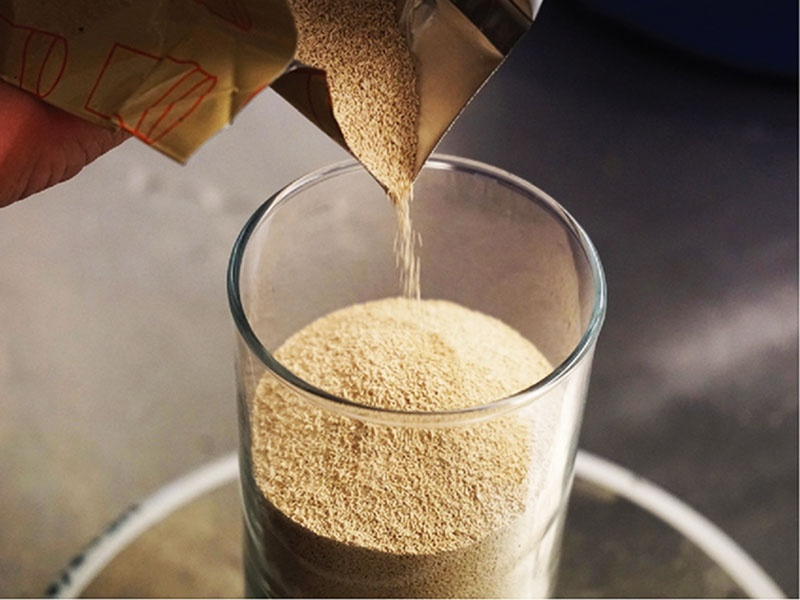
Tilapia is a species of salted and widely raised fish in\r\nmany countries around the world such as China, Indonesia, Thailand, ... (Abu et\r\nal., 2005). As the farming area and production increase, the potential for\r\nenvironmental pollution is increasing, so the study of biological agent\r\ninfluences is a positive trend contributing to environmental stability and\r\nlimiting disease in ponds. feed.
Biofloc technology is a new biotechnology solution that\r\ncontributes to the development of aquaculture towards sustainability,\r\nbiosecurity and environment friendliness thanks to the following outstanding\r\ncapabilities: (1) Elimination Free ammonia in pond water by conversion to\r\nprotein in heterotrophic bacteria biomass in biofloc, (2) Aquaculture animals\r\nuse biofloc as feed, so the ratio of protein conversion in feed increases to\r\n45-50%, (3) Improve biosecurity level and reduce disease risk.
According to Azim and Little (2008), raising tilapia in\r\nbiofloc results in faster growth rate and better water quality than\r\nnon-biofloc. Similarly, Guozhi et al (2014) suggested that when raising\r\ntilapia in the biofloc system, the harvested fish volume was 22% higher and the\r\nfeed conversion ratio was 18% lower than that of the fish raised in the\r\ncirculatory system. whether or not biofloc. Previous research has\r\nevaluated the ability to use yeast in the biofloc system to improve the\r\nnutritional quality of biofloc, improve digestibility for livestock, and\r\nstimulate growth. Therefore, the purpose of this study is to compare the\r\neffect of yeast as a protein source instead of fish meal in tilapia diet\r\n( Oreochromis niloticus ) cultured in either clear water or biofloc\r\nconditions.
The experiment was arranged completely randomly with 4\r\ntreatments, immature tilapia (initial weight of 29 ± 3.2 g), randomly\r\ndistributed into 24 500 L conical tanks to conduct experiments.\r\nexperience. The treatments used feed had the same 5% protein and 19 KJ / g\r\nenergy. Feed treatments in turn with yeast dosage as follows 0%, 30%, 60%\r\nand 100% of fish meal protein were replaced by yeast. Fish were raised for\r\n3 months, fed by hand twice a day.
12 tanks in a recirculating aquaculture system (RAS) with\r\nclear water, with mechanical and biological filters and an average of 15% daily\r\nwater replacement. The other 12 tanks were connected to four open 10-m3\r\nopen biological tanks initially bred with Bacillus subtilis and nutrients to\r\nachieve a C: N ratio of 10, supporting bacterial growth.
At the end of the experiment, the amount of feed, the amount\r\nof protein, weight gain, daily weight gain, specific growth rate, feed\r\nconversion rate, protein efficiency rate, survival rate and body index of the\r\nfish Tilapia has been identified.
Result
After 3 months of the experiment, fish raised in clean water had\r\nlower growth weight than those in biofloc supplemented with\r\nyeast. Although the amount of feed and protein was nearly identical in\r\nboth media, significantly higher growth was observed in fish cultured in\r\nbiofloc media, accompanied by feed conversion rates and efficiency. The protein\r\nimproved significantly and reduced mortality.
In the yeast fermentation treatments, the 60% yeast\r\nfermentation treatment showed that the final weight, the relative and absolute\r\ngrowth rates were the highest and the FCR values were the lowest.
\r\n\r\n\r\n\r\n\r\n\r\n\r\n\r\n\r\n\r\n\r\n\r\n\r\n\r\n\r\n\r\n\r\n\r\n\r\n\r\n
From the study, it can be concluded that people can use\r\nyeast with a 60% dosage to replace fish meal without affecting the growth and\r\nsurvival of tilapia. At the same time, fish cultured in biofloc the environment will bring high efficiency, stimulate growth, thereby raising the survival rate to bring economic efficiency for farmers.
Source: tepbac.com

Ditulis oleh
Tim Minapoli
Kontributor
Pakar di bidang akuakultur dengan pengalaman lebih dari 15 tahun. Aktif berkontribusi dalam pengembangan industri perikanan Indonesia.