

The replacement or reduction of fishmeal in aquafeeds using\r\nalternative ingredients is of great interest to the aquaculture industry, but\r\nthere are some issues including deficiency of some essen...
The replacement or reduction of fishmeal in aquafeeds using\r\nalternative ingredients is of great interest to the aquaculture industry, but\r\nthere are some issues including deficiency of some essential amino acids, the\r\npresence of anti-nutritional factors, palatability and digestibility. Many\r\ncases of successful replacement have been reported in Pacific white shrimp (Litopenaeus vannamei), including by\r\nplant protein sources, also supported by relevant mineral supplementation.
Fish silage – which can be produced using fisheries and\r\naquaculture processing waste – is an alternative protein source to fishmeal and\r\ncan be produced through simple and inexpensive techniques. The potential use of\r\nfish silage as a substitute for protein ingredients in aquafeeds could also\r\nhelp with environmental and sanitary issues related to the inadequate\r\ndisposition of fish residues. And it could also help reduce the cost of feeds\r\nand consequently production costs since feeds represent around 60 percent of\r\nproduction costs for many cultured species.
Various authors have shown positive results using tilapia\r\nsilage incorporated into diets for other species. This article – adapted and\r\nsummarized from the original publication – evaluated the inclusion of\r\ntilapia processing waste silage (TPWS) in diets for L. vannamei juveniles reared under clear-water and biofloc\r\nconditions.
Study setup
The study was carried out at the Universidade Federal Rural\r\ndo Semi-Árido (UFERSA, RN) in Brazil. Two individual systems were set-up\r\naccording to Emerenciano et al. (2007): a biofloc system (BS) and a clear-water\r\nsystem (CWS). The trial was initiated stocking L. vannamei juveniles (1.43 ± 0.33 grams) brought in at PL20\r\nfrom a commercial hatchery and grown in the lab in forty (20 + 20) 40-liter\r\nrectangular plastic bins (27 × 37 × 54 cm) in a density of 63 shrimp per square\r\nmeter (12 juveniles per bin).
The animals were stocked following a factorial, completely\r\nrandomized experimental design (water type and percent tilapia waste silage\r\ninclusion as the main factors) and reared for 45 days. Four replicate tanks\r\nwere randomly assigned to each treatment. The treatments were based on the\r\npercentage of TPWS inclusion (0 or control, 1.5 percent, 3.0 percent, 4.5\r\npercent and 6.0 percent inclusion) in BS or CWS system, totalizing 10\r\ntreatments.
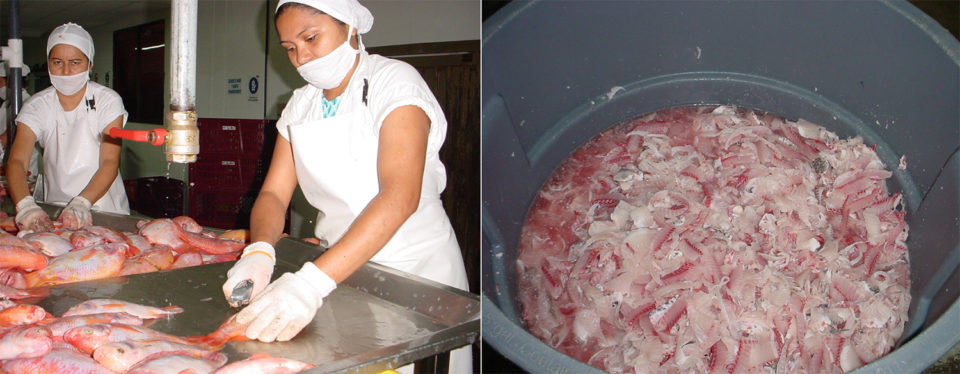
The TPWS used in this study was produced in the Laboratory\r\nof Seafood Technology and Quality Control (LAPESC/UFERSA) using filet residues\r\nof Nile tilapia (Oreochromis niloticus)\r\nprocessing including head, bones, skin, fins and viscera. Five experimental\r\ndiets were formulated to be isocaloric and isoproteic and to attend the\r\nnutritional requirements of the species. The TPWS inclusion ranged from zero to\r\n6 percent of the diet. The overall low level of inclusion was due to the high\r\nlevel of crude lipid presented in the silage (37.4 percent).
For detailed information on the experimental design and\r\nculture conditions; fish silage production; diet formulation and feeding; and\r\nstatistical analyses, refer to the original publication.
Results and\r\ndiscussion
Regarding its proximate analysis, TPWS contained 83.8\r\npercent dry matter, 33.7 percent crude protein, 37.4 percent crude lipid, and\r\n21.5 percent ash based on dry matter. And for shrimp growth performance, no\r\ninteractions between system and diet were observed. Survival was not affected\r\nby system or diet and averaged over 85 percent in all treatments.
Feed conversion rates (FCR) had significantly lower values\r\n(1.35) in the BFT treatment compared to the CWS treatment (1.65). Following the\r\nsame trend, mean final weight and SGR were statistically influenced by the\r\nsystem but not by the diet, with the BS treatment having higher values (7.17\r\n grams and 2.01 percent daily) compared to the CWS treatment (6.35 grams and\r\n1.82 percent daily).
| \r\n Diet (% inclusion tilapia silage) \r\n | \r\n \r\n SGR (%/day) \r\n | \r\n \r\n Mean final weight (g) \r\n | \r\n \r\n Survival (%) \r\n | \r\n \r\n FCR \r\n | \r\n
| \r\n | \r\n | \r\n | \r\n | \r\n |
| \r\n 0 \r\n | \r\n \r\n 1.86 ± 0.20ns \r\n | \r\n \r\n 6.51 ± 0.76ns \r\n | \r\n \r\n 85.29 ± 17.18ns \r\n | \r\n \r\n 1.59 ± 0.37ns \r\n | \r\n
| \r\n 1.5 \r\n | \r\n \r\n 1.90 ± 0.14ns \r\n | \r\n \r\n 6.62 ± 0.60ns \r\n | \r\n \r\n 90.15 ± 6.27ns \r\n | \r\n \r\n 1.56 ± 0.10ns \r\n | \r\n
| \r\n 3 \r\n | \r\n \r\n 1.93 ± 0.18ns \r\n | \r\n \r\n 6.79 ± 0.80ns \r\n | \r\n \r\n 92.93 ± 9.74ns \r\n | \r\n \r\n 1.38 ± 0.29ns \r\n | \r\n
| \r\n 4.5 \r\n | \r\n \r\n 1.83 ± 0.23ns \r\n | \r\n \r\n 6.43 ± 0.94ns \r\n | \r\n \r\n 94.32 ± 4.30ns \r\n | \r\n \r\n 1.61 ± 0.15ns \r\n | \r\n
| \r\n 6 \r\n | \r\n \r\n 2.07 ± 0.11ns \r\n | \r\n \r\n 7.46 ± 0.56ns \r\n | \r\n \r\n 88.88 ± 13.94ns \r\n | \r\n \r\n 1.35 ± 0.23ns \r\n | \r\n
| \r\n System: Clear water \r\n | \r\n \r\n 1.82 ± 0.20b \r\n | \r\n \r\n 6.35 ± 0.54b \r\n | \r\n \r\n 87.50 ± 12.12ns \r\n | \r\n \r\n 1.65 ± 0.23b \r\n | \r\n
| \r\n System: Biofloc \r\n | \r\n \r\n 2.01 ± 0.12a \r\n | \r\n \r\n 7.17 ± 0.79a \r\n | \r\n \r\n 94.23 ± 6.25ns \r\n | \r\n \r\n 1.35 ± 0.18a \r\n | \r\n
Table 1. Growth performance of L. vannamei fed experimental\r\ndiets with increasing percentages of tilapia processing waste silage (TPWS) in\r\nclear-water and biofloc systems for 45 days.
\r\nNo interactions were observed (P > 0.05). Values are means (± standard\r\nerror) of treatments (diets or system); Different letters in columns denote\r\nsignificant differences between experimental systems with α = 0.05 level by\r\nTukey's HSD multiple range test; NS: not statistically different (P > 0.05);\r\nSGR: specific growth rate; FCR: feed conversion ratio.
Under the experimental conditions of our study – both\r\nbiofloc (BS) and clear-water (CWS) systems – the tilapia processing waste\r\nsilage (TPWS) could be included at the highest level (6.0 percent) without\r\nlosses in growth performance and survival. On the other hand, in BS conditions,\r\nshrimp had better performance compared to CWS, probably due to the continuous\r\navailability of natural food. This natural productivity is normally present as\r\nbacteria, microalgae, protozoa, nematodes, copepods and rotifers, all rich\r\nsources of lipids, vitamins and essential amino acids, as well as highly\r\ndiverse “native protein.”
The concept of “native protein” is related to protein\r\nsources without any previous treatment, mainly live feeds. Is important to note\r\nthat bacterial protein sources play an important role in the equilibrium and\r\nre-ingestion of particulate organic matter, and shrimp faeces are a form of\r\nconstant food supply through coprophagia. The colonization of the shrimp gut by\r\nbacteria has been shown to have positive effects, including improvements of the\r\nactivity of shrimp digestive enzymes and also the increase of the availability\r\nof extracellular enzymes acting as “natural probiotics.”
We found no literature references related to the use of TPWS\r\nin L. vannamei diets under\r\nbiofloc condition. Although low levels of silage were included in the diets due\r\nto the high lipid content in the fish silage, our highest inclusion level of 6\r\npercent still could represent a significant cost reduction in shrimp\r\nformulations. In a study with L.\r\nvannamei juveniles using clear water, some authors evaluated feeds\r\ncontaining (i) fish waste silage, (ii) fish waste silage with soybean meal and\r\n(iii) fish waste meal as a protein source. These authors reported that shrimp\r\nfed with diets containing fish waste silage combined with soybean meal gained\r\n0.7 grams per week higher than those fed with fish waste silage or fish waste\r\nmeal (0.3 grams per week).
It is important to note that these reported values are lower\r\nthan observed in our study (e.g. with biofloc conditions, at 0.9 grams per\r\nweek). Additionally, in our study the FCR values were 1.3 and 1.6 for BS and\r\nCWS, respectively, lower than the FCR values of 2.8 and 2.5 observed by other\r\nauthors using soy protein-based diets and low protein content diets,\r\nrespectively, both in biofloc conditions for L. vannamei.
In contrast with our work, other authors evaluated shrimp\r\nsilage in juvenile tilapia (O. niloticus)\r\ndiets and concluded that it is possible to include 2.75 percent of shrimp\r\nsilage, reducing the diets costs by 3.3 percent without losses in fish\r\nperformance. Similarly, other researchers tested shrimp head silage\r\n(approximately 40 percent protein) as a substitute for fishmeal in tilapia\r\ndiets at 0, 33.3 percent, 66.6 percent and 100 percent dietary levels. Their\r\nresults indicate that shrimp silage could replace 100 percent of the fishmeal,\r\nwith economic advantages and without sacrificing feed quality.
Perspectives
\r\n\r\n\r\n\r\n\r\n\r\n\r\n\r\n\r\n\r\n\r\n\r\n\r\n\r\n\r\n\r\n\r\n\r\n\r\n\r\n\r\n\r\n\r\n\r\n\r\n\r\n\r\n\r\n\r\n\r\n\r\n\r\n\r\n\r\n\r\n\r\n
Our results under the experimental conditions tested showed\r\nthat the inclusion of tilapia processing waste silage (TPWS) in L. vannamei diets was possible up\r\nto 6 percent without compromising shrimp performance and survival. In addition,\r\nshrimp raised in BS had better growth performance as compared to CWS.
Source : Global Aquaculture Alliance

Ditulis oleh
Tim Minapoli
Kontributor
Pakar di bidang akuakultur dengan pengalaman lebih dari 15 tahun. Aktif berkontribusi dalam pengembangan industri perikanan Indonesia.