

Results in shrimp growth for different compensatory degrees\r\nwhen compared to the control treatment (B). (A) over-compensation; (C) full\r\ncompensation; (D) partial compensation; (E) no compensatio...
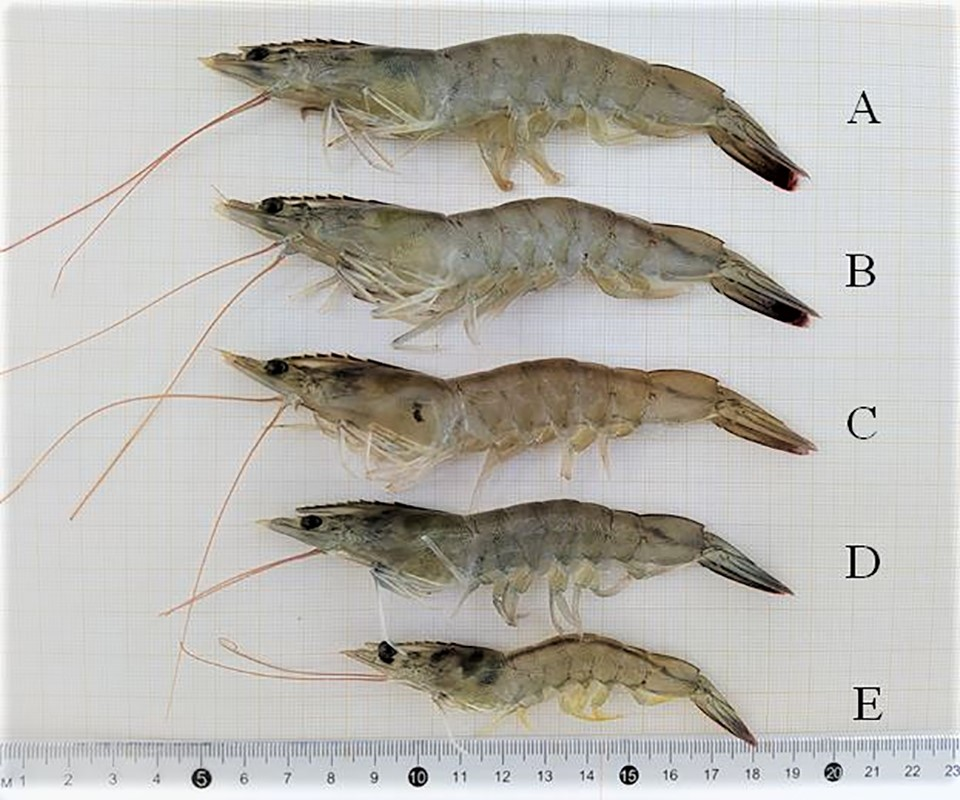
Results in shrimp growth for different compensatory degrees\r\nwhen compared to the control treatment (B). (A) over-compensation; (C) full\r\ncompensation; (D) partial compensation; (E) no compensation.
One of the potential management measures to improve shrimp\r\nproduction is the application of biofloc technology (BFT), which brings several\r\nproduction advantages compared to the traditional systems in ponds. BFT systems\r\nimprove water quality, because there is no water renewal to consequently reduce\r\nor eliminate effluents.
Additionally, these systems make it possible to increase\r\nstocking density, improve biosafety and remove nitrogen compounds through\r\nabsorption by the microorganism community. This community also acts as a food\r\nsupplement for the shrimp, providing a constant feed supply 24 hours a day and\r\nalso enabling a reduction in the protein levels in any manufactured feeds used.
Compensatory growth is defined as a physiological process\r\nwhere the organism goes through a rapid phase of growth after a restricted\r\nperiod of development. It varies according to the species, life stage,\r\nenvironmental conditions, severity and duration of restriction as well as how\r\nthe organism responds once improved or ideal culture conditions are restored.\r\nCompensatory growth has been explored with several aquaculture species\r\n(including shrimp) under different conditions, including feed restriction,\r\nhypoxia, high densities and temperatures, and exposure to toxic compounds. It\r\ncan occur at varying degrees (Fig. 1), according to the classification below\r\nfrom Ali et al. (2003):
1) Full compensation, where organisms that have\r\nsuffered some deprivation reach the same weight as animals that remained under\r\nadequate conditions.
2) Partial compensation, where animals that have undergone\r\nrestriction present rapid growth rate and may have better feed conversion\r\nratios during the recovery period, but do not reach the same weight of animals\r\nkept in adequate, control conditions.
3) Over-compensation, where animals that have\r\nexperienced the restriction reach a larger weight than the control animals.
4) No compensation, when animals that have suffered some\r\nstress do not grow anymore when the optimal conditions are re-established.
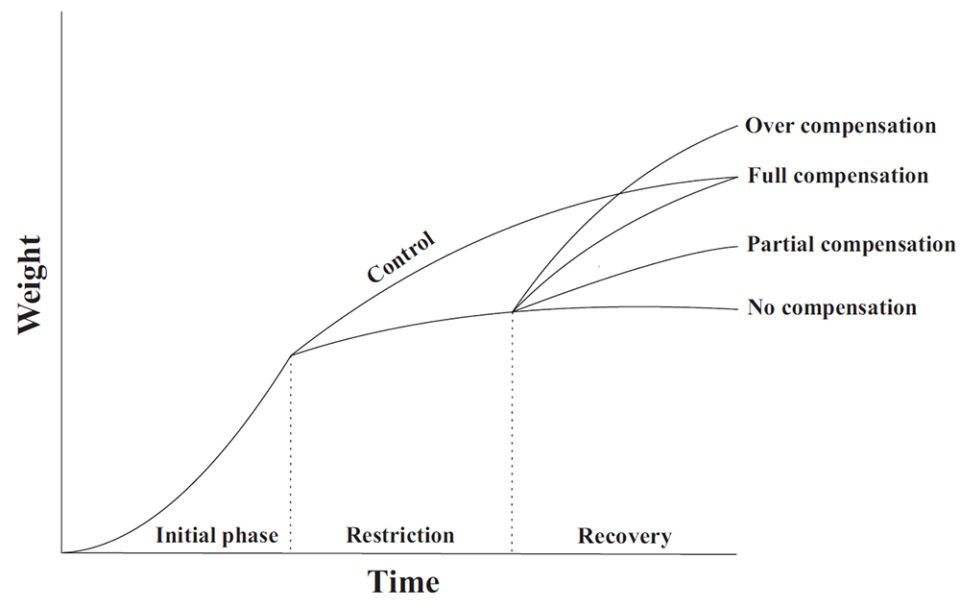
Fig. 1: Theoretical patterns of compensatory growth for\r\nshrimp in a BFT system. Adapted from Ali (2003).
The production of Pacific white shrimp (Litopenaeus vannamei)\r\nin BFT systems has been growing in Brazil, mainly in the South and Southeast\r\nregions. In these regions, production is often limited due to low temperatures\r\nduring the autumn and winter seasons. Thus, the evaluation of compensatory\r\ngrowth after re-establishment of optimal temperatures for the species would\r\nallow the production of two or more annual harvests despite the low growth\r\nrates experienced during the autumn and winter.
In addition to exploring compensatory growth from\r\ntemperature changes, an evaluation of the effects of this process involving\r\nfeed management is relevant, because manufactured feed is the main production\r\ncost – as much as 60 percent – in intensive shrimp farming. Therefore, the use\r\nof feed restriction as a trigger for subsequent compensatory growth could be a\r\nstrategy for reducing feed requirements and costs.
We carried out a study to evaluate the occurrence of\r\ncompensatory growth in L. vannamei shrimp at different temperatures\r\nand under feed restriction at 28 degrees-C. It was conducted at the Marine\r\nStation of Aquaculture (EMA), of the Institute of Oceanography, Federal\r\nUniversity of Rio Grande in Southern Brazil.
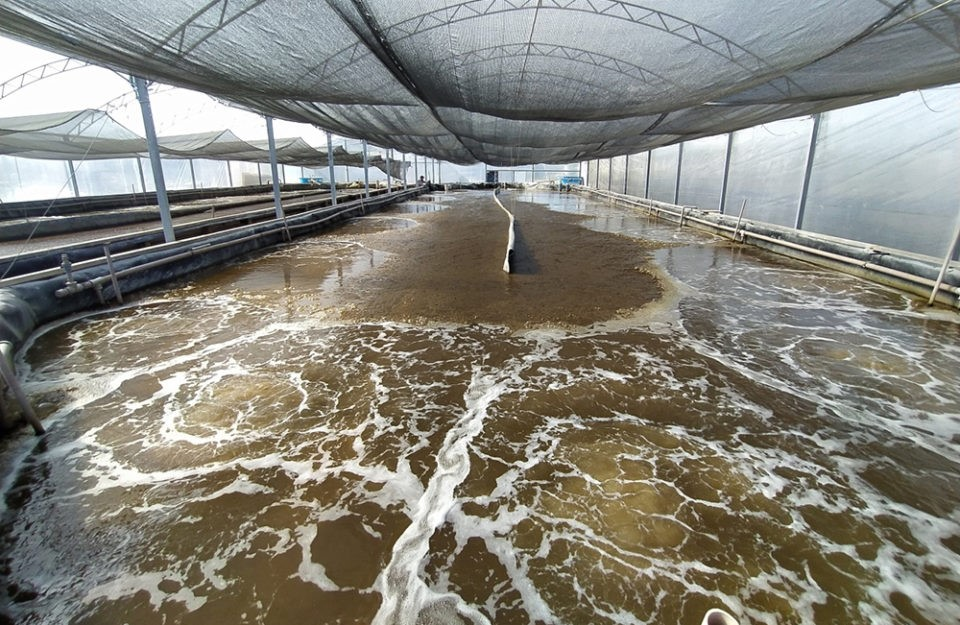
Fig. 2: View of a greenhouse where L. vannamei are\r\nreared in a BFT system at Marine Station of Aquaculture (EMA), where the\r\nanimals and biofloc inoculum for this study were obtained.
Study setup
L. vannamei juveniles (initial weight 1.78 grams ±0.38)\r\nwere initially stocked at a density of 300 shrimp per cubic meter. All of the\r\nexperimental units were filled with 10 percent of their total volume with biofloc-rich\r\nwater from a grow-out raceway. Two treatments were used – temperature and feed\r\nrestriction – in the 65-day trial, which was divided into two phases: (1) a\r\nrestriction period and a recovery period.
To evaluate the compensatory growth at different\r\ntemperatures (Experiment 1), three treatments (in triplicate) were used, where\r\nthe animals were exposed to three temperatures (20, 24 and 28 degrees-C) during\r\nthe first phase and, subsequently, all the experimental units were placed at 28\r\ndegrees-C for 30 days (second phase – recovery).
Regarding food restriction (Experiment 2), two treatments\r\n(in triplicate) were used: (1) control, where the animals received 100 percent\r\nof the recommended feed during the entire experimental period; and (2)\r\nrestriction, where the animals received only 40 percent of the amount of feed\r\noffered to the control group in the first 35 days of the experiment (first\r\nphase) and, then were fed at 100 percent like the control group (second phase –\r\nrecovery). All experimental units were maintained at 28 degrees-C during\r\nExperiment 2.
In both experiments, the animals were fed with a 38 percent\r\nprotein commercial shrimp diet (Guabi®) twice a day using feeding trays.
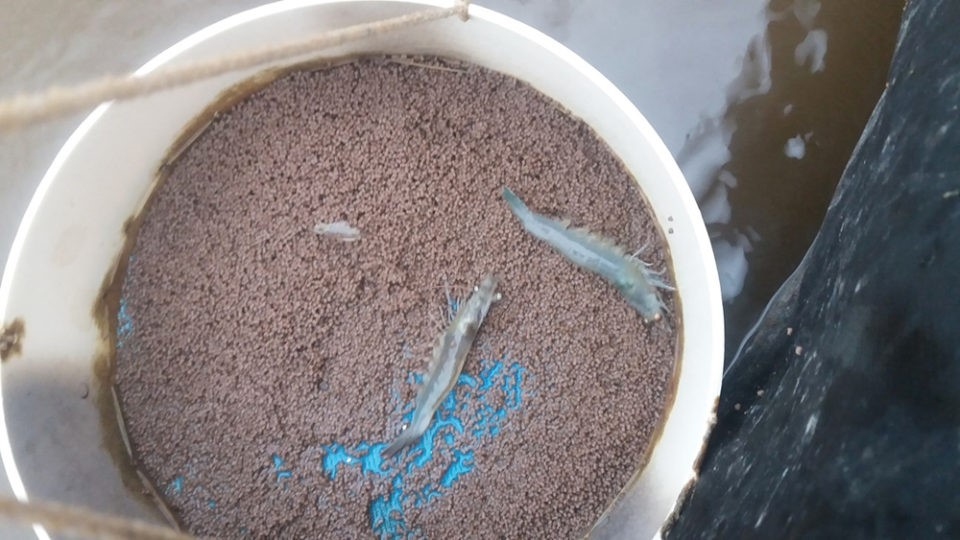
Fig. 3: View of a feed tray used to apply and control feed\r\nconsumption during the study.
During the study, water temperature, dissolved oxygen,\r\nsalinity, and pH were monitored twice a day. Total ammonia, nitrite and\r\nalkalinity were monitored three times a week, while nitrate, phosphate and\r\ntotal solids were monitored once a week. The alkalinity and pH were corrected\r\naccording to Furtado et al. (2011) using hydrated lime to maintain\r\nconcentrations higher than 150 mg/L and 7.2, respectively.
Results and\r\ndiscussion
Water quality parameters – including dissolved oxygen\r\nconcentrations, salinity, pH, ammonia, nitrite nitrate, alkalinity, total\r\nsuspend solids and phosphate – were maintained within acceptable levels\r\nfor L. vannamei throughout the study.
For Experiment 1, at the end of the first and second phases,\r\nanimals in the 20 and 24 degree-C treatments presented a significantly lower\r\nfinal weight than shrimp in for the 28 degree-C treatment (Fig. 4), indicating\r\nthat partial growth compensation had occurred but not full compensation. The\r\nsurvival rates between treatments did not present significant differences, and\r\nanimals in the 20 and 24 degree-C treatments also reached high weekly growth\r\nrates during the recovery period (Fig. 5).
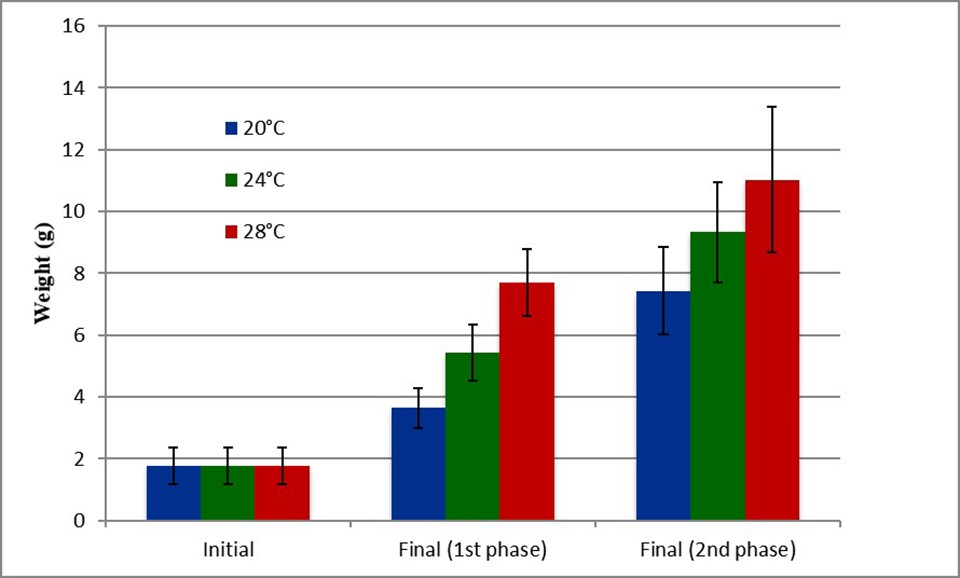
Fig. 4: Initial and final weights of shrimp from the first\r\nand second phases of the 20, 24 and 28 degree-C treatments.
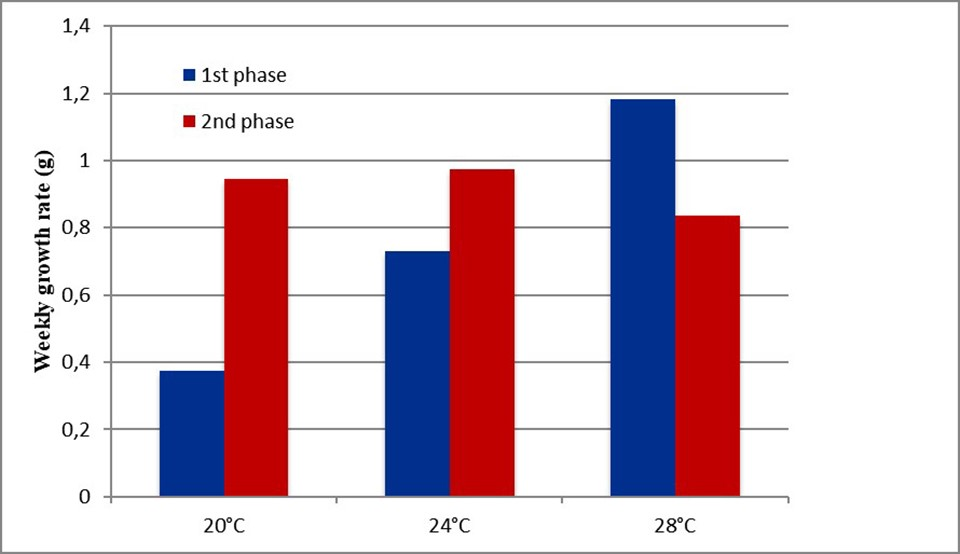
Fig. 5: Weekly\r\ngrowth rates (grams per week) of the shrimp during the first and second phases\r\nof the 20, 24 and 28 degree-C treatments.
For Experiment 2, at the end of phase 1 (food restriction),\r\nanimals in the treatment that received 40 percent of the feed had a\r\nsignificantly lower final weight and the survival rate was not affected by the\r\nfeed restriction. At the end of the second phase (recovery), the final weights\r\ndid not present significant differences, indicating that full compensation had\r\noccurred once the optimal conditions were re-established.
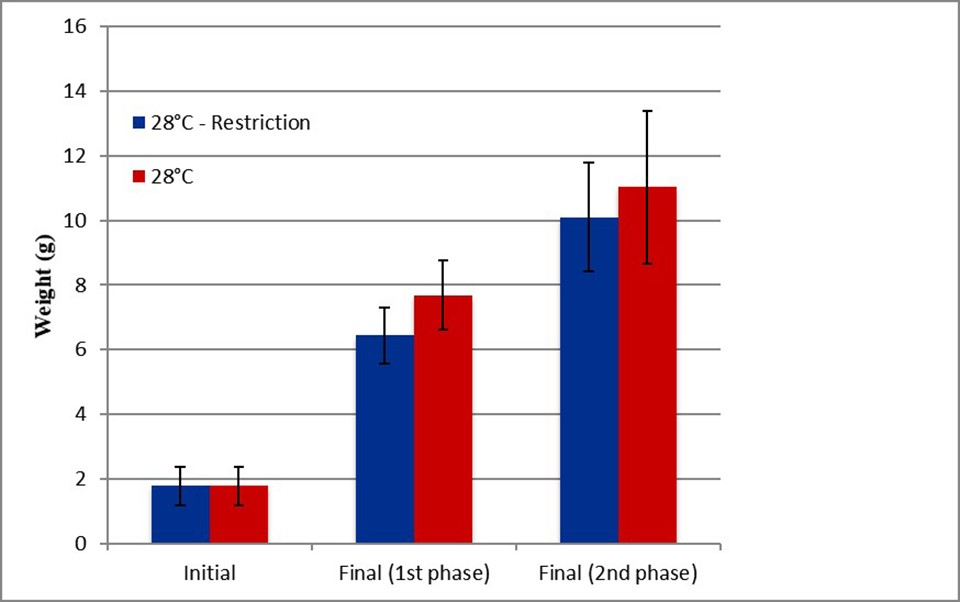
Fig. 6: Initial and final weights of shrimp from the first\r\nand second phases of the control group (red) and the treatment that had feed\r\nrestrictions (blue).
Conclusions
In regions with subtropical or temperate climate where\r\nshrimp production is limited by low temperatures during autumn and winter –\r\nsuch as southeast and southern Brazil – it is possible to maintain L.\r\nvannamei at low temperatures for a long time with low growth rates and\r\nsubsequent partial growth recovery. In this case, survival is not affected and\r\nthe shrimpthat have been subjected to feed restrictions subsequently exhibit\r\nrapid growth rates.
\r\n\r\n\r\n\r\n\r\n\r\n\r\n\r\n\r\n\r\n\r\n\r\n\r\n\r\n\r\n\r\n\r\n\r\n\r\n\r\n\r\n\r\n\r\n\r\n\r\n\r\n\r\n\r\n\r\n\r\n\r\n\r\n\r\n\r\n\r\n\r\n\r\n\r\n\r\n\r\n\r\n\r\n\r\n\r\n\r\n\r\n\r\n\r\n\r\n\r\n\r\n\r\n\r\n\r\n\r\n\r\n
Regarding feed restriction, it is possible to reduce the\r\namount of feed offered during a growing period to reduce feed costs and to\r\nimprove water quality. In this case, the shrimp may show complete compensatory\r\ngrowth. This process is facilitated in BFT systems where shrimp have natural,\r\nsupplementary feeding available 24 hours a day, thus reducing the negative\r\nimpact of feed restrictions.
Source : Global Aquaculture Alliance

Ditulis oleh
Tim Minapoli
Kontributor
Pakar di bidang akuakultur dengan pengalaman lebih dari 15 tahun. Aktif berkontribusi dalam pengembangan industri perikanan Indonesia.