

Diesel and other internal combustion engines have much lower\r\nenergy efficiencies than do electric motors (Table 1), but end-use energy from\r\nthese two types of power units have different relation...
Diesel and other internal combustion engines have much lower\r\nenergy efficiencies than do electric motors (Table 1), but end-use energy from\r\nthese two types of power units have different relationships with primary fuels.\r\nOn average, the efficiency of grid electricity is about 33 percent from primary\r\nfuel to meter at the point of use. When 1 Megajoule (MJ, a unit of measurement of\r\nenergy) of primary energy in coal or other fuel is combusted at a power\r\ngenerating plant, an average of about 0.33 MJ can be delivered to the 2-hp the motor of an electric aerator at a shrimp farm. Small motors are about 79\r\npercent efficient, and 0.26 MJ of energy (0.33 MJ ×0.79) will be available from\r\nthe aerator motor shaft – overall efficiency of 26 percent.
Boyd, aeration Pt. 2, Table 1
| \r\n Electric motors \r\n | \r\n \r\n Efficiency* (%) \r\n | \r\n \r\n Small (<25 hp), stationary internal combustion engine \r\n | \r\n \r\n Efficiency (%) \r\n | \r\n
| \r\n | \r\n | \r\n | \r\n |
| \r\n 1-4 hp \r\n | \r\n \r\n 78.8 \r\n | \r\n \r\n Ethanol (E100) \r\n | \r\n \r\n 20-25 \r\n | \r\n
| \r\n 5-9 hp \r\n | \r\n \r\n 84.0 \r\n | \r\n \r\n Liquid propane gas (LPG) \r\n | \r\n \r\n 25-30 \r\n | \r\n
| \r\n 10-19 hp \r\n | \r\n \r\n 85.5 \r\n | \r\n \r\n Gasoline \r\n | \r\n \r\n 20-30 \r\n | \r\n
| \r\n 20-49 hp \r\n | \r\n \r\n 88.5 \r\n | \r\n \r\n Diesel \r\n | \r\n \r\n 28-32 \r\n | \r\n
Table 1. Efficiencies of small, electric motors and small,\r\nstationary internal combustion engines.
\r\n*https://www.engineering toolbox.com/electrical-motor-efficiency-d_655.html.
In truth, the overall efficiency at which fuel energy is\r\nconverted to output shaft energy is similar for electric motors and internal\r\ncombustion engines. Although internal combustion engines operating on different\r\nfuels have similar efficiencies, fuels have different energy contents per unit\r\nvolume (Table 2). An engine running on ethanol will use a greater volume of\r\nfuel to produce the same energy output than will an engine operating on diesel\r\nfuel because ethanol has a lower energy content per liter than does diesel\r\nfuel. A fuel of lower energy content may be less economical or more economical\r\nthan the fuel of greater energy content, depending on the price of each fuel per\r\nliter.
Boyd, aeration Pt. 2, Table 2
| \r\n Fuel \r\n | \r\n \r\n Energy content (1) \r\n | \r\n \r\n Embodied energy factor \r\n | \r\n
| \r\n | \r\n | \r\n |
| \r\n Ethanol (E100) \r\n | \r\n \r\n 21.27 MJ/L \r\n | \r\n \r\n 1.49 (2) \r\n | \r\n
| \r\n Ethanol (E85) \r\n | \r\n \r\n 22.58 MJ/L \r\n | \r\n \r\n 1.34 (3) \r\n | \r\n
| \r\n LPG (liquid propane gas) \r\n | \r\n \r\n 23.48 MJ/L \r\n | \r\n \r\n 1.12 (4) \r\n | \r\n
| \r\n Gasoline (no ethanol) \r\n | \r\n \r\n 31.80 MJ/L \r\n | \r\n \r\n 1.36 (4) \r\n | \r\n
| \r\n Gasoline (10% ethanol) \r\n | \r\n \r\n 31.25 MJ/L \r\n | \r\n \r\n 1.37 (3) \r\n | \r\n
| \r\n Biodiesel \r\n | \r\n \r\n 33.32 MJ/L \r\n | \r\n \r\n 1.69 (5) \r\n | \r\n
| \r\n Diesel (No. 2) \r\n | \r\n \r\n 35.80 MJ/L \r\n | \r\n \r\n 1.28 (4) \r\n | \r\n
| \r\n Electricity \r\n | \r\n \r\n 3.6 MJ/kW·hr \r\n | \r\n \r\n 2.50 \r\n | \r\n
Table 2. Energy content (lower heating value) of common\r\nfuels and factors for including embodied energy in fuel energy calculations.
\r\n(1) https://afdc.energy.gov/fuels/fuel_comparison_chart_pdf.
\r\n(2)\r\nhttp://large.stanford.edu/courses/2014/ph240/dikeou1/docs/ethanolnetenergy.pdf
\r\n(3) Calculated
\r\n(4) http://www.iea.org/statistics/resources/manuals/
\r\n(5) https://.adfc.energy.gov/files/pdfs/3229.pdf
Internal combustion engines, like electric motors, should be\r\noperated at around 75 percent full load to assure greater service life and\r\nefficiency. While engines consume fuel under no load, the percentage full-load\r\nfuel used when an engine is idling at no load is lower than the percentage of\r\nfull-load electricity used by a motor running under no load (Fig. 1). The fuel\r\nconsumption of an engine declines with load in an approximately linear manner,\r\nand load can be estimated from fuel use. A typical, small diesel engine uses\r\nabout 0.23 L/hr. fuel per horsepower·hour (0.31 L/hr. per kilowatt·hour).
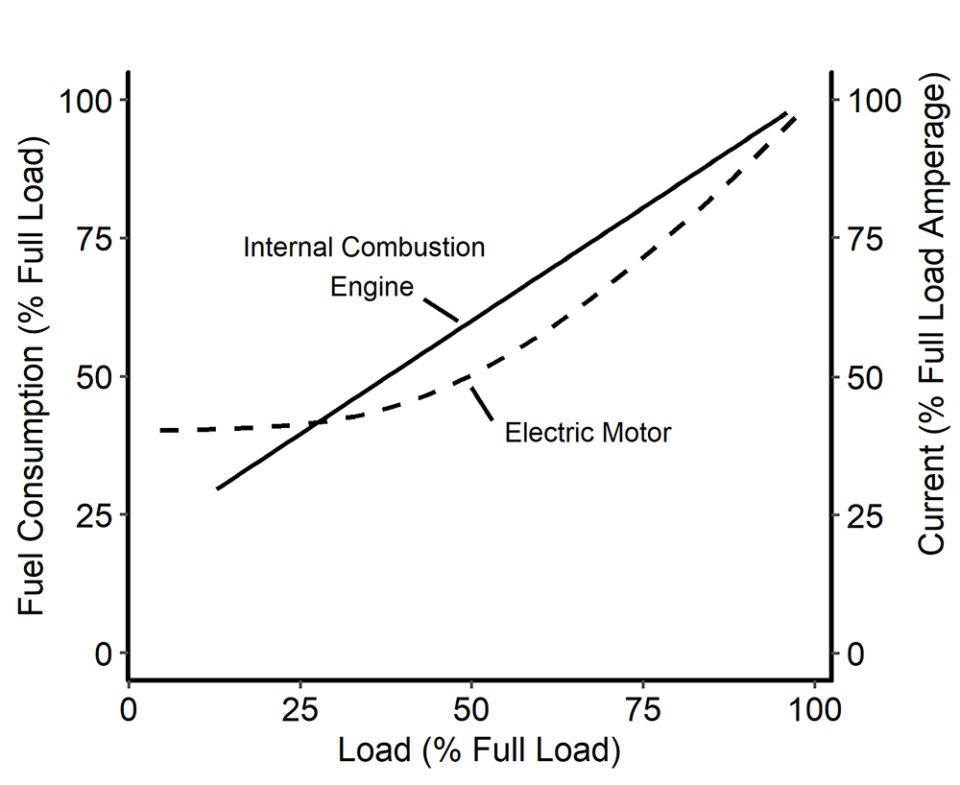
Fig. 1: Load versus fuel use by internal combustion engines\r\nand current use by electric motors (prepared with information from\r\nhttp://dieselserviceandsupply.com/Diesel_Fuel_Consumption.aspx and from\r\nhttp://energy.gov/sites/prod/files/2014/04/f15/10097517.pdf).
Output shaft speeds of small, internal combustion engines\r\nusually are around 3,000 rpm. The most common aerator in shrimp farming\r\nis the paddlewheel aerator, and paddlewheels usually are operated at speeds of\r\n60 to 120 rpm. Output shaft speeds of both electric motors and internal\r\ncombustion engines must be reduced for paddlewheel applications.
Drive trains
Propeller-aspirator-pump aerators and vertical-pump aerators\r\noperate at the speed of their motor shafts. Only a single coupling usually is\r\nnecessary between motor and aerator shaft. However, these aerator types are not\r\nas common in shrimp farming as the paddlewheel aerator.
There are three main types of paddlewheel aerators. The 1-\r\nand 2-hp Asian floating, electric paddlewheel aerators, have a motor with a two\r\ndirectional gear-reducer mechanism mounted on floats, with a shaft upon which\r\nthe paddlewheels are mounted extending from each side of the gear-reducer.
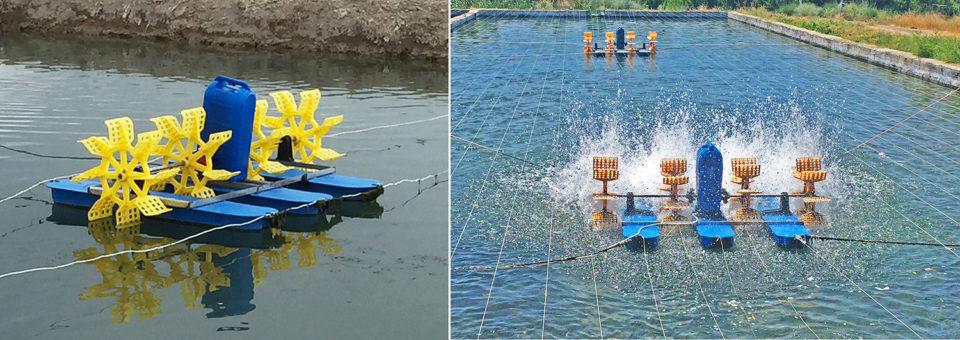
Views of Asia-style, small, electric, floating paddlewheel\r\naerators.
The second type, a 5- or 10-hp aerator, which will be called\r\na U.S. catfish pond paddlewheel aerator is used sometimes in shrimp ponds in\r\nthe western hemisphere. The motor of this kind of aerator is mounted on one end\r\nof a flotation platform, there is a gearbox or other speed reduction mechanism\r\nbetween the motor, and a hub upon which paddles are welded to form a\r\npaddlewheel.
Views of U.S. catfish\r\npond paddlewheel aerators.
In the first two kinds of aerators, the rotating shafts of\r\nthe paddlewheels must be supported by bearings or other mechanisms that allow\r\nrotation with a minimum friction loss. These aerators have relatively high efficiency of energy transfer from the motor shaft to paddlewheel shaft – the\r\nefficiency usually is 90 to 95 percent.
The third type of paddlewheel aerator is the so-called\r\nlong-arm aerators popular in Thailand and some other Asian countries. The\r\npaddlewheel is mounted on floats installed in the pond, and the engine or motor\r\nis mounted on the pond bank. The speed of the engine or motor output shaft\r\nusually is reduced by V-belts or chains and sprockets in which two shafts\r\n(often called jackshafts) are used to diminish the motor output shaft speed to\r\nthe desired paddlewheel speed.
The equation for relating speeds of driver shafts to driven\r\nshafts for pulleys (sheaves) and belts are:
D1 × RPM1 = D2 × RPM2
where D1 and D2 = pitch or flat-face diameters of\r\ndriver and driven pulleys, respectively, and RPM1 and RPM2 are speeds\r\nof the driver and driven shafts, respectively.
The equation for speed reduction by chains and sprockets is\r\nsimilar to that for speed reduction by belts and pulleys:
T1 / T2 = RPM1 / RPM2
where T1 and T2 = teeth on the driver and driven sprockets,\r\nrespectively, and RPM1 and RPM2 are sped off the driver and driven\r\nshafts, respectively.
The principle of the jackshaft mechanism often used to\r\nreduce motor speed when driving a paddlewheel aerator from an engine or motor\r\non the pond embankment can be explained by an example. A 12-cm pulley could be\r\nplaced on the motor shaft (1,735 rpm) and a 70-cm pulley mounted on a\r\nshort-driven shaft mounted in a metal frame. The driven shaft would turn at 297\r\nrpm [(12 cm)(1735 rpm) = (70)(RPM2); RPM2 = 297] which is still too fast\r\nfor the paddlewheel.
The first driven shaft could have a 15-cm pulley attached to\r\nit and connected by a belt with a 50-cm pulley to a second shaft mounted in the\r\nmetal frame. The second driven shaft would rotate at 89 rpm [(15 cm)(297 rpm) =\r\n(50 cm)(RPM2); RPM2 = 89] – a speed suitable for the paddlewheel. The two\r\njackshafts would have to be firmly mounted in bearings supported in a metal\r\nframe beside the motor shaft.
The output shaft of the jackshaft mechanism must be\r\nconnected by a driveshaft to the aerator shaft. The drive shaft must extend\r\ndownward at an angle to the shaft of the paddlewheel aerator mounted on floats\r\non the pond. This usually is accomplished by connecting shafts with the aid of\r\nuniversal joints. At many farms, directional gear mechanisms also are used in\r\nthe drive train to allow power to be distributed to multiple floating\r\npaddlewheels.
The devices used to slow rotation speeds, connect shafts,\r\nand change directions of power transmission in the drive train incur energy\r\nlosses. Typical efficiencies are V-belt drives, 90 to 95 percent; roller chain drives, 95 to 98 percent;\r\ngearboxes, 85 to 90 percent. Energy loss is small (~1 to 2 percent) in\r\ncouplings that are properly designed and installed, but misalignment of\r\ncouplings and vibrations in shafts results in much larger losses of energy.
At Asian shrimp farms, the shafts between the driver shaft\r\nof the jackshaft mechanism and the aerator shaft usually is a long, 3.75 to 5\r\ncm diameter galvanized water pipe which vibrates considerably and misalignment\r\nbetween shafts and couplings are obvious. There are no studies (to my\r\nknowledge) of energy loss in the drive trains of long-arm paddlewheel aerators.\r\nThe overall loss is likely at least 30 to 40 percent when only one aeration\r\nunit is operated from a motor or engine of a long-arm aerator. Greater losses\r\nno doubt are incurred with multiple long-arm aerators powered from a single-engine or motor.
Potential for energy\r\nconservation
The large, floating electric paddlewheel aerators used on\r\nU.S. catfish farms are about 30 percent more efficient in transferring\r\ndissolved oxygen than are floating, electric aerators used in Asia. Based on\r\nthe “rule of thumb” of 2.5 hp/MT shrimp for Asian paddlewheel aerators, the\r\naerator rate could be reduced to 1.75 hp/MT of shrimp by use of the U.S.-style\r\npaddlewheel aerators. The drive train efficiencies are probably about 70\r\npercent for long-arm aerators and 90 percent for Asian, floating, electric\r\npaddlewheel aerators. As a result, about 3.22 hp/MT of shrimp should be required\r\nfor long-arm paddlewheel aerators. Energy use would be 11.5 GJ/MT of shrimp\r\nwith Asian floating, electric aerators.
By using long-arm aerators, the energy use would be\r\nincreased by the ratio of 3.22 hp/MT/2.5 hp/MT, which would result in the energy use\r\nof 14.8 GJ/MT. Likewise, by use of the larger US floating paddlewheel aerators,\r\nenergy use could be reduced to 8.1 GJ/MT. According to an average aeration\r\nschedule of 16 hr./day and 80 days/crop, aerators would run for 1,440 hours/crop\r\nor 4,637 hp·hr for a diesel-powered, long-arm aerator. At fuel consumption of\r\n0.23 L/hp·hr, 1,067 liters of diesel fuel would be consumed per MT of shrimp.\r\nThis amounts to 38.2 GJ/MT of shrimp produced.
Perspectives
The estimates above are for direct energy use. Applying\r\nembodied energy factors for fuels from Table 2 give total energy use as the U.S.\r\nstyle, floating, electric paddlewheel aeration, 20.25 GJ/MT shrimp; Asian\r\nstyle, floating, electric paddlewheel aerator, 28.8 GJ/MT shrimp;\r\nelectric-powered, long-arm aerator, 37 GJ/MT shrimp; and diesel-powered,\r\nlong-arm aerator, 48.9 GJ/MT shrimp.
These calculations are based on certain assumptions and\r\nobviously subject to uncertainty, but they suggest that the efficiency of\r\nshrimp pond aeration could be improved to save a considerable quantity of\r\nenergy. Assuming that 4 million MT of shrimp are produced in aerated ponds,\r\neach 1 GJ/MT reduction in energy use would reduce energy use in penaeid shrimp\r\nfarming by 4 million GJ or roughly 830 million kW·hr (71,367 MT of oil or\r\n488,234 barrels of oil equivalent).
\r\n\r\n\r\n\r\n\r\n\r\n\r\n\r\n\r\n\r\n\r\n\r\n\r\n\r\n\r\n\r\n\r\n\r\n\r\n\r\n\r\n\r\n\r\n\r\n\r\n\r\n\r\n\r\n\r\n\r\n\r\n\r\n\r\n\r\n\r\n\r\n\r\n\r\n\r\n\r\n\r\n\r\n\r\n\r\n\r\n\r\n\r\n\r\n\r\n\r\n\r\n\r\n\r\n\r\n\r\n\r\n\r\n\r\n\r\n\r\n\r\n\r\n\r\n\r\n\r\n\r\n\r\n\r\n\r\n\r\n\r\n\r\n\r\n\r\n\r\n\r\n\r\n\r\n
There would be both energy conservation and farm-level\r\neconomic benefits to improving the energy efficiency of shrimp pond aeration.
Source: Global Aquaculture Alliance

Ditulis oleh
Tim Minapoli
Kontributor
Pakar di bidang akuakultur dengan pengalaman lebih dari 15 tahun. Aktif berkontribusi dalam pengembangan industri perikanan Indonesia.