

Technology that had its genesis in a search for an obesity\r\ntreatment could end up helping fish grow faster – without requiring more feed.Automated egg-sorting technology developed by from Tucson,\r...
Technology that had its genesis in a search for an obesity\r\ntreatment could end up helping fish grow faster – without requiring more feed.
Automated egg-sorting technology developed by from Tucson,\r\nAriz.-based GenetiRate is being tested by prominent aquaculture\r\ncompanies and showing promising results.
Explaining GenetiRate’s approach, Benjamin Renquist, the\r\ncompany’s president, pointed out that some people eat a lot but don’t gain\r\nweight, a consequence of fundamental differences.
“Some people’s cells, to stay alive, require a lot of\r\nenergy. Some people’s cells, to stay alive, require very little energy. And the\r\nsame is true with fish,” he said.
To measure that difference in aquatic species, GenetiRate’s\r\npatented method determines the level of the biochemical NADH (nicotinamide\r\nadenine dinucleotide) present in an egg or via biopsy in a mature living\r\norganism. NADH is central to metabolism. If more is present, the metabolic rate\r\nis higher.
That higher metabolism can manifest itself in different\r\nways, something Renquist discovered when he worked with zebra fish in an\r\nattempt to identify genes that could cause weight loss. He found that zebra\r\nfish eggs that resulted in heavier fish were those with higher initial levels\r\nof NADH.
“That increase in NADH production that we were measuring was\r\nactually an increase in growth rate,” Renquist said, adding that he licensed\r\nthe technology from the University of Arizona, where he did the research that\r\nlead to the discovery. GentiRate then developed products based on that\r\ntechnology.
If the NADH reading is done on an egg or embryo, this\r\npicking of metabolic winners and losers happens before variations in feed can\r\nhave an effect. So, the test detects fundamental individual differences and can\r\nbe used to improve broodstock by, for instance, eliminating eggs that have a\r\nlower growth potential.
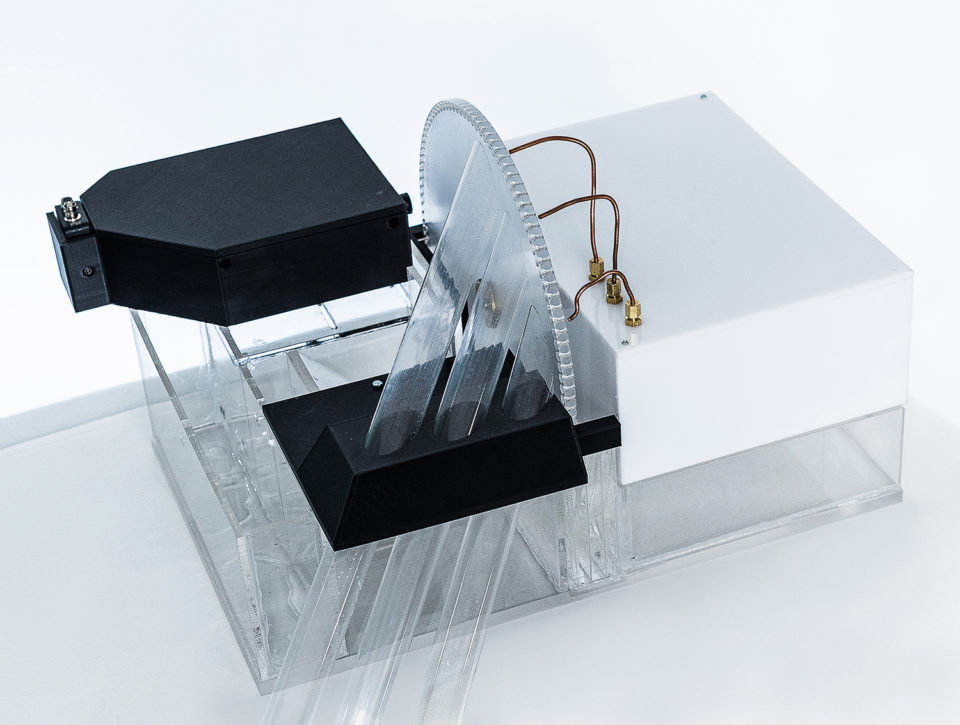
GenetiRate uses a proprietary diagnostic assay and sorter to\r\ntest various aquatic eggs, embryos, hatchlings and tissues to select aquatic\r\nspecies with greater growth potential and feed efficiency. Courtesy photo.
In practice, this is done by tagging eggs with a fluorescent\r\ndye that reacts with NADH, with more dye sticking to those embryos with more\r\nNADH. Then within a machine, a green laser sweeps briefly across the eggs. The\r\ndye glows orange, a visual signal that the human eye can see in the right\r\nlight.
Based on this laser-induced indicator, the system identifies\r\nembryos that have higher growth rates. This information can be used as desired,\r\nsuch as sorting and selecting better performing individuals for breeding.
To see what’s possible with this approach, consider that in\r\nthe 1920s, it took 16 weeks to get a newly hatched chicken to market. By the\r\nend of the century, that time had been cut in half, as had the feed needed,\r\naccording to data from the U.S. National Chicken Council. That is a model cited\r\nby Carsten Krome, a managing partner in Alimentos Ventures and co-founder of\r\nthe Hatch aquaculture accelerator. The company has invested in\r\nGentiRate, in part because of the poultry industry’s example.
“GenetiRate’s technology is jump-starting this development\r\nfor the aquaculture sector and has the potential to get aquaculture the same\r\nresults in a fraction of that time,” Krome said.
Robins McIntosh, executive VP of Bangkok-based Charoen\r\nPokphand Foods, said his company is considering GentiRate’s technology as a\r\ntool for determining the feed conversion ratio. FCR is difficult to assess,\r\naccording to McIntosh but is important since feed can be a significant part of\r\nthe cost in raising an aquatic species to maturity. A lower FCR can translate\r\ninto a better bottom line.
“The system works and does differentiate metabolic rates at\r\nearly fish stages,” McIntosh said of GentiRate’s products, hinting about plans\r\nto put the technology without specifying how his company might use the tool.
He noted, however, that the technology does require\r\nsignificant manpower in some applications. The problem is the plating of\r\nembryos, an issue Renquist said has been addressed by automating the analysis\r\nprocess for salmonids. Similar mechanization is on the way for tilapia and\r\nshrimp.
GentiRate plans to sell sorters and is looking at other\r\napplications of its methodology. Users will pay on a per test basis, Renquist\r\nsaid, and there could eventually be installations in many different locations.
\r\n\r\n\r\n\r\n\r\n\r\n\r\n\r\n\r\n\r\n\r\n\r\n\r\n\r\n\r\n\r\n\r\n\r\n\r\n\r\n\r\n\r\n\r\n\r\n\r\n\r\n\r\n\r\n\r\n\r\n\r\n\r\n\r\n\r\n\r\n\r\n
“This test can be applied in any aquatic species. It can\r\nthen be applied to land-based species,” he said. “It actually applies across\r\nall species.”
Source: Global Aquaculture Alliance

Ditulis oleh
Tim Minapoli
Kontributor
Pakar di bidang akuakultur dengan pengalaman lebih dari 15 tahun. Aktif berkontribusi dalam pengembangan industri perikanan Indonesia.