

Stress is a condition of high aerobic energy demand to\r\nsupply the body’s maintenance mechanisms during activation for adaptation and\r\nresistance of the body to stressful conditions. In aquacultur...
Stress is a condition of high aerobic energy demand to\r\nsupply the body’s maintenance mechanisms during activation for adaptation and\r\nresistance of the body to stressful conditions. In aquaculture, fish are\r\nsubjected both to acute stressors, such as handling, and chronic stressors,\r\nincluding environmental changes (such as temperature, water quality and\r\nsalinity), interactions with other fish and prolonged physical stress (such as\r\ntransport and increased densities).
When fish are subjected to stress, vigorous swimming\r\nincreases anaerobic glycolysis, leading to lactic acid production and a\r\nconsequent decline in muscle pH, which is accompanied by a faster onset of\r\nrigor mortis. The combination of stress and intense physical activity at\r\npre-slaughter can increase the degree of protein denaturation and, thus,\r\nincrease the access of proteolytic enzymes to protein substrates, leading to\r\nfaster muscle softening, which is detrimental for fish muscle.
In addition to denaturation and proteolysis, muscle proteins\r\nalso undergo oxidative damage after slaughter and subsequent meat aging.\r\nProtein oxidation is responsible for many biological changes, such as protein\r\nfragmentation or aggregation and decreased protein solubility, which affects\r\nmeat quality. Oxidation may also play a role in controlling the proteolytic\r\nactivity of enzymes and may be linked to meat tenderness.
However, endogenous antioxidant factors, such as enzymes,\r\ncontrol oxidation in muscle tissues. Several enzymes can neutralize meat\r\noxidation. A recent study has shown that the activities of these enzymes are\r\nsignificantly lower in pale, soft and exudative (PSE) chicken meat, which makes\r\nthis type of meat more susceptible to proteolysis and protein oxidation.
Thus, oxidative stress may be an important cell mechanism in\r\nthe process of meat softening. Oxidative metabolism has also been cited as a\r\npotential controlling factor of heat shock proteins (HSPs; a family of proteins\r\nproduced by cells in response to exposure to stressful environments),\r\nespecially because it protects structural proteins against oxidative stress and\r\nproteolysis, which are essential for tenderness. HSPs can act as molecular\r\nchaperones, facilitating protein folding, preventing protein aggregation, or\r\nconducting improperly folded proteins into specific degradation pathways, and\r\nHSPs also play a role in the refolding of damaged proteins for protection and\r\nrepair of cells and tissues. A variety of stresses, including oxidative stress,\r\nhave been linked to increased HSP expression in skeletal muscle.
The relationship between redox imbalance and meat quality in\r\nfish subjected to pre-slaughter stress is still unknown. This article – adapted\r\nand summarized from the original\r\npublication – evaluated the effect of depuration-related oxidative\r\nstress on the instrumental and sensory quality of Nile tilapia fillets.
Study setup
Experimental animals were obtained from farming cages in the\r\nCorvo River, Diamante do Norte Municipality, Paraná (PR), Brazil. Nile Tilapia\r\nof the Tilamax variety (±800 grams) were transported to the UEM/CODAPAR\r\nAquaculture Station in the municipality of Maringá-PR, and stocked into\r\n10-cubic-meter concrete tanks at a density of 5 kg per cubic meter. The fish\r\nwere kept in these tanks for 40 days to recover from the stress related to\r\ntransportation and for adaptation of the animals to the experimental structure.
After this period, an experiment was conducted in a 2×2 factorial\r\narrangement using density (60 and 300 kg per cubic meter) and depuration time\r\n(1 and 24 hours) as experimental factors with a total of 4 treatments with 20\r\nreplicates per treatment (where the fish was the experimental unit).
Initially, the animals were removed from the concrete tanks\r\nwith the aid of a hand net, and placed in 500-liter polyethylene tanks equipped\r\nwith water recirculation and an artificial aeration system, and one box was\r\nused per treatment. The fish were subjected to the following treatments: 60 kg\r\nper cubic meter for 1 hour; 60 kg per cubic meter for 24 hours; 300 kg per\r\ncubic meter for 1 hour; and 300 kg per cubic meter for 24 hours. We sampled 20\r\nfish per treatment. Of these, five fish were used for blood, muscle and liver\r\ncollection for cortisol analysis and gene expression, after which, these\r\nanimals were euthanized and filleted for meat quality analyzes. Instrumental\r\nquality analyzes of fillets were performed on 10 fish per treatment (including\r\nanimals submitted to blood and tissue samples). Sensory analysis was performed\r\nwith the remaining 10 fish per treatment. Whole skinless fillets were washed in\r\nchlorinated water at 5 ppm, vacuum packed and transported on ice to the\r\nlaboratory for meat quality analyses.
For detailed information on the experimental design;\r\ndetermination of cortisol levels; evaluation of gene expression, pH, color,\r\ntenderness and water-holding capacity analyses; sensory analysis; and\r\nstatistical analyses, refer to the original publication.
Results and discussion
In fish, acute stress exposure causes rapid elevation of\r\ncortisol levels, which are quickly restored to resting levels during recovery\r\nfrom stress. Our results show that the increase in the density of tilapia for a\r\nshort period of time increased serum cortisol levels regardless of the density\r\nbeing high or low. However, the maintenance of fish at low density allowed\r\nrecovery from stress over time, which did not occur at high density. In\r\ngeneral, plasma cortisol levels increase rapidly after exposure to acute\r\nstress, and normal conditions are restored within a few hours.
The maintenance of tilapia at high density for a long period\r\nof time apparently led to a chronic stress condition because the cortisol level\r\nin fish at a density of 300 kg per cubic meter for 24 hours was higher than the\r\nothers. High fish densities can affect fish performance and well-being through\r\ncrowding stress and/or changes in water quality. Chronic stress usually\r\ninvolves changing the energy metabolism to deal with the stressor agent, which\r\nsignificantly affects the immune system of the animal.
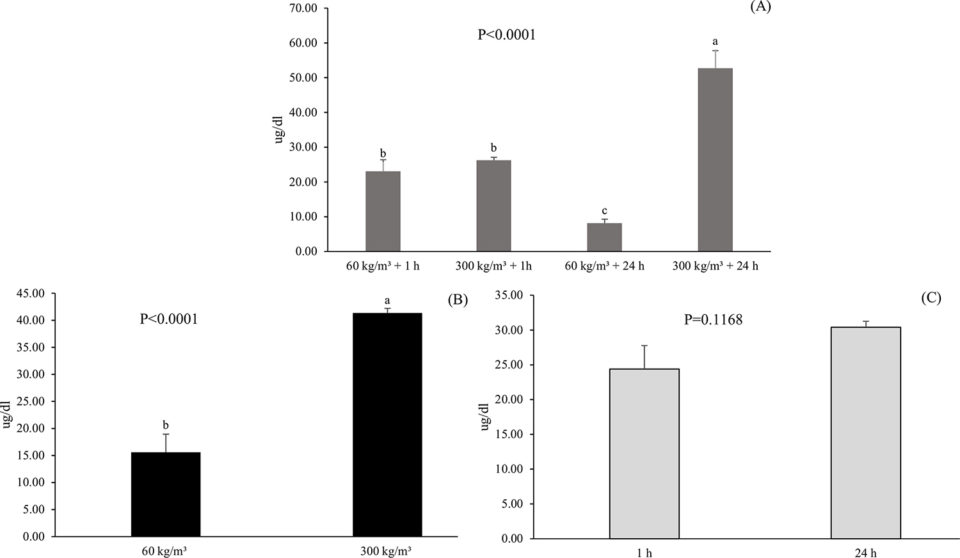
Fig. 1: Serum cortisol levels of Nile tilapia at different\r\ndensities (60 and 300 kg per cubic meter) and depuration times (1 and 24\r\nhours). Effects of the interaction density x depuration time (A) and the\r\nindividual factors (B and C). Lower case letters indicate a significant\r\ndifference.
During stress, elevated levels of plasma cortisol mobilize\r\nenergy stores primarily through genomic actions. In the present study, the\r\nexpression of the catalase (CAT) and glutathione peroxidase (GPx) enzymes was\r\nsimilar in both liver and muscle. The fish subjected to the lower stocking\r\ndensity and the shortest depuration time had the highest CAT and GPx expression\r\nlevels. The activity of these enzymes is an important indicator of the\r\nactivation of the cellular antioxidant defense system and protection against\r\noxidative stress.
Oxidative stress is the imbalance between the production and\r\ndegradation of oxygen reactive species (ROS), such as superoxide anion,\r\nhydrogen peroxide and lipid peroxides. The enzymatic inactivation of ROS in\r\nmuscle tissue is performed mainly by the superoxide dismutase (SOD), CAT and\r\nGPx enzymes. The decrease in enzyme activity may be related to alteration or\r\nreduction of gene expression and transcription. In our study, the most stressed\r\nanimals (at a density of 300 kg per cubic meter) presented lower expression of\r\nthe CAT and GPx enzymes. Oxidative stress may have led to a decrease in the\r\nactivity of antioxidant enzymes
The higher stress caused by high density resulted in lower\r\nexpression of the CAT and GPx enzymes, which may have generated more tender\r\nfillets. The oxidative stress was related to the process of meat softening due\r\nto greater proteolysis and protein oxidation. Oxidation leads to protein\r\nfragmentation or aggregation and decreased protein solubility, which affects\r\nmeat quality. Protein oxidation may also play a role in controlling the\r\nproteolytic activity of enzymes and may be linked to meat tenderness. PSE\r\nchicken meat has lower CAT, GPx and SOD activity than normal meats. Other\r\nauthors have reported that enzymes involved in oxidative stress, such as SOD or\r\nperoxiredoxin 6 (PRDX6), are negatively related to tenderness.
Changes in meat tenderness may also be related to the\r\nactivation of heat shock proteins (HSPs) in the muscle. In our study, animals\r\nsubjected to high density stress (300 kg per cubic meter) showed higher HSP70\r\nexpression and more tender fillets. In response to cell stress, such as\r\nhyperthermia, oxidative damage, physical injury or chemical stressors, the\r\nexpression of HSPs increases dramatically. HSPs delay the rate of muscle aging\r\nand decrease the degradation of myofibrillar proteins.
Studies on beef have identified HSPs as biomarkers of meat\r\ntenderness, and HSP activity differs between tender and tough meat. The lower\r\nactivity of HSP70 is associated with higher beef tenderness. In contrast, in\r\nour study the fish with higher HSP70 expression (high density = greater stress)\r\nproduced fillets with a less firm texture. Thus, the higher HSP70 expression\r\nwas apparently not enough to slow protein oxidation, demonstrating that this is\r\nnot as efficient in fish as it is in beef.
Another mechanism associated with decreased firmness in\r\nfillets may be pH decline. Fish subjected to high density (300 kg per cubic\r\nmeter) for 1 hour produced fillets with lower pH and shear force. Vigorous\r\nswimming under stress conditions leads to intense white muscle use, increasing\r\nanaerobic glycolysis and lactic acid production, which leads to a reduction in\r\nmuscle pH. Slaughtering fish stocked at high density (300 kg per cubic meter)\r\nafter 1 hour may have resulted in a faster use of glycogen with an increased\r\nanaerobic respiration rate, resulting in higher production of lactic acid and\r\nlower pH of the meat. The pH decline post-mortem may negatively affect the\r\ntexture of fillets as it alters protein solubility and increases the\r\nproteolysis and denaturation rate.
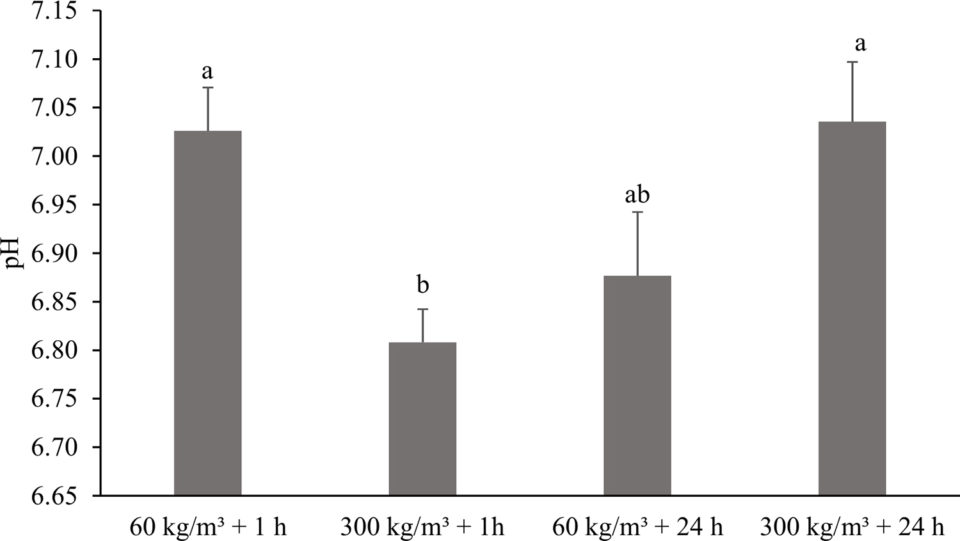
Fig. 2: pH values of Nile tilapia fillets at different\r\ndensities (60 and 300 kg per cubic meter) and depuration times (1 and 24\r\nhours). Lower case letters indicate significant difference. Vertical bars\r\nindicate standard error of the mean.
High density (300 kg per cubic meter) for 24 hours resulted\r\nin higher pH, which may be related to the depletion of glycogen reserves. The\r\nintense activity for a long period of time before slaughter causes the fish\r\nsuffer great wear and can deplete glycogen completely. The high consumption of\r\nglycogen by stress and the simultaneous removal of lactic acid by the\r\ncirculatory system in the living animal would leave it without reserve of\r\nglycogen, so that, after death, rigor mortis would proceed without production\r\nof lactic acid, with the pH remaining high, resulting in the absence of the\r\npre-rigor phase and a full rigor without decreasing pH, called alkaline rigor\r\nmortis.
High-density stress also led to the production of fillets\r\nwith higher lightness and lower redness. More stressed fish fillets can develop\r\nwith higher brightness, and changes in color. This may be related to a change\r\nin pH caused by stress, which induces a faster denaturation of the protein and\r\ntherefore a change in the pattern of light reflection in the muscle, an effect\r\nestablished quite early in the rigor process. These hypotheses were\r\ncorroborated in the present study, which evidenced the relationship between\r\nstress arising from higher density and the development of changes in fillet\r\ncolor. Other studies with fish have also reported an increase in lightness\r\nafter exposure to acute pre-slaughter stress.
Changes in the quality of fish fillets subjected to high\r\ndensity stress resulted in losses in the sensory acceptance of fillets because\r\ntilapia at the density of 300 kg per cubic meter presented fillets with less\r\ngeneral acceptability. In the correlation analysis, the acceptability was more\r\nrelated to the juiciness of the fillets. A previous study has shown that less\r\nstressed tilapia produces meat with higher water holding capacity (WHC), lower\r\nwater loss by pressure and higher juiciness. In the present study, the lower\r\nacceptance may be related to the changes observed in the instrumental quality\r\n(greater tenderness, greater lightness and lower redness). In fish, the best\r\nquality is firm and cohesive flesh with good water holding capacity. Therefore,\r\nexcessive fillet tenderness is highly undesirable as it can have a major impact\r\non consumer acceptance.
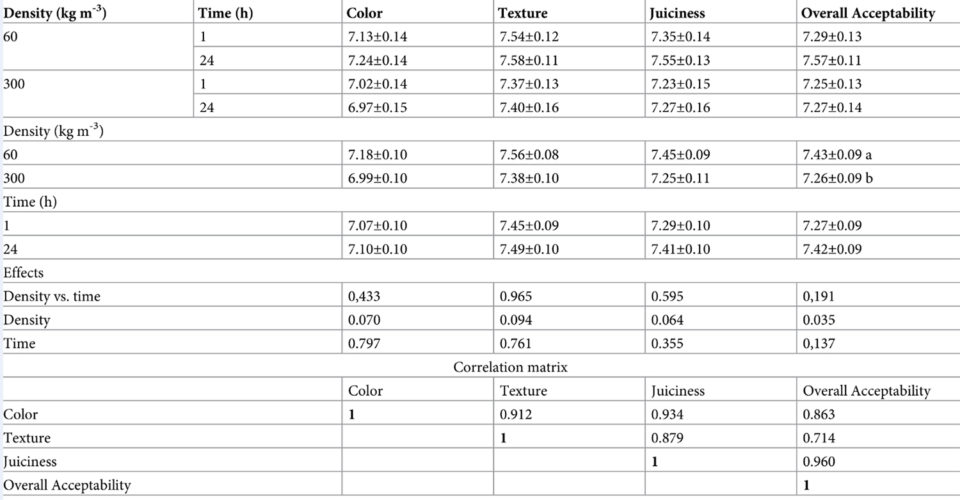
Table 1. Sensory profile and correlation matrix between the\r\nattributes of Nile tilapia fillets at different densities (60 and 300 kg per\r\ncubic meter) and depuration times (1 and 24 hours). Hedonic scale between 1\r\n(disliked extremely) and 9 (liked extremely). Data are expressed as the mean ±\r\nstandard error of the mean.
It should be noted that fish fillets subjected to lower\r\ndensity (60 kg per cubic meter) were more associated with the sensory attributes\r\nevaluated, while the fillets from more stressed fish (300 kg per cubic meter)\r\nwere inversely related to the attributes analyzed as demonstrated by the PCA.\r\nLikewise, a previous study with cod has also shown that less stressed fish\r\nobtain higher scores on the attributes of general acceptance, texture and\r\njuiciness.
Therefore, high density generated oxidative stress,\r\ndecreased the expression of antioxidant enzymes (CAT and GPx) and increased the\r\nexpression of HSP70 in tilapia. These changes negatively affected the quality\r\nof the fillets, which presented less firm texture, greater lightness, less\r\nredness and less sensory acceptability. To our knowledge, these are the first\r\ndata on the link between redox imbalance and deleterious changes in fish meat quality.\r\nThese results indicated stress should be controlled in the pre-slaughter period\r\nof fish, aiming to improve the quality of the meat and the lives of the\r\nanimals. Although the maintenance of fish at high density is feasible, it can\r\ncause sensory damage to the quality of fish fillets.
Perspectives
\r\n\r\n\r\n\r\n\r\n\r\n\r\n\r\n\r\n\r\n\r\n\r\n\r\n\r\n\r\n\r\n\r\n\r\n\r\n\r\n\r\n\r\n\r\n\r\n\r\n\r\n\r\n\r\n\r\n\r\n\r\n\r\n\r\n\r\n\r\n\r\n\r\n\r\n\r\n\r\n\r\n\r\n\r\n\r\n\r\n\r\n\r\n\r\n\r\n\r\n\r\n\r\n\r\n\r\n\r\n\r\n\r\n\r\n
High fish stocking density (300 kg per cubic meter) during\r\ntilapia pre-slaughter causes lower expression of the CAT and GPx enzymes but\r\nhigher expression of HSP70, resulting in the production of fillets with higher\r\ntenderness, higher lightness, lower redness and decreased sensory\r\nacceptability. Based on our results, low density and longer depuration times\r\nare recommended for decreased stress and improved quality of tilapia fillets.
Source : Global Aquaculture Alliance

Ditulis oleh
Tim Minapoli
Kontributor
Pakar di bidang akuakultur dengan pengalaman lebih dari 15 tahun. Aktif berkontribusi dalam pengembangan industri perikanan Indonesia.