

Repeated cycles accelerate changes of protein,\r\nmicrostructure, water distribution, qualityResults of this study showed that repeated freeze-thaw\r\ncycles accelerate the changes of protein, microst...
Repeated cycles accelerate changes of protein,\r\nmicrostructure, water distribution, quality
Results of this study showed that repeated freeze-thaw\r\ncycles accelerate the changes of protein, microstructure, water distribution\r\nand quality deterioration in Pacific white shrimp, especially after three\r\ncycles, with a threshold of six cycles.
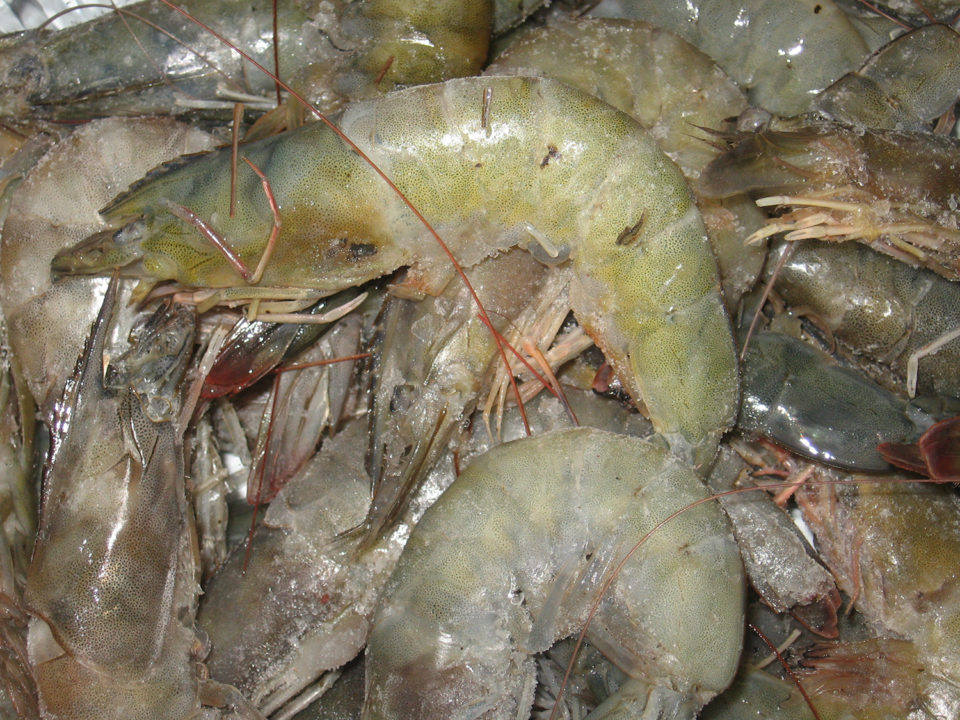
Shrimp is easily spoiled by protein degradation and\r\nbacterial and other activities and its shelf-life is also limited by melanosis\r\n(unpleasant, harmless black spots on the bodies of harvested, raw shrimp due to\r\na naturally occurring enzyme) or red stain due to the appearance of black or\r\nred spots during frozen storage, a common method for the preservation of\r\naquatic products.
Thawing is necessary for frozen food in order to facilitate\r\nthe subsequent food processing and, it is inevitable that temperature changes\r\nor repeated freezing-thawing (F-T) cycles will occur in retail stores,\r\nrestaurants or households. Unsold shrimp are usually frozen by retailers and\r\nthen sold as iced shrimp, which can also involve repeated F-T cycles and this\r\nlargely influences the integral structure and physicochemical quality of the\r\nshrimp.
Protein oxidation and denaturation are probably accelerated\r\nby lipid oxidation caused by F-T cycles and may decrease the edible quality\r\nthrough poor taste and discoloration. F-T cycles can destroy the texture of\r\nmeat and transfer or redistribute its moisture, which decreases the water\r\ncapacity and the sensory quality of the meat. As water is the main component of\r\nmeat products, especially in aquatic products, the quality and stability of the aquatic product will be influenced by the physical state of water to a large\r\nextent.
This article – adapted and summarized from the original (Lan\r\net al. 2019. Effect of the number of freeze-thaw cycles number on the quality\r\nof Pacific white shrimp: An emphasis on moisture migration and\r\nmicrostructure by LF-NMR and SEM. Aquaculture\r\nand Fisheries) – presents the results of a study with Pacific white shrimp\r\n(Litopenaeus vannamei) to investigate the maximum number of F-T cycles during\r\nstorage by physicochemical indexes, and determine the relationship between the\r\nchanges of water migration, muscle microstructure, protein degradation and\r\nquality in shrimp influenced by the number of F-T cycles.
The study was financially supported by China Agricultural\r\nResearch System (CARS-47-G26), Shanghai to promote agriculture by applying\r\nscientific and technological advances projects (2016No.1-1); Ability promotion\r\nproject of Shanghai Municipal Science and Technology Commission Engineering\r\nCenter (16DZ2280300); Key Laboratory of Refrigeration and Conditioning Aquatic\r\nProducts Processing, Ministry of Agriculture; and Rural Affairs. The project\r\nwas supported by Key Laboratory of Refrigeration and Conditioning Aquatic\r\nProducts Processing, Ministry of Agriculture and Rural Affairs (Grant No.\r\nKLRCAPP2018-11).
Study setup
Samples of fresh Pacific white shrimp weighing 1.6 kg\r\n(average weight of 12.0 ± 1.0 grams) were obtained from a local market in\r\nPudong (Shanghai, China) and euthanized with ice water in the laboratory within\r\n30 minutes. Subsequently, to simulate the temperature fluctuations or\r\nrepeated freeze-thaw cycles during commercial sale process and circulation,\r\nthey were stored at minus-20 degrees-C for 12 hours and then thawed with\r\ncrushed ice at 4 degrees-C for 12 hours. This sequence represented one F-T\r\ncycle and the thawed shrimp samples were subjected to a total of eight F-T\r\ncycles, and then analyzed by various techniques.
For detailed information on the experimental design; sample\r\npreparation; low-field nuclear magnetic resonance (LF-NMR) & magnetic\r\nresonance imaging (MRI); scanning electron microscopy (SEM) analysis; sodium\r\ndodecyl sulfate-polyacrylamide gel electrophoresis (SDS-PAGE) for protein\r\nextraction; physicochemical analyses including microbiological analysis and\r\nsensory analysis; and statistical analyses refer to the original publication.
Results and\r\ndiscussion
Results showed that, as the F-T cycles progressed,\r\nimmobilized water shifted to free water and the content of water in muscle\r\ntissue decreased. During repeated F-T cycles, the different size, and location\r\nof ice crystals formed during each freeze-thaw cycle damaged the protein\r\nnetwork and the reduction of water content was closely related to the damage of\r\ncell membranes and myofibrillar (muscle) protein caused by the repeated\r\nformation of ice crystals, especially after three cycles.
The damaged myofibrillar network made immobilized water\r\ndifficult to retain. Repeated F-T cycles could also cause the water to be\r\ncontinuously transferred from intracellular to extracellular regions and\r\nincrease the content of free water and drip (gravimetric) loss. The brightness\r\nof the pseudo-color diagram (Fig. 1) decreased from high to low with the\r\nincrease of F-T cycles. The changes were most evident after four F-T cycles,\r\nindicating that the water loss and quality deterioration became more serious.
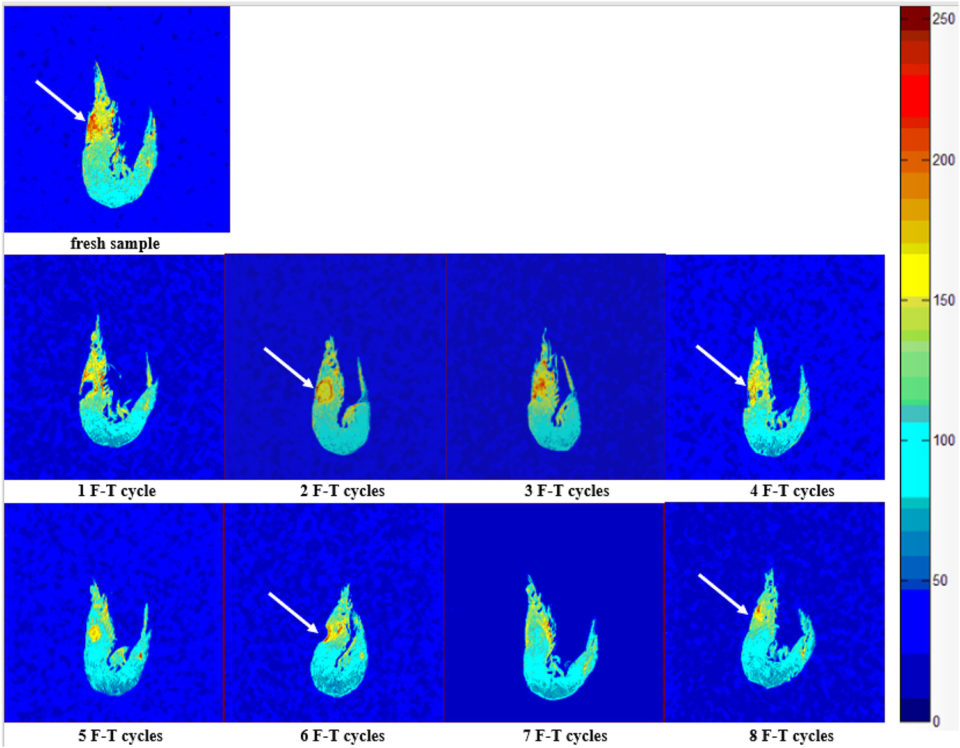
Fig. 1: Pseudocolor of 1H-MRI in Pacific white shrimp with\r\ndifferent freeze-thaw cycles.
The recrystallization of water causing mechanical damage of\r\nmuscle tissue and protein oxidative denaturation was the primary cause of\r\nwater migration and loss. The results indicated that F-T cycles induce water\r\nmigration and loss, especially after three F-T cycles, as compared to the fresh\r\nshrimp. And repeated F-T cycles more seriously damaged to the microstructure,\r\ntexture properties, and muscle protein especially after four F-T cycles (Fig.\r\n2).
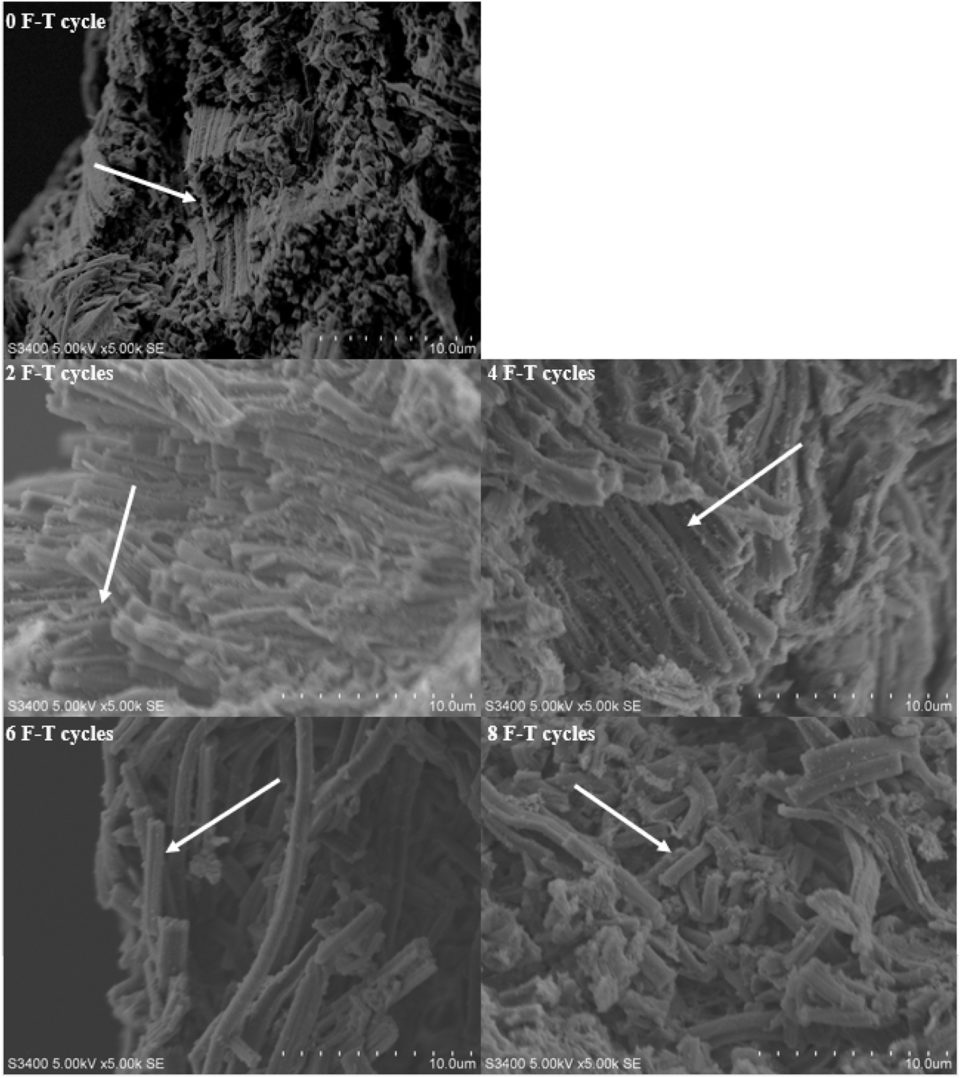
Fig. 2: Scanning electron microscopy micrographs\r\n(magnification: 5,000×) of the shrimp samples with different freeze-thaw\r\ncycles. The sample under 0 F-T cycle represented fresh shrimp.
Frozen storage leads to protein oxidative denaturation. For\r\nthe test of sodium dodecyl sulfate-polyacrylamide gel electrophoresis\r\n(SDS-PAGE), the decrease may be caused by the proteolysis (the breakdown of\r\nproteins into smaller polypeptides or amino acids), denaturation or oxidation\r\nof protein during F-T cycles. At the same time, the release of some enzymes may\r\nfacilitate the protein fragmentation, especially at the fourth F-T cycle,\r\ncaused by the disruption of muscle cells during repeated F-T cycles. The\r\nresults of SDS-PAGE indicated that protein fragmentation was accompanied by the\r\naggregation of protein during repeated F-T cycles and the protein oxidative\r\ndegradation was accelerated by increasing F-T cycles, especially after four\r\n F-T cycles (Fig. 3).
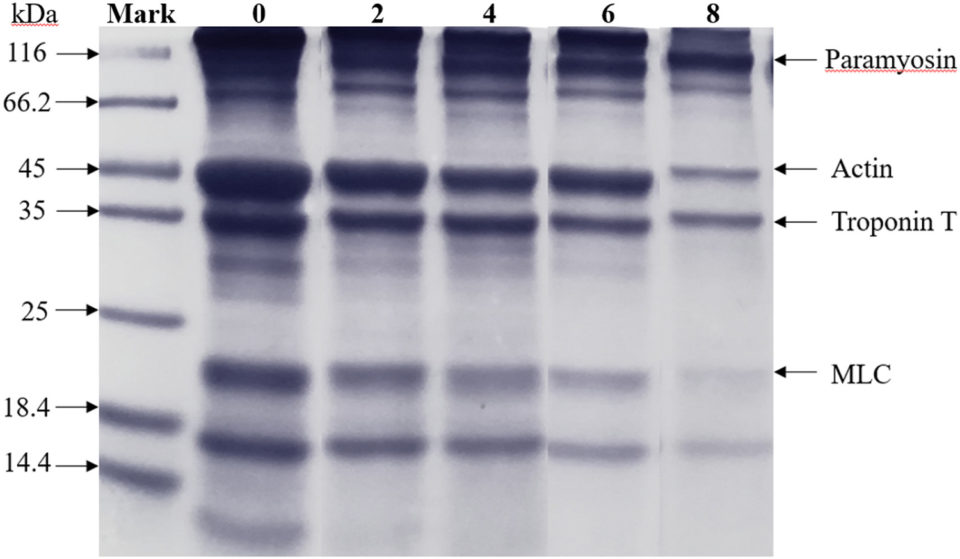
Fig. 3: SDS-PAGE patterns of muscle proteins in shrimp\r\ntreated with different freeze-thaw cycles. 0, 2, 4, 6, 8 at the top of the picture\r\nrepresent the number of F-T cycles. The sample under 0 F-T cycle represented\r\nfresh shrimp.
Results showed that repeated F-T cycles could cause a clear a linear decrease in the hardness of shrimp samples and the softening of shrimp\r\nmuscle during storage, which produced detrimental side effects in the textural\r\nproperties of shrimp. This decrease in texture properties caused by the\r\nrepeated formation of ice crystals was associated with the loss in the integrity of muscle fibers and the weakening structure of muscle, which implied lower resistance to shear force.
Compared to fresh shrimp samples, repeated F-T cycles were\r\nmore likely to accelerate the destruction in muscle fiber integrity, the\r\nincrease of drip loss and the deterioration of texture properties, especially\r\nin the first and second cycles.
The melanosis of shrimp is related to the role of polyphenol oxidase (PPO), an enzyme involved in the black spot formation in\r\ncrustaceans during postmortem storage. The increase in the number of F-T cycles\r\naggravated the release of PPO and the increase in PPO activity, especially\r\nafter the second F-T cycle (Fig. 4).
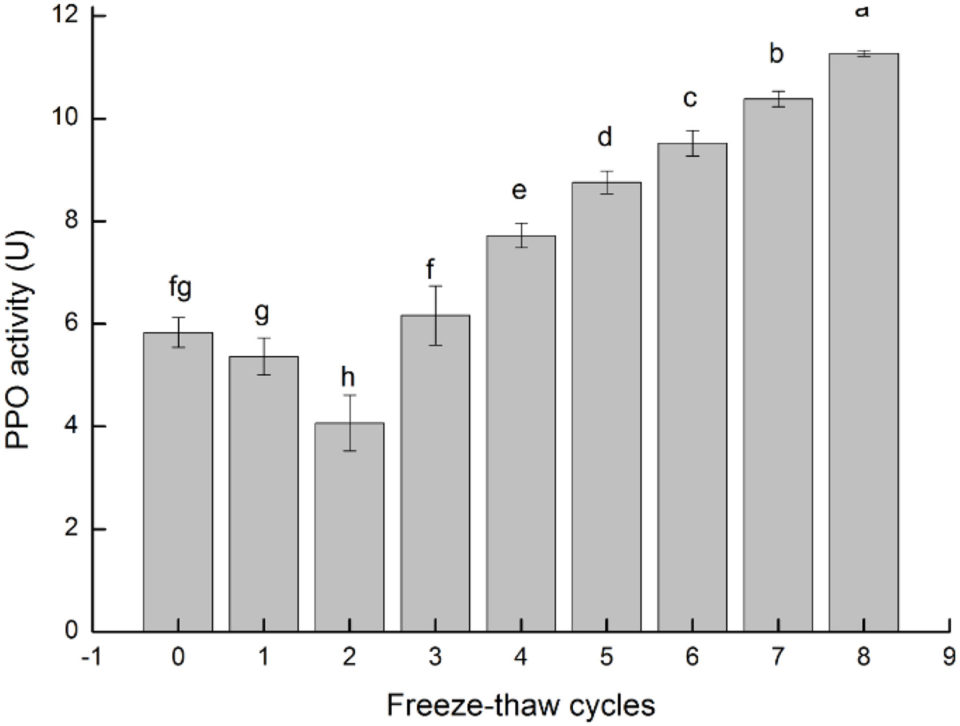
Fig. 4: Changes of PPO activity of Pacific white shrimp with\r\ndifferent freeze-thaw cycles.
Regarding changes in total volatile basic nitrogen (TVB-N;\r\nan important index of freshness) value, microbiological analysis, and sensory\r\nevaluation, the TVB-N value of 20 mg N/100 grams protein in shrimp generally\r\nrepresented the threshold of freshness and below 30 mg N/100 grams protein\r\nwas considered acceptable. TVB-N values were unacceptable following the sixth\r\nF-T cycle. These results revealed that F-T cycles could cause the oxidative\r\ndegradation of protein, especially after four cycles. For seafood products, the\r\nthreshold of freshness about TVC value is 5 lg CFU/g and a TVC value above 6 lg\r\nCFU/gram represents an unacceptable quality.
With the blackening, reddening, and putrification of samples\r\nduring repeated F-T cycles, sensory characteristics such as color and odor\r\ndeteriorated, which was reflected in the decrease in sensory scores. After\r\nthree F-T cycles, the sensory scores of samples decreased significantly and\r\nwere lower than 15 (acceptable threshold) after the sixth F-T cycle, which was\r\nconsistent with the change in color difference and texture. Based on these\r\nindicators, the quality of shrimps treated with different F-T cycles started to\r\ndeteriorate visibly at the third F-T cycle and became unacceptable at the sixth\r\nF-T cycle.
Perspectives
Results showed that multiple F-T cycles cause mechanical\r\ndamage of muscle tissue and protein oxidative denaturation, especially after\r\nthree F-T cycles, which prolonged relaxation time significantly. Immobilized\r\nwater and brightness of the pseudo-color diagram decreased. Protein aggregation\r\nwas measured from scanning electron microscope (SEM) and the result of SDS-PAGE\r\ndemonstrated the protein degradation was accelerated by multiple F-T cycles,\r\nespecially after four F-T cycles, and caused a sharp decrease in texture\r\nproperties.
In addition, the reformation of ice crystals caused by\r\nrepeated F-T cycles resulted in the deterioration of texture properties and\r\ncolor, which was closely related to the damage of muscle microstructure and PPO\r\nactivity.
\r\n\r\n\r\n\r\n\r\n\r\n\r\n\r\n\r\n\r\n\r\n\r\n\r\n\r\n\r\n\r\n\r\n\r\n\r\n\r\n\r\n\r\n\r\n\r\n\r\n\r\n\r\n\r\n\r\n\r\n\r\n\r\n\r\n\r\n\r\n\r\n\r\n\r\n\r\n\r\n\r\n\r\n\r\n\r\n\r\n\r\n\r\n\r\n\r\n\r\n\r\n\r\n\r\n\r\n
Consistent with TVC, TVB-N value and sensory score results,\r\nthe deterioration of color and texture properties became noticeable after three\r\n F-T cycles and unacceptable after six F-T cycles. The changes in sensory\r\nquality, TPA, TVB-N, TVC, protein degradation and nutritive value were not\r\nobvious in the first three F-T cycles, were noticeable after three F-T cycles,\r\nand were unacceptable after six F-T cycles.
Source: Global Alliance Aquaculture

Ditulis oleh
Tim Minapoli
Kontributor
Pakar di bidang akuakultur dengan pengalaman lebih dari 15 tahun. Aktif berkontribusi dalam pengembangan industri perikanan Indonesia.