

As Skretting explained, the FAO forecasts that by 2030 there\r\nwill be a 30 million tonne increase in aquaculture production, which will\r\nrequire an additional 45 million tonnes of feed r...
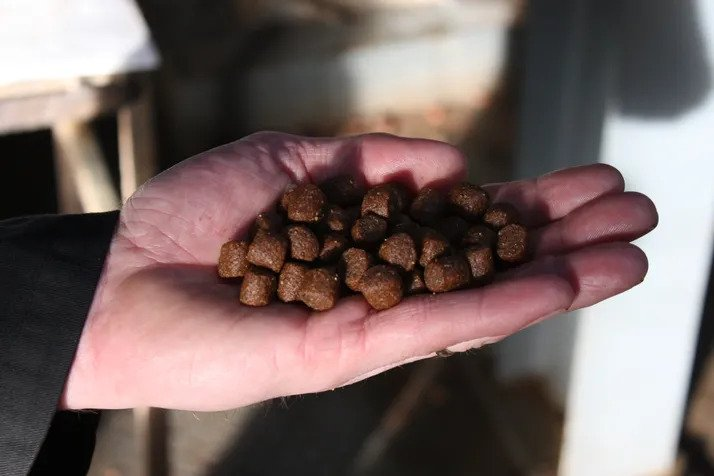
As Skretting explained, the FAO forecasts that by 2030 there\r\nwill be a 30 million tonne increase in aquaculture production, which will\r\nrequire an additional 45 million tonnes of feed raw materials. To ensure that\r\nthe sector can maximize its contribution to sustainably feeding a population\r\nthat will reach up to 10 billion people by 2050, there is a fundamental need to\r\novercome
Through its mission of "Feeding the\r\nFuture", the feed giant is focused on increasing the flexibility of\r\nthe macro- and micro-ingredients in its aquaculture feeds. A key aspect of this\r\nambition mission is to develop and support a circular bioeconomy, where\r\npreviously under-valued or under-utilized ingredients or nutrients can re-enter\r\nthe food chain.
Fitting closely with this ambition, Skretting is working\r\nwith companies developing alternative protein ingredients, one of which\r\nis Kiverdi, a California-based a company using unique NASA-inspired carbon transformation technology to solve\r\nglobal issues. Kiverdi’s CO2 aquafeed solution\r\nconverts CO2 into protein for use in aquaculture feed through a single cell\r\nbioprocessing. The company is working closely with Skretting’s parent\r\ncompany Nutreco, through its\r\ninnovation division NuFrontiers, and\r\nsee a bright collaborative future after the pilot phase.
“NuFrontiers and Skretting have been working closely with\r\nKiverdi through the different stages of development and fish trials are\r\nongoing,” says May-Helen Holme, salmonid nutrition department manager at\r\nSkretting Aquaculture Research Centre (ARC). “The protein produced using this\r\nprocess is concentrated and ideal for carnivorous fish. It also has the\r\npotential to significantly reduce the carbon footprint of our feed, which is\r\nsomething we are committed to doing.”
Kiverdi’s CO2 aquafeed technology uses proprietary\r\nbioreactors, CO2, nitrogen, hydrogen, water and nutrients that are combined\r\nwith biocatalysts in a gas process, where these different elements are\r\nconverted into protein-rich biomass. The CO2 can come from any industry\r\nsource that has been cleaned to food-grade, the same as is found in carbonated\r\ndrinks. The process uses renewable energy to further enhance the sustainability\r\ncredentials.
“CO2 aquafeed offers a protein feed solution that is\r\nnutritionally comparable to traditional fishmeal but can be scaled quickly,\r\nefficiently and without the need for wild-caught fish,” says Dr. Lisa Dyson, CEO, and founder of Kiverdi. “Our technology takes CO2 out of the air and\r\ninserts the carbon back into the food chain, driving a circular bioeconomy and\r\nreducing pressure on finite resources, like wild-caught fish. At Kiverdi, we\r\nshare a vision of a cleaner, more secure, and wholly sustainable tomorrow.”
While the application of sustainable novel ingredients in\r\naquafeeds – both through replacement and interchange – is recognized as a\r\nviable means to overcome the dependence on any single ingredient, the biggest challenge facing innovations in this space is reaching commercial scale.
Kiverdi and Skretting are optimistic that the extended value\r\nfor fish producers will see them jump on board and answer the rising consumer\r\ndemand for sustainable food.
\r\n\r\n\r\n\r\n\r\n\r\n\r\n\r\n\r\n\r\n\r\n\r\n\r\n\r\n\r\n\r\n
“We are excited to see what the future holds and are\r\ncommitted to our project with Kiverdi. From a sustainability viewpoint it’s a\r\nperfect protein,” says Viggo Halseth, chief innovation officer at Nutreco. “It\r\nrequires very little land, and can be produced close to consumption. Our planet\r\nis warming, largely caused by an excess of CO2 in the atmosphere. In\r\naddition, as the population continues to grow we are also approaching a global\r\nfood crisis. This technology holds a wealth of opportunity to be one of the\r\nmany solutions to these challenges of our time.”
Source: The Fish Site

Ditulis oleh
Tim Minapoli
Kontributor
Pakar di bidang akuakultur dengan pengalaman lebih dari 15 tahun. Aktif berkontribusi dalam pengembangan industri perikanan Indonesia.