

Tilapia that have not been treated with hormones appear to\r\nbe more robust against diseases such as tilapia lake virus, strengthening the argument to use males produced via more natural means.Tilapi...
Tilapia that have not been treated with hormones appear to\r\nbe more robust against diseases such as tilapia lake virus, strengthening the argument to use males produced via more natural means.
Tilapia are among the world’s most farmed finfish – with 6.3\r\nmillion tonnes (worth the estimated US $9 billion) – produced in 2018. From 2010\r\nto 2016 production volumes leapt by an impressive 68 per cent – an expansion\r\nthat has brought numerous opportunities but also some serious challenges. Over\r\nthe past five years, a number of viruses and other pathogens have been wreaking\r\nhavoc on the tilapia sector, as recently reported on The\r\nFish Site.
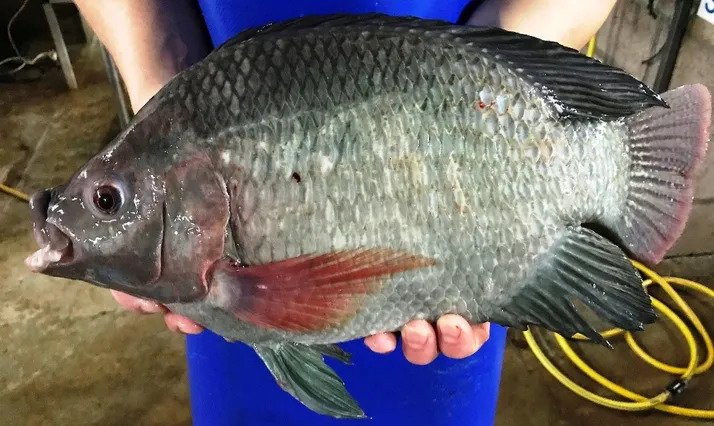
One of Til Aqua's silver tilapia brood fish
\r\n\r\n
© Til Aqua
One of the main culprits is tilapia\r\nlake virus (TiLV), which was discovered in 2014 and causes up to 90 per\r\ncent mortalities. Until earlier this year it was thought that the virus only\r\nspreads between fish cultured in the same ponds via direct horizontal\r\ntransmission, but new\r\nevidence suggests that it may also be transmitted vertically from\r\nbroodstock to their eggs, fry and fingerlings, making the situation even more\r\ndire. Experts\r\nhave warned that a social and economic catastrophe might transpire if\r\nthe virus continues to wipe out tilapia stocks.
WorldFish, one of the main promotors of tilapia farming, is\r\nprioritising research to determine causes. So far it has concluded that, in the\r\ncase of Egypt – where around 35 per cent of farms have been suffering high\r\nmortality rates due to continued disease outbreaks – the deaths can be\r\nattributed to a variety of reasons, including water quality, temperature,\r\ndensity at harvest, lack of biosecurity and poor management practices.\r\nWorldFish admits that there is a pressing need to better understand the\r\ninteractions between pathogens and components.
At the moment farmers are advised to combat TiLV and other\r\ndisease outbreaks by increasing biosecurity, by more stringently screening\r\nnewly acquired broodstock and fingerlings, and by decreasing potentially\r\nstress-inducing situations on their farms. However, scant attention has been\r\ngiven to determine and resolve the root causes of the increased occurrence of\r\nthese disease outbreaks.
One of the main risk factors for TiLV, as suspected by\r\nthe World Organisation for Animal Health (OIE),\r\nis stress. However, they also point out that some natural all-male strains\r\nof tilapia seem to be mostly unaffected by the virus. Why might this be the\r\ncase?
Root causes
Increasing numbers of scientists believe that using\r\ntestosterone or other hormonal products to stimulate sex-reversal and create\r\nall-male fry, the side effects of using large amounts of chemicals and\r\nveterinary drugs, and inbreeding, are three of the main root causes of TiLV\r\nthat must be addressed.
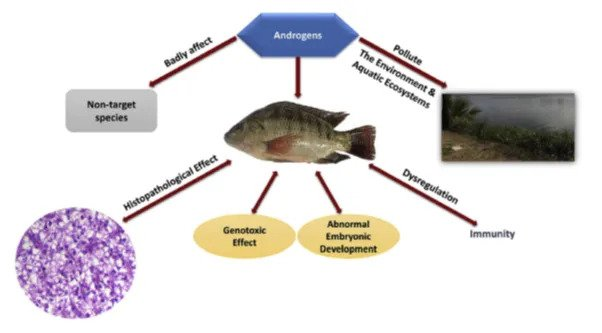
The diverse effects of the use of hormones on both fish and\r\ntheir environments
© Abo-Al-Ela, 2018
Single-sex populations, preferably all-male populations,\r\nhave long been known to be favourable for tilapia producers, as their culture\r\nresults in higher and more uniform growth rates. Unlike mammals, many fish have\r\nthe possibility to change their sex. With tilapia, the easiest way of achieving\r\nthis is through the use of hormones at the juvenile stage. By feeding the fry\r\nwith certain steroids or by dipping them in water doused with steroids, sex\r\nchange can be rapidly achieved. Although an assortment of steroids is used,\r\nthe most common one is methyltestosterone.
Abo-Al-Ela (2018) recently\r\nprovided a thorough overview of the many concerns associated with the\r\nuse of steroids in aquaculture, including their effects on exposed farm staff,\r\ncontamination of public waterways with residues, genotoxic effects and on\r\nsuppressing the immune systems of treated fish.
As Abo-Al-Ela explains, methyltestosterone is a severe\r\nendocrine disrupter and is known to induce genotoxic effects on human\r\nlymphocytes, which help regulate our immune systems. In Egypt, researchers have\r\nrecently shown that tilapia treated with hormones have low levels\r\nlymphocytes plus white blood cells, which again play an important role in\r\nsuppressing and combatting the disease.
Similar research\r\non Chinook salmon showed that fish treated with testosterone showed a\r\nsignificant decrease in antibody-producing cells. The magnitude of the\r\nsteroid-induced immunosuppression was reduced in winter and increased again in\r\nspring, which might explain the comparable seasonality in disease outbreaks for\r\ntilapia as well.
An even less-investigated topic is the genotoxicity of these\r\nhormones and other chemicals, including antibiotics, used in aquaculture. Genotoxicity is\r\ndescribed as the property of chemical agents which damages the genetic\r\ninformation of a cell, causing mutations which may lead to cancer. These\r\npermanent changes can be passed on to future generations of fish.
A recent study on the exposure of fish to antibiotics\r\n(including short-term exposure to low environmental concentrations often\r\npresent in farming environments), revealed significant\r\ndamage to the DNA of the fish as per Botelho et al. (2015).\r\nAlthough organisms can generally repair damaged DNA, some of the damage is most\r\nlikely permanent and, worryingly, this damaged DNA can be passed on to future\r\ngenerations of tilapia.
Another understudied issue is the lack of genetic diversity\r\nin captive tilapia strains plus the loss of genetic diversity in aquaculture\r\nand wild fish stocks in general, as discussed in our recent article on invasive\r\nand non-native species. By using the same breeding stock for generation\r\nafter generation without following sophisticated breeding programmes, which\r\nhappens often in tilapia culture, inbreeding occurs and the number of alleles\r\n(gene variations) present in the fish is reduced. Some of these alleles might\r\nhave bolstered disease resistance and pathogen defence, while others might have\r\nmade the fish more adaptable to climate change or other situations.
Maintaining genetic diversity is key. A study characterising\r\nthe genetic structure of introduced Nile tilapia strains in Tanzania showed\r\na serious decline in genetic diversity for most of the locally-cultured tilapia\r\nstrains. An important conclusion is that the effects of inbreeding and the consequent decline in genetic diversity is mostly affecting small-scale\r\nproducers, who tend to have less knowledge of breeding programmes and less\r\naccess to new breeding material.
If there is a link between the reduction of genetic\r\ndiversity and reduced effectiveness of the immune systems of tilapia, then\r\ndeveloping countries and small-scale farmers will most likely be hit the\r\nhardest, validating current reports from the field.
Solutions
Eric Bink is a Dutch fish farmer who is a strong believer in\r\nalternative and truly sustainable paths for the tilapia sector. Studying\r\naquatic ecology, he early on developed an interest in food fish production. “I\r\nwas primarily interested in fish production without artificial intervention, using\r\nnatural spawning cycles and carefully manipulating light and temperature. I\r\nwanted to develop a fish farming system in a wholly different direction, away\r\nfrom (at the time) salmon (hormone injection), catfish (hormones and taking out\r\nparts of the testes) and shrimp (eye-stalk ablation).”
During a visit to Mombasa where his wife was finishing a\r\nveterinary degree, he visited a tilapia hatchery and saw an opportunity to\r\nstart his own hatchery in the Netherlands. “Our operations don’t use hormones\r\nfor sex-reversal. Instead, we apply insights into fish genetics in combination\r\nwith genetic selection, also known as YY-technology.”
Over 20 years have passed and Til-Aqua has become a leading player\r\nin the hatchery production of YY males, and natural male tilapia (XY males, the\r\noffspring of the YY males), the trademarked term used by the company.
In brief, YY technology uses genetic selection to produce\r\nall-male juveniles without the use of hormones, or other chemicals, as\r\nthoroughly explained in our article on monosex\r\nselection in Macrobrachium.
The company only uses genetic selection and careful\r\ntemperature changes in the first days after hatching to change fish sex from\r\nmale to female. The end product is a completely normal male with normal\r\nXY-chromosomes. This is in contrast with hormone sex-reversed tilapia, in which\r\n50 per cent of the phenotypical males are still genetically female and have XX\r\nchromosomes.

The development of YY lines at Til-Aqua
© Til-Aqua
Bink and his team have been perfecting this technology for\r\nthe past 20 years and have developed two strong lines which they sell both as\r\nfingerlings (natural male tilapia) and broodstock (YY males). Their silver or\r\nwild type natural male tilapia reaches over 800 grams, making it ideal for\r\neither fillets or whole fish, while their red natural male tilapia is sold\r\nwhole and performs very well in brackish and full-strength\r\nseawater systems.
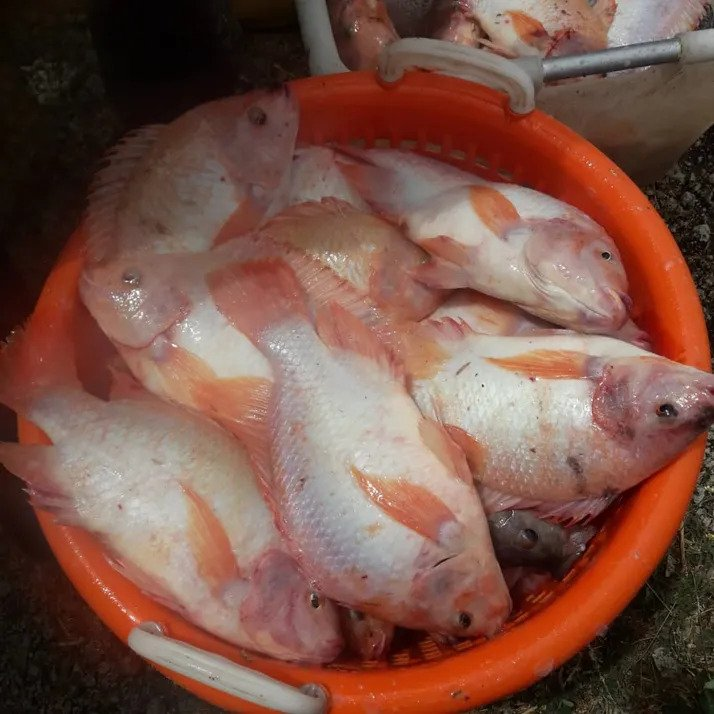
Red and silver tilapia are the two main strains developed by\r\nTil-Aqua
© Gardsfisk
The company also provides tailor-made training programmes,\r\nsuccessfully assisting companies across the globe, specifically in Africa and\r\nSouth America.
Bink explains that they have worked hard to maintain the\r\ngenetic diversity of their strains by avoiding inbreeding. “Our way of breeding\r\nwith two distinct O. niloticus lines (YY line and female line) shows\r\na heterosis effect,” he explains.
Also known as hybrid vigour, this means when two breeding\r\nlines are crossed together, the resulting hybrids are often more robust,\r\nvigorous and productive than their original parents.
Unsurprisingly, the aforementioned study, which determined\r\ngenetic diversity in selected tilapia strains scored Til-Aqua’s silver strain\r\nas the most genetically diverse.
Several researchers have also used their breeding lines for\r\nexperiments with the TiLV virus and other diseases, with the results being very\r\noptimistic. Though not all results are conclusive, even OIE notes on the TiLV\r\ndisease card for tilapia that: “There is evidence that certain genetic strains\r\nof tilapia are resistant. Ferguson et al. (2014) noted that one\r\nstrain of tilapia (genetically male tilapia) incurred a significantly lower\r\nlevel of mortality (10 – 20 per cent) compared with other strains.”
The paper mentioned by OIE argues that the most likely cause\r\nfor this would be the genetic make-up of the fish or the fact that they have\r\nnot been subjected to feeding with methyltestosterone early in life. Either\r\nway, it shows there is a solution for farmers. In line with these findings,\r\nBink and his team hope to develop a TiLV-resistant YY-line in the future.
“Unfortunately our company cannot afford such a long and\r\nexpensive project at the moment. But we are definitely open to collaboration,”\r\nhe explains.
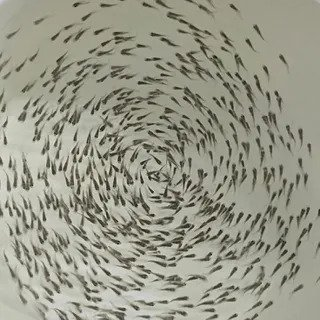
Tilapia fry
© Til-Aqua
Future developments
To bring the tilapia sector back on track, the unique resistance of Til-Aqua’s tilapia against TiLV should be better understood. For\r\nthis purpose, more research must be conducted to ascertain the relationship\r\nbetween the use of hormones for sex reversal and long-term effects on the\r\nimmune responses of fish. The same goes for genetic selection and the genotoxic\r\neffect of veterinary drugs and other chemicals used in aquaculture.
The stakes are high as the lives and livelihoods of millions\r\nof people in developing nations are at risk. Collaborative, inclusive and\r\ntransparent research is crucial to stop the virus from spreading further.
Simultaneously, more attention should be given to the genetic\r\nselection and the use of rigid breeding programmes to maintain and improve\r\ngenetic diversity in fish farms. Using genomic tools to determine genetic\r\ndiversity will be crucial for this.
However, as the findings in this article show, a precautionary approach is warranted – the use of hormones should be seriously\r\nquestioned, while the use of genetic selection for the natural production of\r\nall-male fish should seriously be considered as the most sustainable\r\nalternative.
Source: The Fish Site
\r\n\r\n\r\n\r\n\r\n\r\n\r\n\r\n\r\n\r\n\r\n\r\n\r\n\r\n\r\n\r\n\r\n\r\n\r\n\r\n\r\n\r\n\r\n\r\n\r\n\r\n\r\n\r\n\r\n\r\n\r\n\r\n\r\n\r\n\r\n\r\n\r\n\r\n\r\n\r\n\r\n\r\n\r\n\r\n\r\n\r\n\r\n\r\n\r\n\r\n\r\n\r\n\r\n\r\n\r\n\r\n\r\n\r\n\r\n\r\n\r\n\r\n\r\n\r\n\r\n\r\n\r\n\r\n\r\n\r\n\r\n\r\n\r\n\r\n\r\n\r\n\r\n\r\n\r\n\r\n\r\n\r\n\r\n\r\n\r\n\r\n\r\n\r\n\r\n\r\n\r\n\r\n\r\n\r\n\r\n\r\n

Ditulis oleh
Tim Minapoli
Kontributor
Pakar di bidang akuakultur dengan pengalaman lebih dari 15 tahun. Aktif berkontribusi dalam pengembangan industri perikanan Indonesia.