

Aquaculture has long depended on the intuition and\r\nexperience of farmers in areas such as feeding or disease prediction. Today\r\nsome companies are harnessing the power of artificial intelligence ...
Aquaculture has long depended on the intuition and\r\nexperience of farmers in areas such as feeding or disease prediction. Today\r\nsome companies are harnessing the power of artificial intelligence (AI) to\r\nimprove operations.
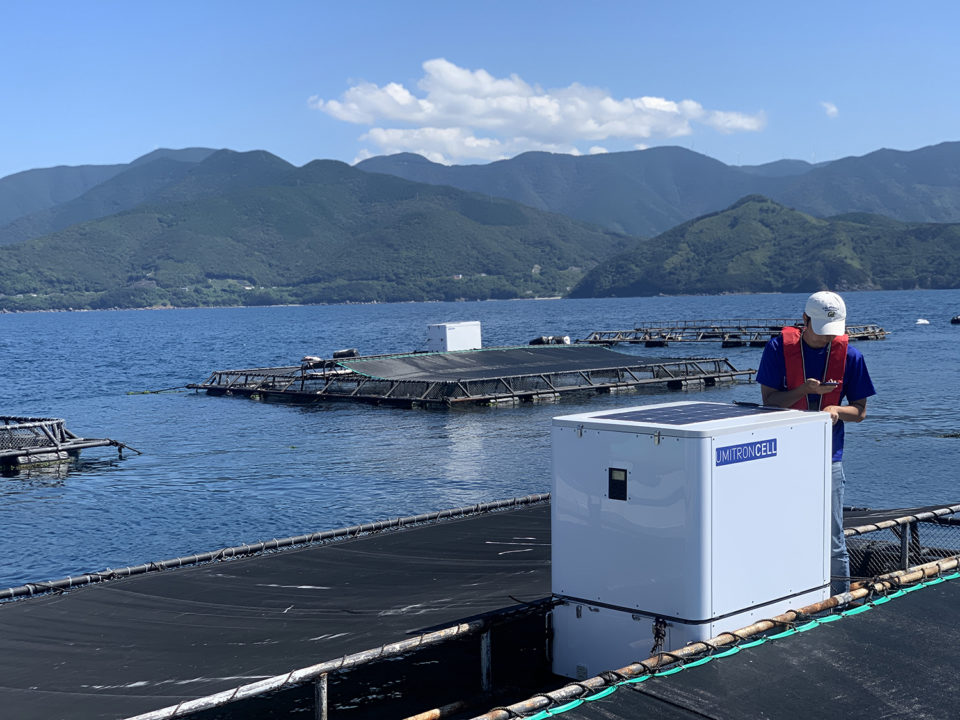
In Japan, where the population is aging and the workforce is\r\nshrinking, efficient farming operations are crucial. Umitron, an aquaculture\r\ntechnology provider in Japan and Singapore, offers data platforms using IoT,\r\nsatellite remote sensing and AI. One of its recent solutions is UMITRON CELL (CELL),\r\na smart fish feeder that holds 400 kg of feed and includes a solar-power\r\nmanagement system, onboard computer, weight sensors, dispensing motor and a\r\ncamera for observing fish 24 hours a day. The feeder is remotely controlled and\r\nfish videos are monitored with a smartphone or desktop computer.
“CELL’s development came from discussions with farmers who\r\nstruggled to monitor all their cages and feed the correct amount each day,”\r\nsaid Andy Davison, product manager at Umitron. “They didn’t typically take\r\nweekends or holidays since they needed to visit their fish cages every day to\r\nfeed the fish and monitor their condition. CELL allows them to accurately\r\nmanage their feed and stay onshore occasionally while still monitoring their\r\nfish.”
CELL is installed on cages and allows farmers to check a\r\nlive stream or saved video data. The farmer can adjust the feeder’s timing and\r\namount settings to fine-tune feeding, and check historical feeding and fish\r\ndata to see the amount of feed used over the past day, week or month. The\r\nsystem is remotely powered by a solar panel connected to a battery. CELL is now\r\nbeing used in tandem with Umitron’s latest AI-powered algorithm Fish Appetite\r\nIndex (FAI), a real-time ocean-based fish appetite detection system in which\r\nmachine-learning algorithms analyze video data collected directly from farm\r\nsites to calculate fish appetite. Farmers can check FAI metrics to determine\r\nwhen their fish are hungry or full and adjust feeding accordingly.

“They can obtain more\r\ninformation on their fish’s behavior and move toward data-driven\r\ndecision-making to further optimize feeding schedules,” said Davison. “FAI\r\nreduces wasted feed, improves profitability and environmental sustainability,\r\nand offers a better work life by eliminating the need to be out on the water in\r\ndangerous conditions. It also reduces the need for every employee to be a\r\nfeeding expert and frees workers to focus on other tasks that improve fish\r\nwelfare.”
Japan has a robust environmental regulatory system for\r\naquaculture and requires permits that specify the size and location of offshore\r\nfarms. Davison says that with more efficient feeding and data collection, it\r\nmay also become possible to specify precisely how many farms should be located\r\nin a given area, potentially allowing aquaculture to use available space more\r\nefficiently.
Meanwhile, other firms are also tapping into the potential\r\nof AI. Aquaconnect,\r\na startup in India, is helping shrimp farmers predict disease and enhance water\r\nquality with its mobile application FarmMOJO. The tool uses machine-learning\r\ntechnology to provide insights and suggest appropriate steps.
“Smart technology is key to better productivity and disease\r\nmanagement. It accelerates rapid detection, real-time reporting and data-driven\r\ndecision-making,” said Rajamanohar Somasundaram, CEO and co-founder.
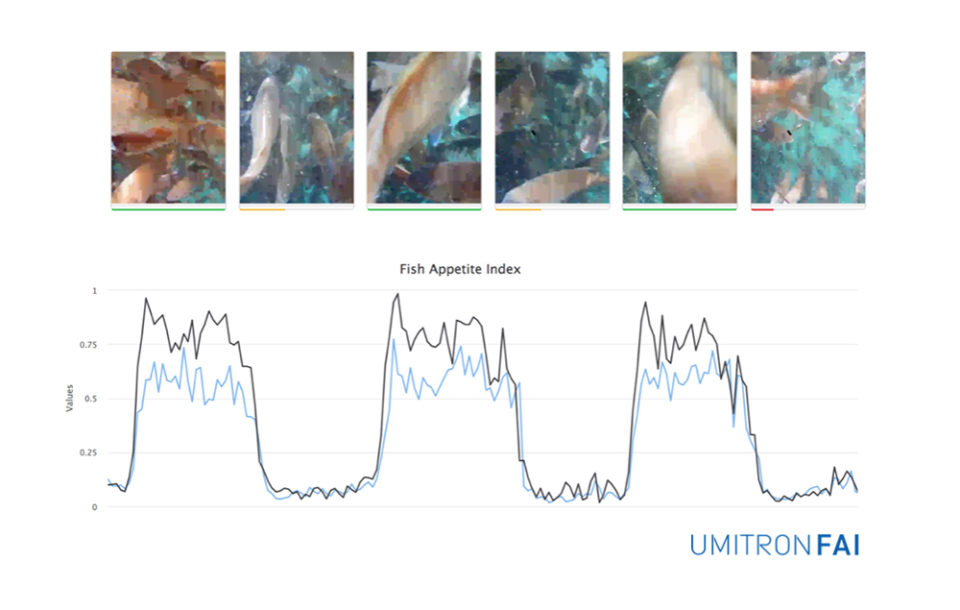
An example of Fish Appetite Index (FAI) data and the traffic\r\nlight warning system of green, yellow and red to indicate good, OK and bad\r\nappetite levels, respectively.
AI in aquaculture appears promising, but just how far could\r\nit revolutionize the industry? Its importance will depend a lot on the species\r\nand farming methods involved. Commodity seafood markets like shrimp and salmon,\r\nwhere global competition sets the price, will require data and AI to stay\r\ncompetitive. Countries with strict environmental guidelines and environmentally\r\nconscious consumers could use AI to improve product traceability and\r\nmarketability. However, for lower-value species that are typically consumed\r\nlocally, investing in AI may not make financial sense.
Davison believes that amidst growing awareness and\r\ntechnological improvements, AI is likely to be adopted in full.
“As soon as its advantages are better recognized, we could\r\nsee a mass adoption and that may revolutionize aquaculture,” he said. “But\r\nadopting new ideas and technologies takes time. This can be frustrating, but\r\nwhat we may consider slow adoption could just be the regular speed of\r\nadoption.”
“AI, real-time sensors and IoT have many advantages. They\r\ncan identify water quality changes at the initial stage and detect changes in\r\nthe consumption and growth pattern of animals or help farmers take preventive\r\nmeasures before a disease outbreak,” said Somasundaram. “Aquaculture\r\nstakeholders should focus on the innovation of affordable IoT devices and\r\nfarming equipment to facilitate the continuous monitoring of water quality, animal\r\nperformance and growth.”
But challenges remain. With data security awareness growing,\r\nsome farmers want to know how their data are being used and by whom. Explaining\r\nthe specific steps taken to ensure that data are transmitted and stored\r\nsecurely is in itself a challenge, says Davison, with specifics on encryption,\r\nkeys and HTTPS protocols lost on the average technology user. This makes it all\r\nthe more crucial for firms to be good stewards of their customers’ data and\r\nmaintain trust. Somasundaram agrees that technology often poses a steep\r\nlearning curve among farmers.
“Fish and shrimp farmers have always worked through\r\nword-of-mouth advice from their peers and will need to be guided when adopting\r\ntechnology. Incentives, training and adequate exposure may help,” he said.\r\n“Data ownership and security haven’t yet gained much attention among farmers,\r\nso the government and stakeholders must engage in conversation and create\r\nstandards for both. This could be a great challenge in future for multinational\r\nfirms that want to offer their solutions in multiple geographies, where each\r\ncountry may have its own standards.”
A final dilemma, according to Davison, is what to do with\r\nall of the data that you now have.
“It’s easy to be overwhelmed with new sources of data but\r\nnot have established methods on how to process and use all that information to\r\nmake better decisions,” he said. “All that data is useless unless companies\r\nhave a way to use it.”
With time, hard work and clever people, many traditional\r\nindustries including aquaculture could become fully automated. Making good use\r\nof the power of science and technology to improve efficiency and increase\r\nyields is likely to produce significant results.
\r\n\r\n\r\n\r\n\r\n\r\n\r\n\r\n\r\n\r\n\r\n\r\n\r\n\r\n\r\n\r\n\r\n\r\n\r\n\r\n\r\n\r\n\r\n\r\n\r\n\r\n\r\n\r\n\r\n\r\n\r\n\r\n\r\n\r\n
“To increase AI’s adoption, we need to appeal to farmers on\r\na rational and emotional level,” said Davison. “When a farmer realizes they no longer\r\nneed to work seven days a week thanks to AI, that greatly impacts their lives.\r\nOn the rational level, when we can clearly demonstrate increased profitability\r\nwith AI data-driven decision making and automation, we’ll see a big uptick in\r\nuse.”
Source : Global Aquaculture Alliance

Ditulis oleh
Tim Minapoli
Kontributor
Pakar di bidang akuakultur dengan pengalaman lebih dari 15 tahun. Aktif berkontribusi dalam pengembangan industri perikanan Indonesia.