

The black soldier fly (Hermetia illucens) larvae (BSF) is\r\nquickly emerging as a viable fishmeal alternative in aquafeeds based on\r\nnutritional value and ability for eco-friendly production. Adult...
The black soldier fly (Hermetia illucens) larvae (BSF) is\r\nquickly emerging as a viable fishmeal alternative in aquafeeds based on\r\nnutritional value and ability for eco-friendly production. Adult black soldier\r\nflies are now distributed throughout the world and despite having a wasp-like\r\nappearance, they lack any appendage for biting or stinging. Thus, they are not\r\npests to humans or other animals and much like other flies, are often found\r\nnear compost/rotting organic material.
This article describes an “all-in-one” stacked system for\r\nindoor BSF larvae production, which is designed to be self-harvest the larvae\r\nand repopulate the adults and provides some observations regarding the breeding\r\nof adult BSF.
Structure design and\r\nindoor settings
At the University of Arkansas at Pine Bluff (UAPB), a\r\nthree-tier system for BSF larvae production was designed and built using steel\r\nand mesh based on previous pilot studies to reduce space and facilitate\r\nharvesting (Fig. 1). Each layer has hardware cloth on top of a quarter-inch\r\nwire mesh to hold/retain the substrate, provide air flow and also allow\r\ndrainage of excess water. Each layer is a trapezoid so that the flat surface\r\nallows an even spread of the substrate, while the 45-degree-angle provides\r\nsurface area for the larvae to crawl up the sides and fall into a harvester (a\r\nlong trough).
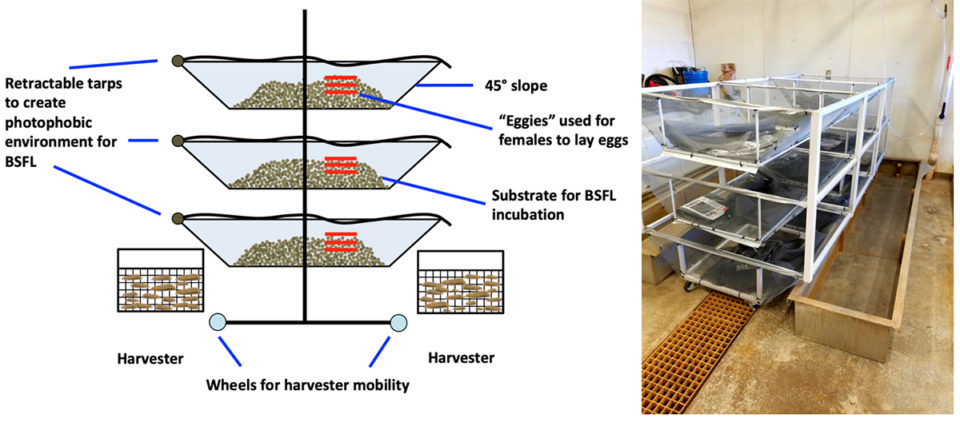
Fig. 1: Left: initial design for a three-tier trapezoid\r\n“all-in-one” structure that feeds the larvae, self-harvests and is repopulated\r\n(left) and a total three sets were fabricated at UAPB. Right: the design\r\nprovides a total of nine units that were three layers high.
A retractable tarp was also placed on top because the larvae\r\nare photophobic [intolerant of light] as well as to help retain moisture. A top\r\nslit allows access for future adult flies to lay their eggs. Each of the nine\r\nunits were moved indoors and kept at a set temperature of 88 degrees-C over the\r\nlate fall/early winter. A humidifier maintained humidity at above 45 percent to\r\ncounter the dry, hot air from the vents.
Starting production
A total of 9,000 instar 4 (developmental stage of arthropods\r\nsuch as insects) larvae were purchased and added directly on top of either the\r\nspent coffee grounds or the pizza dough. These ingredients were chosen based on\r\nbeing locally available in large quantities as well as being different in their\r\ncomposition and texture. However, several days after adding the larvae, softer\r\nitems including oranges, pumpkins and other household leftovers were also\r\ndistributed to further gauge larval food preferences (Fig. 2). Compared to the\r\ncoffee grounds, the larvae were observed to prefer softer food items. Despite\r\nthe humidity being relatively high (above 45 percent), the substrates dried\r\nwithin a day, and thus a soaker hose was laid on the top layer to periodically\r\ndrip water along with a mister system that was manually turned on once in the\r\nmorning.
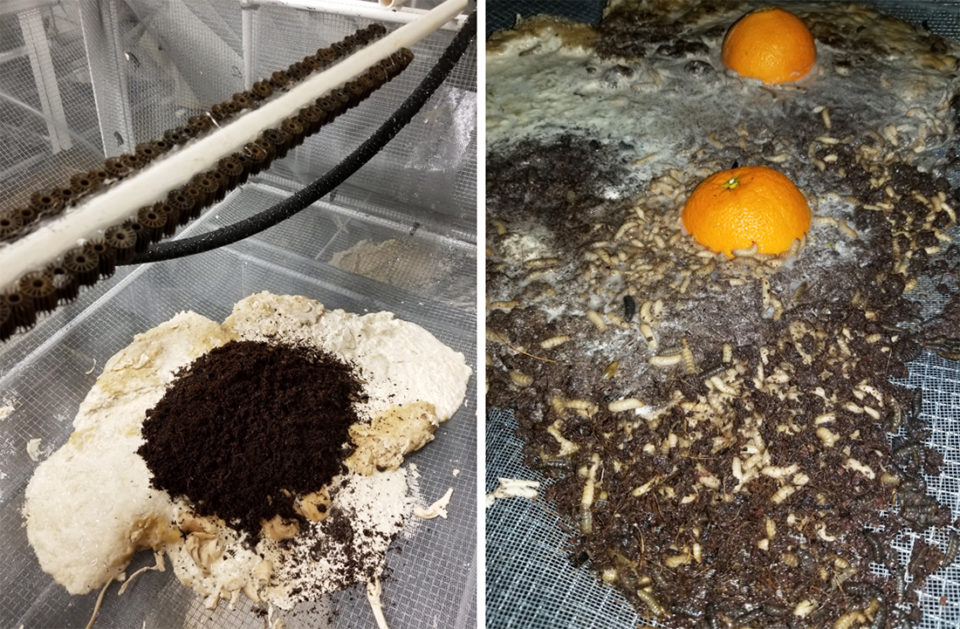
Fig. 2: Left: adding larvae and contents directly on top of\r\npizza dough. Above is a soaker hose followed by a series of “eggies” made out\r\nof biofilter media that turned out not be utilized. Right: several days after\r\nadding the larvae, most of the pizza dough was consumed. Oranges and other soft\r\nfood items were then provided to assess food preferences.
Within a week, the first pre-pupae [life stage of some\r\ninsects before transformation to other stages] larvae were observed to climb up\r\nthe 45-degree sides and fall into the trough harvester, which had quarter-inch\r\nof sand to help soften the impact as well as to facilitate harvesting with\r\nscoop nets. Pre-pupae larvae were much larger when cultured on pizza dough\r\n(length 1.75 ± 0.04 cm; width 0.43 ± 0.02 cm) compared to those grown on coffee\r\ngrounds (length 1.27 ± 0.03 cm; width 0.29 ± 0.01 cm), likely due to the dough\r\nbeing softer and richer in easily digestible starches (Fig. 3). It should be\r\nnoted that not all the larvae migrated to be harvested, but the majority did.
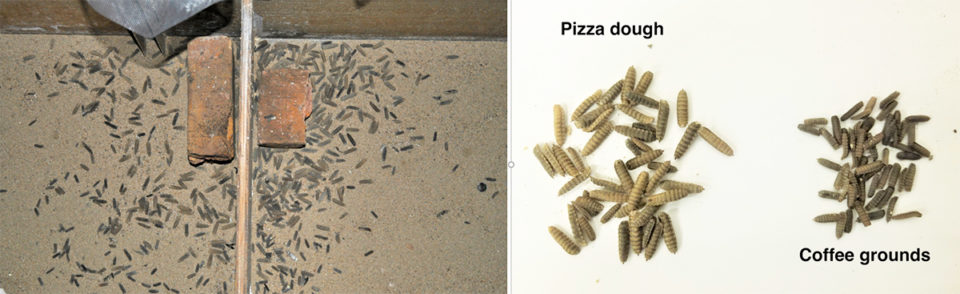
Fig. 3: Left: pre-pupae that just migrated up the\r\n45-degree-angle side and fell into the trough with some sand to cushion the\r\nfall and facilitate harvesting. This was the third day from initially observing\r\nthe pre-pupae. Right: direct comparison of harvested pupae cultured mostly with\r\npizza dough versus coffee grounds.
Adult reproduction
Within a few days, the pupae hardened, appeared darker and\r\nthe tips turned upwards until the adult black soldier fly emerged. The use of\r\n“eggies” has been recommended to facilitate egg transfer to different\r\nlocations/incubators, the eggs can be easily removed and sold to vendors and to\r\nallow the substrate to be mixed or added upon without disturbing the eggs.\r\nTypically, corrugated sides of cardboard, stacks of wood or other media with\r\nsmall crevices are preferred by adults. While we placed different media types\r\naround or on top of the substrate, the adults initially preferred to lay their\r\neggs onto the substrate (Fig 4). Only after two weeks were eggs first noticed\r\non the cardboard (but not other media), indicating smell is important for egg\r\nlaying choices.
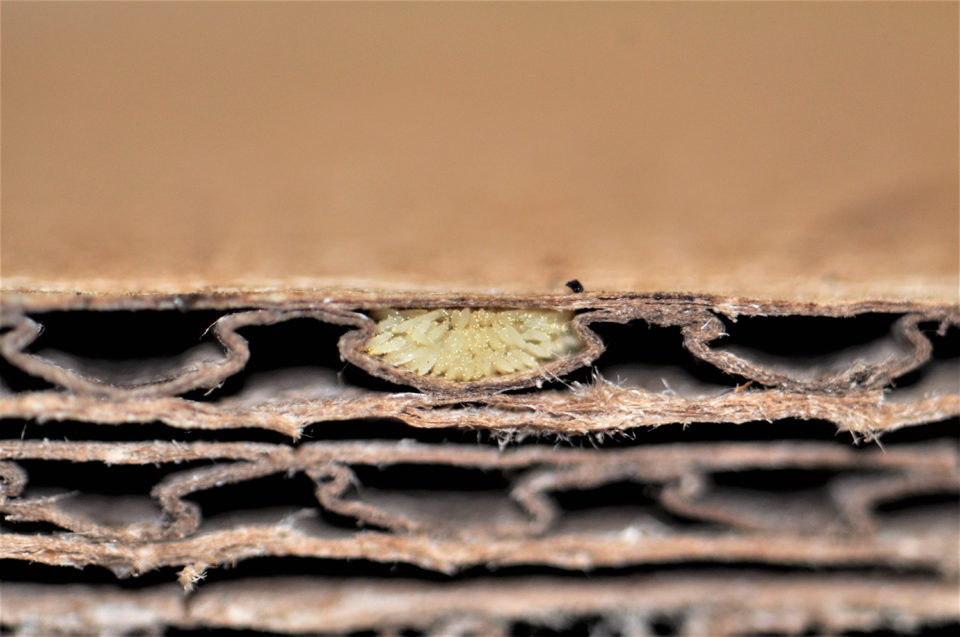
Fig. 4: Newly laid black soldier fly eggs in corrugated\r\ncardboard.
After about two months of initially adding the advanced\r\nlarvae, we observed pupae at various life stages in the substrate (Fig. 5),\r\nwhich demonstrated that the life cycle was successfully closed indoors and over\r\nthe winter. The substrate smell changed from a manure/rotting smell to more of\r\na sweet/earthy aroma. The room became full of adult flies, but high mortalities\r\noccurred after about four to seven days. Subsequently, we laid out containers\r\nwith small amounts of sugar and water around the room. The flies were\r\nimmediately attracted to these, particularly yellow containers, and used a\r\nmouthpart similar to household flies to feed (Fig. 6). Soon afterwards, it\r\nappeared that the mortalities subsided. This appears to counter the idea that\r\nblack soldier flies have no mouthparts or digestive tract, as sometimes\r\nanecdotally reported.
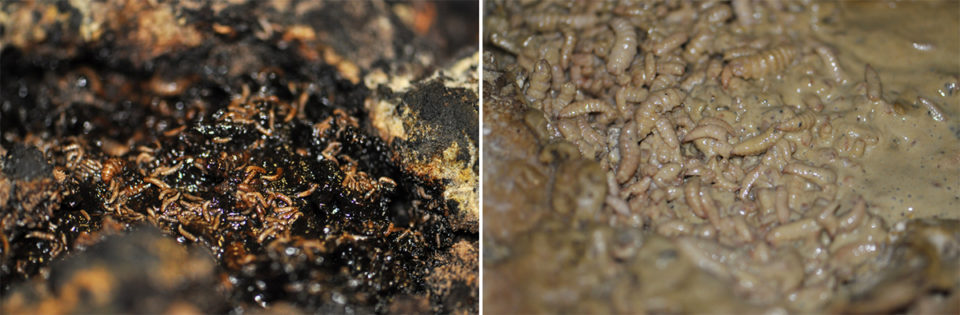
Fig. 5: Next generation of larvae that hatched and grew\r\ndirectly from the coffee grounds (left) or pizza dough (right). Photo taken the\r\nsame day (after about two weeks) of initially adding larvae, and the size\r\ndifferences of the larvae are clearly evident.Fig. 6: Adult flies were\r\nimmediately attracted to the sugar and appeared to prefer the yellow container\r\ncompared to petri dishes or white lids. Insert: Adult fly using its labella\r\n(spongy pad-like appendage) to soak up the sugar water.
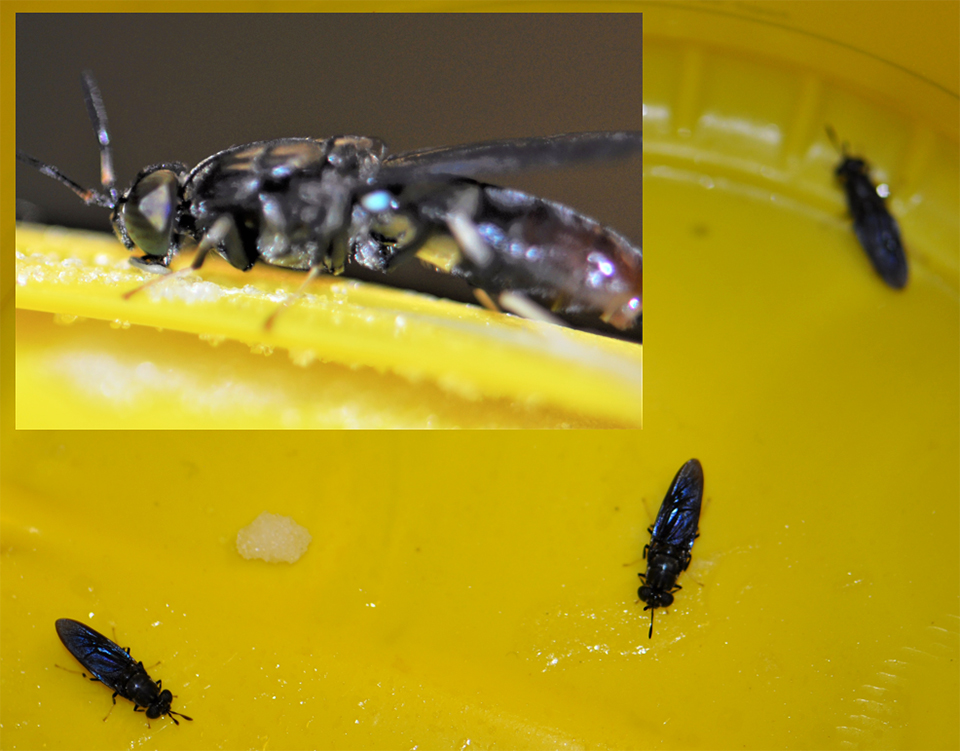
Fig. 6: Adult flies were immediately attracted to the sugar\r\nand appeared to prefer the yellow container compared to petri dishes or white\r\nlids. Insert: Adult fly using its labella (spongy pad-like appendage) to soak\r\nup the sugar water.
Overall production
After two months from the initial addition of advanced\r\nlarvae, we estimated there was approximately over a 50-fold increase from the\r\nfirst generation, where numerous handfuls of larvae were obtained (Fig. 7).\r\nThis really was only obvious after moving the substrates into bins to prepare\r\nfor experiments. Currently, from this second generation we are testing\r\ndifferent locally available substrate types and their blends to assess BSF\r\nlarvae productivity, bioconversion rates and nutritional value, as well as trying\r\nout additional designs for larval harvesting.
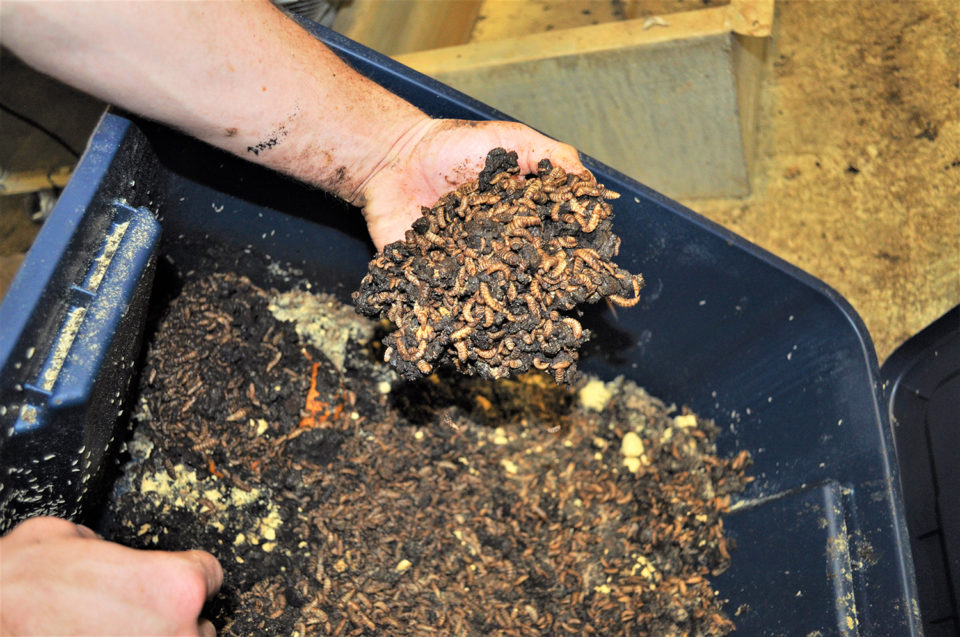
Fig. 7: After one generation, this was one container out of\r\nnine that were full of advanced BSF larvae.
Issues and recommendations
Some difficulties throughout production included maintaining\r\nconsistent moisture content of the substrate in the hot/dry room. This was\r\nespecially important for the pizza dough, because insufficient moisture led to\r\nthe dough hardening while oversaturation led to the loss of dough through the\r\nnetting. However, we later blended plant fibers or coffee grounds with the\r\npizza dough and mitigated this concern.
Another issue we observed was that the adults often laid\r\ntheir eggs directly on the substrate, and thus we were cautious about\r\nmixing/adding the substrate as well as over saturating the substrate with\r\nwater. We also emphasize the importance of keeping the floors clean to minimize\r\nthe chances of the BSF adults laying their eggs in any areas with\r\nspilled/leaked substrate.
Source: Global Aquaculture Alliance

Ditulis oleh
Tim Minapoli
Kontributor
Pakar di bidang akuakultur dengan pengalaman lebih dari 15 tahun. Aktif berkontribusi dalam pengembangan industri perikanan Indonesia.