

The overuse of chemicals and antibiotics in intensive shrimp\r\nfarming has now disrupted ecological balance and adversely affected the\r\nenvironment, poor product quality and the retention of banned...
The overuse of chemicals and antibiotics in intensive shrimp\r\nfarming has now disrupted ecological balance and adversely affected the\r\nenvironment, poor product quality and the retention of banned chemicals and\r\nantibiotics. barriers in exporting Vietnam shrimp to the world market. The\r\napplication of biotechnology in commercial shrimp farming is now considered an\r\nindispensable support solution for the stable and sustainable development of\r\nindustrial shrimp farming.
I. Use of probiotics\r\n(Probiotics)
Currently on the market there are many types of probiotics\r\nwith many different brands. However, the most commonly used probiotics,\r\nlow cost, high efficiency and easy to apply for shrimp farmers are EM (Efective\r\nMicroorganism).
1. The\r\nrole of EM preparations
In animal husbandry and aquaculture:
- EM works well for all species of pets, all species of\r\naquatic animals.
- Increase the resistance and resistance of livestock to\r\nadverse external conditions; Improve the ability to digest and absorb pet\r\nfood; Increases reproductive stimulation of pets; Increasing\r\nproduction and quality of livestock; inhibition of harmful\r\nmicroorganisms; Limiting environmental pollution.
Also read: Probiotics in Aquaculture
In environmental protection:
When spraying EM into garbage, sewers, barns, ponds, ...\r\nwill eliminate odors quickly; reduce the number of flies, mosquitoes,\r\ninsects in the environment; deodorizing organic waste and speeding up\r\nhumus; prevent the process of causing rot and mold in preserving\r\nagricultural products; High efficiency, environmentally safe and cheap\r\nprice.
2. How to\r\nproduce EM2 from original EM
- Procedure: (with a 50L container)
Sterile the containers; Add 46 liters of fresh, clean\r\nwater; Add 1kg molasses, stir well; Add 2kg of rice bran or\r\ncornstarch, stir; Add 10 g of table salt, stir; Add 1 liter of\r\noriginal EM, stirring; Cover anaerobic incubator for 7 days.
For larger volumes (100L, 200L, 500L, etc.), the increase in\r\nraw materials is proportional to the increase in volume.
- Usage:
+ Water treatment: 50 liters of EM2 / 1,000 m 3 of water; Handling\r\npond: 10 liters EM2 / 1,000 m 2 pond; Use periodically in ponds:\r\n50 liters EM2 / 1,000 m 3 of water, during the first month of farming\r\nevery 5-7 days, the 2nd month use 3-5 days / time, the 3rd month onwards 2-3\r\ndays / times; Use to treat odors: Use EM2 aerosol directly on the surface\r\nwhere the odors are born.
3. How to\r\nproduce EM5 from original EM
- Raw materials:
1 liter of original EM; 1 liter of molasses; 1\r\nliter of vinegar; 2 liters of wine.
- Procedure:
Use a covered lid, clean and disinfect; Order of input\r\nmaterials: 2 liters of wine → 1 liter of vinegar → 1 liter of molasses → 1\r\nliter of original EM → stirring → tightly closed; Anaerobic incubation for\r\n3 days. Dosage used: 3.5 liters EM5 / 1,000 m 2 .
- Usage:
Treatment of pond bottoms: 5 liters EM5 / 1,000 m 2 ; Water\r\ntreatment: 4 liters EM5 / 1,000 m 3 , every 7 days, when large shrimp\r\nincrease the number of uses.
Also read: Probiotic Capacity of Pseudovibrio Denitrificans Isolates From a Marine Sponge
4. How to\r\nproduce EM garlic from EM5
- Raw materials:
1 liter EM5; 1 kg pureed garlic; 8 liters of clean\r\nwater
- Procedure:
Use a covered lid, clean and disinfect; Order of\r\ningredients: 8 liters of water → 1 kg of pureed garlic → 1 liter of EM5 →\r\nstirring → tightly closed; Anaerobic incubation for 24 hours.
- Usage:
Prevention: 1 liter EM garlic + 10 kg of food, compost after\r\n1 hour, feed periodically; Treatment: Use a double dose, feed continuously\r\nfor 7-10 days, then return to the preventive dose.
5. How to\r\nproduce EM bananas from EM2
- Material:
1 liter EM2; 1 kg of molded bananas, pureed.
- Procedure:
Use a covered lid, clean and disinfect; Order for the\r\ningredients: 1 kg of pureed peeled bananas → 1 liter of EM2 → stirring →\r\ntightly closed; Anaerobic incubation for 24 hours.
- Usage:
1 liter of EM bananas + 10 kg of feed, compost after 1 hour,\r\ncontinuous feeding.
Also read: Can Probiotics Make Shrimp Farming More Environmentally Friendly?
6. Principles\r\nof using probiotics
- Do not use probiotics concurrently with antibiotics and\r\nbactericidal chemicals.
- Use the right dose, not as much as possible.
- Powdered probiotics should use dissolved pond water and\r\nstrong aeration 2-4 hours before use to increase bacterial biomass.
- Water-based probiotics should be incubated anaerobic to\r\nincrease biomass before use.
- The best microbiological treatment time is about 8-10 am,\r\nduring the warm sunshine, clear sky and high dissolved oxygen content.
- Periodically treat microorganisms to maintain appropriate\r\nbacterial density in order to control biological environment of water and pond\r\nbottom, stabilize environmental factors, prevent pathogenic bacteria, toxic\r\nalgae and pathogens latent in the pond.
* Environmental\r\nfactors affecting the efficiency of using CPVS:
- O xy dissolved: aerobes ( Bacillus )\r\nand strictly aerobic bacteria (VK nitrate) to ensure adequate dissolved oxygen\r\nefficiently.
- Alkalinity, salinity: High alkaline water (80 -\r\n150mg / l CaCO 3 ) → Stable pH, low alkaline water (50mg / l\r\nCaCO 3 ) → Fluctuating pH → reduced efficiency of microbiology\r\nshort. Salinity is too high → causes death or inhibits the growth of\r\nmicroorganisms.
- Weather: Greatly affecting the growth of algae\r\nand water color → affecting the efficiency of using microorganisms. Use\r\nbest microorganisms in the morning, when it's clear.
- Nutrition: It is necessary to add C to nitrate\r\nbacteria to effectively reduce
\r\nN-NH 3 → NO 3 .
* Time and frequency\r\nof use:
- Should use microorganisms right from the beginning of the\r\ncrop → high efficiency.
- From mid to end of crop → low efficiency.
- At the beginning of the crop 7-10 days to use once, from\r\nmid to late crop 3-4 days to use once.
* Dosage used:
- Use as directed by the manufacturer.
- Excessive use → ecological imbalance, reduced DO,\r\nirritated animals, stress.
- Use too little → do not work well.
Also read: Effect of Streptomyces Probiotics on Gut Microbiota of Pacific White Shrimp
* Culture of\r\nbacterial biomass:
- Some probiotics need to be cultured to increase the number\r\nof bacteria, anaerobic cultures are needed to avoid contamination.
- Some probiotics with high bacterial density do not need to\r\nincrease biomass and can be used directly in ponds. However, it should be\r\nmixed with water and strong aeration for several hours before splashing into\r\nthe pond.
* Other factors:
- Too many protozoa will eat bacteria → the density of\r\nmicroorganisms will decrease.
- Simultaneous use of biocides, antibiotics, water changes,\r\n... will reduce the effectiveness of microorganisms.
7. The\r\nprevention and treatment of some diseases for shrimp by microbial\r\nproducts
• Shrimp floating head due to toxic gases:
- Dissolve 2-3 liters of original EM into 20 liters of water\r\ntaken from the pond and then throw it into the pond at the first floating\r\nshrimp.
- Open fans running at full capacity.
• Shrimps with tail and stubble:
- Use 2 liters of EM garlic + 10 kg of food.
- Mix well and incubate for 4 hours.
- Feed the shrimp at the rate of 1kg / 100,000 postlarvae /\r\nday.
- Or use 50 liters of EM2 / 1,000 m 2 / day, use 3\r\ntimes in a row with intervals of 2 days / time.
• Crumbled shrimp:
- Use 4 liters EM5 / 1,000 m 2 , use continuously\r\nfor 5 days in the morning.
- When algae dies a lot → low pH → use lime to raise pH.
• Shrimp with white spot disease:
- Use 5 liters EM5 / 1,000 m 2 / day for 5 days in\r\na row used in the morning.
- When shedding many stop using EM5 and uses 50 liters of\r\nEM2 / 1,000 m 2 /2 days, used continuously until the WSD descending\r\n(Thailand used effectively for over 10 years).
II. Biofloc\r\ntechnology
Currently many businesses are adopting Biofloc technology\r\nand have very good results. Approaching Biofloc technology to improve the\r\nbiomass of microorganisms as feed for shrimps by adding C so that bacteria can\r\nmore fully utilize the source of waste N converted into biomass in Biofloc,\r\nimproving environmental management efficiency rearing ponds, reducing diseases,\r\nreducing food intake.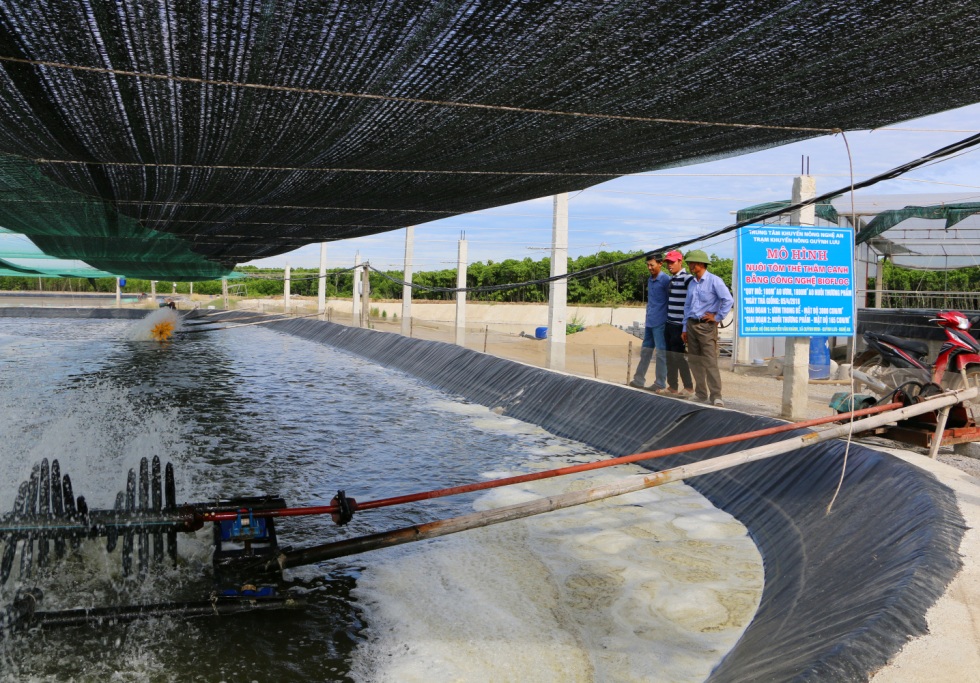
Biofloc components include: A mixture of heterotrophic\r\nmicroorganisms (floc-producing bacteria and filamentous bacteria), debris,\r\ncolloids, biopolymers, cations, dead cells, crystal salts, etc. Biofloc also\r\nhas microalgae (filamentous algae, silica algae), fungi, protozoa, zooplankton\r\n(rotifers), nematodes, etc.
Also read: Research Backs Value of Probiotics in Shrimp Ponds
Inducing Biofloc in\r\nshrimp ponds (2 . 000 m 2 ):
After supplying water from the settling pond up to the\r\nrequirements, conduct Biofloc:
- Use 3 kg of food number 0.
- 1 liter of original EM or 0.5 kg of Ta-pondpro or other\r\nprobiotics on the market.
- 3 kg of Stomi or N8 minerals, or minerals on the market.
- 6 liters of molasses.
Incubate after 24 hours into the pond. Every 2 days,\r\nrepeat the process, after 7-10 days, Biofloc will come up and when using imhoff\r\nmeasuring cup to reach 3-5 mm, you will conduct stocking.
During the culture process, 0.6 liters of molasses / kg of\r\nfeed were used to maintain the Biofloc density in the pond. When Biofloc\r\ncontent is too thick, reduce molasses to 0.2 liter / kg of feed.
Shrimp farming using Biofloc technology requires a large\r\namount of energy to operate the aeration system. If the power outages\r\nwithin 1 hour can cause the situation of settling the entire amount of Biofloc\r\nin the pond. Ponds with this technology must be lined or made of\r\ncement. Biofloc technology requires higher technical training for\r\ntechnicians.
\r\n\r\n\r\n\r\n\r\n\r\n\r\n\r\n\r\n\r\n\r\n\r\n\r\n\r\n\r\n\r\n\r\n\r\n\r\n\r\n\r\n\r\n\r\n\r\n\r\n\r\n\r\n\r\n\r\n\r\n\r\n\r\n\r\n\r\n\r\n\r\n\r\n\r\n\r\n\r\n\r\n\r\n\r\n\r\n\r\n\r\n\r\n\r\n\r\n\r\n\r\n\r\n\r\n\r\n\r\n\r\n\r\n\r\n\r\n\r\n\r\n\r\n\r\n\r\n\r\n\r\n\r\n\r\n\r\n\r\n\r\n\r\n\r\n\r\n\r\n\r\n\r\n\r\n\r\n\r\n\r\n\r\n\r\n\r\n\r\n\r\n\r\n\r\n\r\n\r\n\r\n\r\n\r\n\r\n\r\n\r\n\r\n\r\n\r\n\r\n\r\n\r\n\r\n\r\n\r\n\r\n\r\n\r\n\r\n\r\n\r\n\r\n\r\n\r\n\r\n\r\n\r\n\r\n\r\n\r\n\r\n\r\n\r\n\r\n\r\n\r\n\r\n\r\n\r\n\r\n\r\n\r\n\r\n\r\n\r\n\r\n\r\n\r\n\r\n\r\n\r\n\r\n\r\n\r\n\r\n\r\n\r\n\r\n\r\n\r\n\r\n\r\n\r\n\r\n\r\n\r\n\r\n\r\n\r\n\r\n\r\n\r\n\r\n\r\n\r\n\r\n\r\n\r\n\r\n\r\n\r\n\r\n\r\n\r\n\r\n\r\n\r\n\r\n\r\n\r\n
Applying biotechnology without using antibiotics and\r\nchemicals in commercial shrimp farming can manage water quality throughout the\r\ncrop, minimize environmental pollution, control disease outbreaks, minimize\r\nrisks, increase efficiency. use feed, reduce production costs, improve product\r\nquality, This is a solution for sustainable development of commercial shrimp\r\nfarming on the sand.
Source : www.khuyennongvn.gov.vn

Ditulis oleh
Tim Minapoli
Kontributor
Pakar di bidang akuakultur dengan pengalaman lebih dari 15 tahun. Aktif berkontribusi dalam pengembangan industri perikanan Indonesia.