

A recent report just published in the Journal of Applied\r\nPhycology shows the benefits of the vannamei farming model integrated with blue\r\nseaweed in the minimum water exchange aquaculture system....
A recent report just published in the Journal of Applied\r\nPhycology shows the benefits of the vannamei farming model integrated with blue\r\nseaweed in the minimum water exchange aquaculture system.
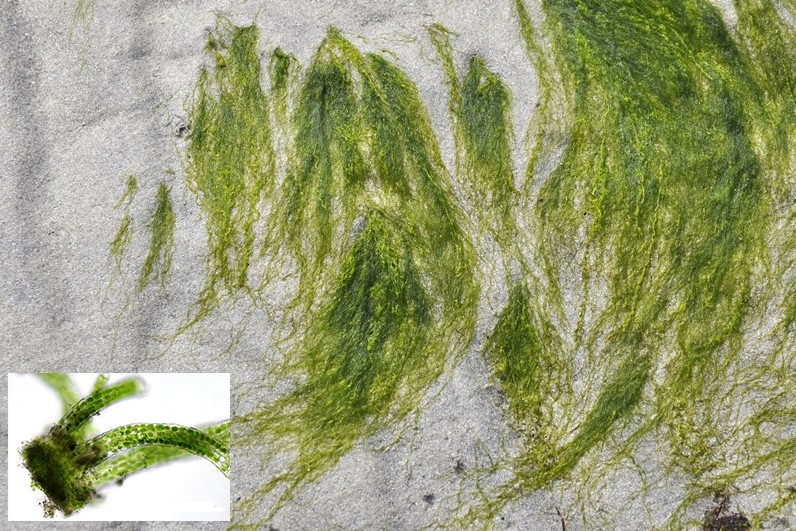
Application of\r\nseaweed ( Ulva prolifera ) in aquaculture
The aquaculture industry has been developing rapidly all\r\nover the world, resulting in the consequences of waste water sources that are\r\ncausing significant impacts on the environment. Recognizing this problem,\r\nmany new aquaculture methods are being widely used to recycle water while\r\nminimizing the amount of waste water discharged into the environment and\r\nthereby solving the problem of nitrogen accumulation in the environment.\r\ncountry. One of the solutions that can be assessed as having potential in\r\naquaculture is a model of aquaculture combined with seaweed or\r\nalgae.
Seaweed Ulva prolifera known for rapid growth, and\r\nreproduction of it effectively removes nitrogen quickly. Seaweed Ulva\r\nprolifera reported that the powerful can develop in an environment\r\nrich in nutrients and able to absorb nutrients efficiently accumulate in the\r\nwater.
In the study Le Ngoc Hanh and Toshiro Masumoto (2018),\r\npublished in the 12th issue of the Mekong Journal of Fisheries in 2018, seaweed\r\ncan be used as a biofilter in combination with the farming system. closed to\r\nminimize nitrogen in aquaculture.
The results showed that the addition of seaweed as a\r\nbiofilter in the culture system effectively reduced the amount of ammonia\r\nreleased from the fish. The research results also show that the optimal\r\ndensity when applying this seaweed in the culture system is 6 g / L or more,\r\nwhich brings high efficiency and significant difference compared to lower\r\ndensities.
From the results of this study, it was shown that Ulva\r\nprolifera can be applied effectively in the circulatory system as a biofilter ,\r\nand the optimal density to be applied to nutrient uptake. of seaweed is 6 g /\r\nL.
Farming integrated\r\nwhite shrimp with seaweed
Integrating seaweed culture in shrimp farming systems is\r\nconsidered a potential aquaculture practice because seaweeds can convert\r\ndissolved inorganic nitrogen into biomass and biomass can be easily harvested.
Hong-xing Ge et al. 2019 conducted the study of the effect\r\nof integrating green seaweed ( Ulva prolifera ) with Pacific white shrimp (Litopenaeus\r\nvannamei) at a stocking density of 500 shrimp / m3 at other\r\nwater exchange levels. to assess water quality and shrimp growth performance.
Four daily water exchanges were 5% (T1), 10% (T2), 15% (T3)\r\nand 20% (T4) with U. prolifera seaweed stocking density of 800\r\nmg / L.
Results: There was no significant difference in total\r\nammonia nitrogen (TAN) concentration between T2 and T3 (P> 0.05) from the\r\nbeginning to the end of the experiment. And during the experiment the\r\nnitrite and nitrate concentrations in all groups were constant and always\r\nlow. On day 35, there was no significant difference in survival rate of\r\nshrimp between groups T2, T3 and T4. There was no significant difference\r\nin feed conversion ratio (FCR) in T2 groups, compared to T1, T3 or T4.
This study has demonstrated that Pacific white shrimp\r\nculture (500 shrimp / m3) incorporates U. prolifera seaweed (800\r\nmg / L) in culture systems with a 10% water exchange rate that can control\r\nquality. water and enhance the growth of shrimp.
\r\n\r\n\r\n\r\n\r\n\r\n\r\n\r\n\r\n\r\n\r\n\r\n\r\n\r\n\r\n\r\n\r\n\r\n\r\n\r\n\r\n\r\n\r\n\r\n\r\n\r\n
From the two studies above, the potential of using U.\r\nprolifera seaweed to control water quality in aquaculture through the\r\nability to convert nitrogen and ammonia in water. Therefore the integrated\r\nshrimp / fish farming model with seaweed culture is a sustainable and potential\r\nfarming model in the future.
Source : tepbac

Ditulis oleh
Tim Minapoli
Kontributor
Pakar di bidang akuakultur dengan pengalaman lebih dari 15 tahun. Aktif berkontribusi dalam pengembangan industri perikanan Indonesia.