

Singapore’s first-ever smart floating fish farm, equipped\r\nwith a S$1 million integrated artificial intelligence (AI) and video analytics\r\nsystem that detects if fish are sick and tracks their gro...
Singapore’s first-ever smart floating fish farm, equipped\r\nwith a S$1 million integrated artificial intelligence (AI) and video analytics\r\nsystem that detects if fish are sick and tracks their growth rates, was opened\r\non Monday (Feb 17).
Located off Pasir Ris Coast, the 3,000 sqm offshore facility\r\nhouses 10 tanks, each of which can hold up to 10 tonnes of fish.
The tanks work on a closed loop system that recycles water\r\nand does not release waste into the ocean. In a bid to reduce its carbon\r\nfootprint, the farm uses solar power to run at least 50 per cent of its operation.
Dr Michael Voigtmann, chief technical officer of Singapore\r\nAquaculture Technologies (SAT) that owns the offshore farm, said that it can\r\nproduce up to 350 tonnes of fish by 2021 when it operates at full\r\ncapacity.
This is at least 10 times the minimum yield that a\r\nconventional coastal fish farm in Singapore of the same size is required to\r\nproduce, he added
Right now, half of its tanks are used, and the fish are sold\r\non online home delivery platform StraitsMarket.com, which is SAT's sister\r\ncompany.
Also read: Japan Adopts AI for Tuna Quality Evaluation
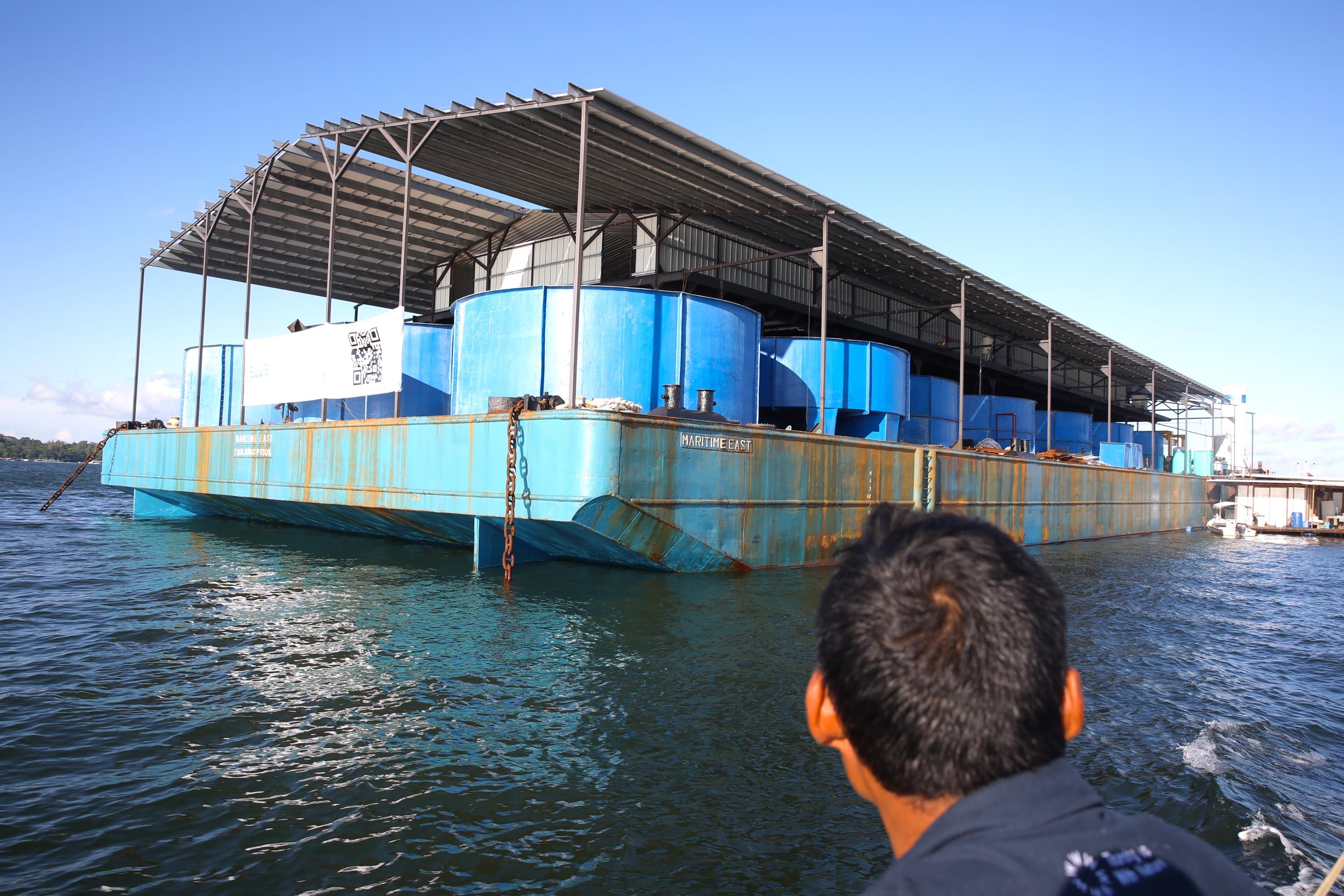
Singapore Aquaculture Technologies launched its smart\r\nfloating fish farm, which houses 10 tanks that can each hold up to 10\r\ntonnes of fish.
The farm’s smart system, which was developed in partnership\r\nwith German engineering company Siemens, is attuned to tracking barramundi —\r\nthe sole species of fish that it rears for now.
Dr Voigtmann said that having a digital system largely helps\r\nto make fish farming more predictive and precise.
For example, at SAT’s other Singapore fish farms built on\r\nbarges and wooden platforms along the Johor Strait — none of which are equipped\r\nwith its new AI system — staff members determine how well a batch of fish was\r\ngrowing by removing a sample of 50 or so specimens by hand and recording their\r\nlengths.
However, this is not always representative of the entire\r\nfish population.
Now, this AI system uses camera feeds to automatically\r\ndetect the length of individual barramundi in the tanks, and then calculates\r\nthe average length of the fish and the average weight of the tank’s population.
Also read: A Practical Guide to Using AI in Aquaculture
It also observes how entire tanks of fish react when fish\r\nfood is deposited into a tank. The data collected can be used by employees to\r\ndetermine if the food should be changed or if the fish is sick and not ready to\r\nfeed.
Before this, staff members would have to personally decide\r\nwhether the fish is full by watching how many of them surfaced for food, making\r\nthe process subjective and imprecise, Dr Voigtmann said.
The farm can also combine these two features to study which\r\nfish foods are more effective in helping the barramundi to grow — by comparing\r\ntheir growth rates to the types of foods offered.
In handling diseases, the AI system’s cameras can detect if\r\na barramundi has a bulging eye infection or white spots on its skin, and will\r\ndeliver a warning to farm employees, who can then check on each tank in\r\nperson.
In the future, SAT may add more cameras to its facility that\r\nmonitor abnormal swimming patterns, such as when a fish swims upward in a\r\ncorkscrew pattern or isolates itself from the rest of the school — telltale\r\nsigns for when it is not well.
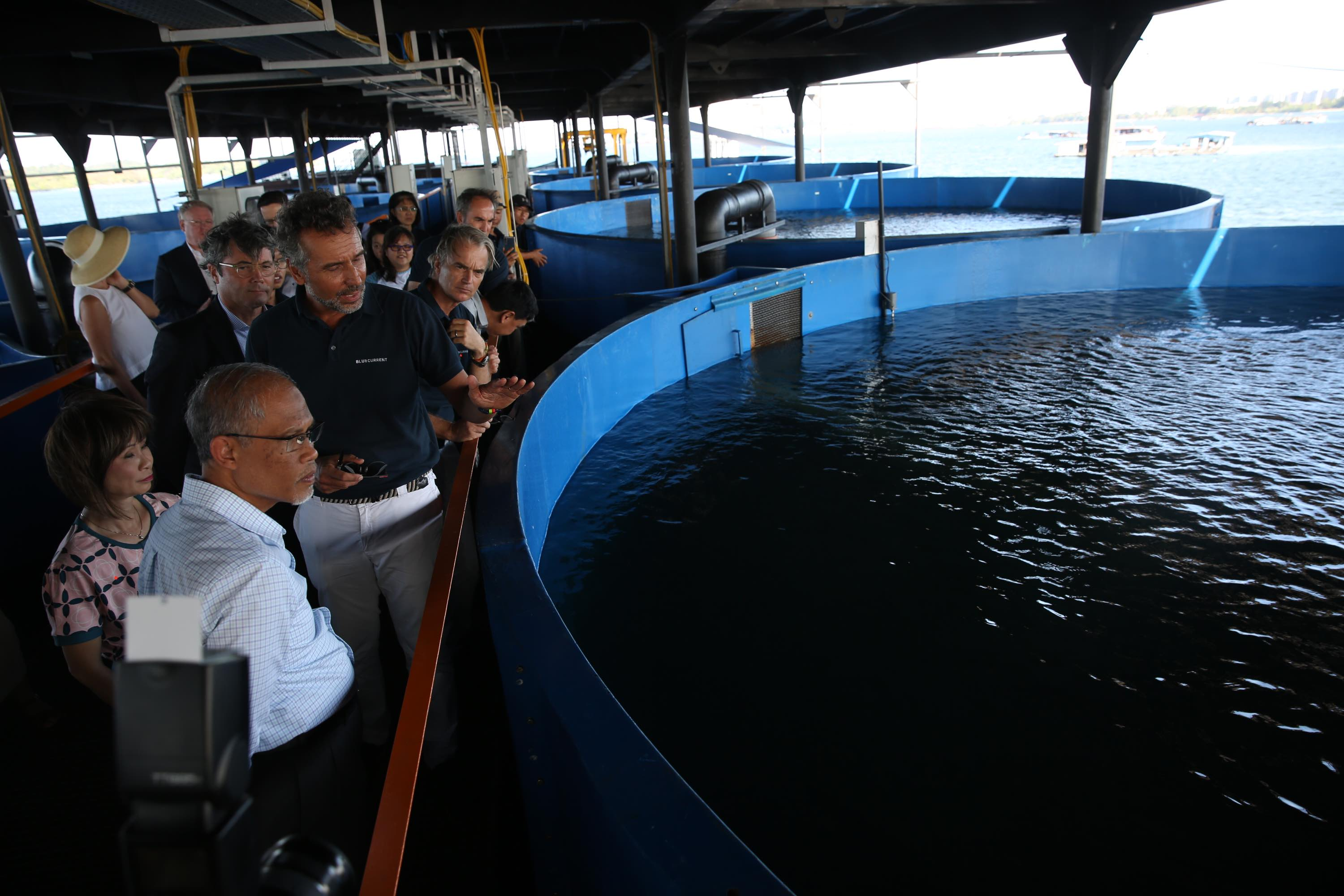
Dr Michael Voigtmann (front row, second from left), chief\r\ntechnical officer of Singapore Aquaculture Technologies, showing what video\r\nanalytics can do in monitoring the fish population. Looking on are Mr Masagos\r\nZulkifli (front row first from left), Minister for the Environment and Water\r\nResources, and Dr Amy Khor (second row, first from left), Senior Minister of\r\nState for for the Environment and Water Resources.
Mr Masagos Zulkifli, Minister for the Environment and Water\r\nResources, said in his speech at the opening that this off-shore smart fish\r\nfarm is in line with Singapore’s vision to bolster homegrown agri-food\r\nproduction to make up 30 per cent of the country’s nutritional needs by 2030.
“Today, less than 1 per cent of our land is used for\r\nagriculture. This will continue to be the case as we seek to ramp up our local\r\nproduce. Our food production methods must therefore adapt and improve,” he said
\r\n\r\n\r\n\r\n\r\n\r\n\r\n\r\n\r\n\r\n\r\n\r\n\r\n\r\n\r\n\r\n\r\n\r\n\r\n\r\n\r\n\r\n\r\n\r\n\r\n\r\n\r\n\r\n\r\n\r\n\r\n\r\n\r\n\r\n\r\n\r\n\r\n\r\n\r\n\r\n\r\n\r\n
“Food security is an existential challenge for Singapore,\r\nbut it also provides the impetus to build a strong and vibrant agri-food\r\nindustry, and foster national pride in homegrown produce.”
Source: Today

Ditulis oleh
Tim Minapoli
Kontributor
Pakar di bidang akuakultur dengan pengalaman lebih dari 15 tahun. Aktif berkontribusi dalam pengembangan industri perikanan Indonesia.