

Shrimp feeds are the most important variable cost, source of\r\nnutrients and biological waste in semi-intensive and intensive systems. Albeit\r\ncurrently available feeds are generally considered ade...
Shrimp feeds are the most important variable cost, source of\r\nnutrients and biological waste in semi-intensive and intensive systems. Albeit\r\ncurrently available feeds are generally considered adequate, there are several\r\nstudies focusing on optimizing shrimp nutrition through either feed formulation\r\nor feeding protocols. As with other species, there are multiple studies and\r\ncommercial reports validating production viability with less-costly, more\r\nsustainable soy-based feeds. However, feed management is the conjugation of\r\nnutritional content and feed delivery mechanism. While much research focused on\r\nnutrition and feed formulation, little effort is put into feed delivery\r\npractices. Hence, our group focuses on improving feed management techniques\r\nthrough systematic evaluations of different techniques.
To optimize feed delivery methods, it is essential to\r\nunderstand shrimps’ natural feeding behavior. Shrimp are benthic grazers with\r\nlimited capacity to store ingested feed which results in preferring frequent\r\ningestion of small quantities of food. Multiple authors have reported better\r\ngrowth when shrimp meals were increased which also allows higher feed inputs\r\nsince nutrient loading is spread over a longer time period. Reis et.al\r\n(2019) reported\r\nthat when using automated feeding systems higher growth rate occurred with\r\nincreasing levels of feed input.
Testing soy-optimized feeds and automated feeding systems in\r\nshrimp pond production
Presently, many shrimp farms around the globe still rely on\r\nhuman labor to feed shrimp, therefore increasing the number of meals often\r\nresults in higher labor costs. Moreover, penaeid shrimp naturally feed at\r\nnight, which could logistically complicate management even more. This issue is\r\nparticularly important in central America where wages are higher than in other\r\nshrimp production regions such as Southeast Asia.
Utilization of automatic feeders is a solution to increase\r\nnumber of meals without compromising labor costs. Timer feeders have been used\r\nby the shrimp industry for well over a decade but more recently acoustic\r\nfeedback feeding technology was developed and made commercially available. This\r\nis a type of on-demand feeding system that integrates live acoustic recording\r\nshrimp activity as the factor to determine when to feed. Ulman et al. (2019) and Reis et al. (2019) have\r\nreported faster growth and higher product value for semi-intensive system\r\nutilizing acoustic feedback feeding systems.
Even though by definition a timer-feeder will never be as\r\nefficient as a demand feeder, results by Reis et al. (2019) indicate that it is\r\npossible to reduce the efficiency gap between timer-feeders and demand acoustic\r\nfeedback feeding systems. Although published data on automatic feeder\r\nutilization is available, there is little to no information about preferred\r\nfeeding schedule in outdoor pond production environment.
The goal of our work has been to systematically explore the\r\npotential for integration of automatic feed delivery systems in shrimp\r\naquaculture, particularly in outdoor pond systems. This specific project\r\ndescribed here had the objective of finally establishing a standard feeding\r\nprotocol for timer feeders in shrimp production through the evaluation of\r\nshrimp growth fed different feed amounts through different schedules. In short,\r\nassessing if approximation to natural feeding behavior schedule (nighttime)\r\nwould favor growth.
As reported for previous years, it has been carried out in\r\nparallel with a commercial acoustic demand-feeding system (AQ1 Systems,\r\nTasmania, Australia), which has allowed the validation of this technology under\r\na practical production scenario. In addition to a practical feed demonstration\r\nusing new automated technology, these data demonstrate the efficacy and\r\nperformance of shrimp on soy-optimized feeds.
Study design
This study was performed at the Alabama Department of\r\nConservation and Natural Resources, Claude Peteet Mariculture Center, Gulf\r\nShores, Alabama (USA). Pacific white shrimp (Litopenaeus vannamei) larvae were\r\nobtained from American Penaeid (Fort Myers, Fla., USA), acclimated and nursed\r\nin a greenhouse system. Juvenile shrimp were then stocked into 16 outdoor,\r\n0.1-hectare (ha) ponds at 35 shrimp per square meter.
Feed management
All ponds were offered the same two diets: a 1.5-mm\r\ncommercial diet (40 percent crude protein, 9 percent crude lipids) produced by\r\nZeigler Bros. Inc. (ZBI, Gardners, Pa., USA) for the first four weeks, and a\r\n2.4-mm ZBI diet with 35 percent protein, 8 percent lipid diet and fed from the\r\nfourth week on. Four treatments were set to evaluate shrimp growth performance\r\nunder different feeding protocols. Feed inputs for all treatments were\r\ncalculated based on a standard feeding protocol (SFP) that expects weight gain\r\nof 1.3 grams per week, a feed conversion ratio (FCR) of 1.2, and expected\r\npopulation based on a 1.5 percent weekly mortality during the grow-out period. All\r\ntreatments were fed the same amount twice a day during the first 30 days of\r\nproduction and only then started the differential feed management throughout\r\nthe cycle.
Three timer-feeder treatments using commercial units\r\n(BioFeeder, S.A., Guayaquil, Ecuador) were used to distribute 34 meals evenly\r\nspread throughout the following schedules: Daytime (0700 to 1900), Nighttime\r\n(1900 to 0700) and 24 hours. Based on previous data, we developed a standard\r\nfeeding protocol for automatic feeding systems (SPAF) for all timer-feeder\r\ntreatments where feed inputs were adjusted to SFP+30 percent during the first\r\n45 days of production, SFP+45 percent from day 46 through 60, and SFP+60\r\npercent from day 60 through 90. The 24-hour treatment feed inputs were further\r\nincreased to SFP+75 percent from day 75 through 90.
A fourth treatment was also used in this experiment, which\r\nconsisted of the AQ1 Systems technology. This is an on-demand acoustic feedback\r\nfeeding system that integrates shrimp acoustic input through a hydrophone inside\r\nthe pond and feeds accordingly. This system was initiated 30 days into the\r\nproduction cycle and was also set to feed ad libitum until a maximum\r\nof 16 kg per day in order to avoid water-quality degradation to critical\r\nlevels. This system was also equipped with a dissolved oxygen (DO) sensor in\r\norder to further self-regulate both feeding and mechanical aeration. Each\r\ntreatment was replicated in four ponds.
Sampling and water\r\nquality
Shrimp were sampled weekly through the entire production\r\nstage using a cast net (1.52 meters radius; 0.96 cm mesh) to collect\r\napproximately 60 individuals per pond. Pond sampling enabled growth assessment\r\nand inspection for general health. Ponds were monitored (DO, temperature,\r\nsalinity and pH) at least three times a day, at sunrise (5:00 to 5:30 a.m.),\r\nafternoon (2:00 to 2:30 p.m.) and sunset (7 to 8 p.m.). For maintenance of\r\ndissolved oxygen (DO) above 3 mg/L, all ponds were supplied with one 2-HP\r\nAire-O2 (Aire-O2, Aeration Industries International, Inc., Minneapolis, Minn.,\r\nUSA) as a main source of mechanical aeration and one 1-HP Air-O-Lator (Kansas\r\nCity, Mo., USA) for backup and/or supplemental aeration as needed.
Results and\r\ndiscussion
Growth rates (grams per week) for this trial are present in\r\nFig. 2. These data validate results by various authors – including Napaupaiporn\r\net al. (2013) . Ulman et al. (2019. and Reis et al. (2019) – that\r\nsuggested better growth with utilization of the AQ1 Systems acoustic feedback\r\nsystem.
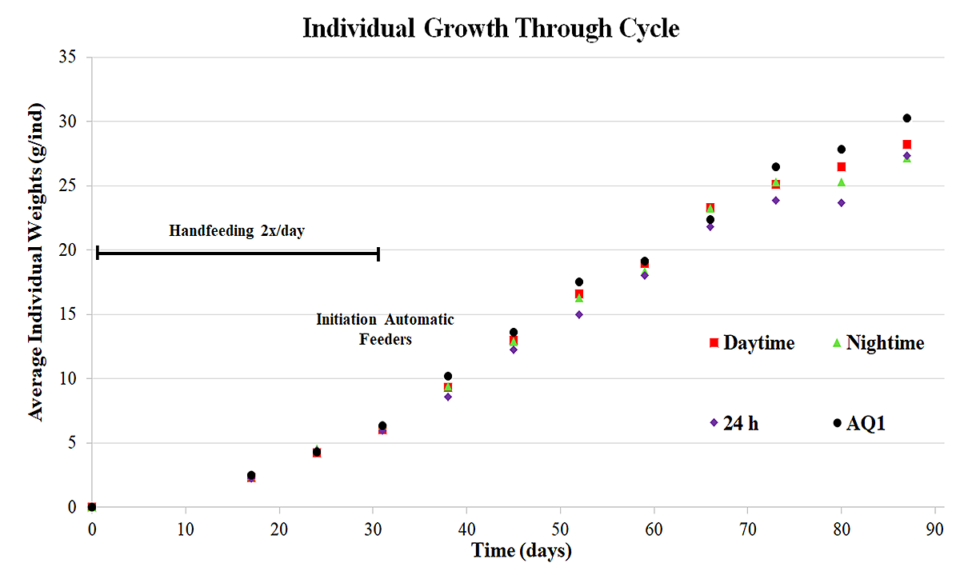
Fig. 1: Average individual weight per treatment throughout\r\nproduction cycle in this study.
Also, in line with reported by previously mentioned authors,\r\nthis project registered higher feed inputs in ponds using the AQ1 system (Fig.\r\n2). Although no statistical differences were observed among feed inputs for\r\nautomatic feeders, both nighttime and 24-hour feeding treatments fed\r\nnumerically lower feed amounts than daytime treatment. As a natural consequence\r\nof differential feed inputs, this study has found differences between shrimp\r\nfed during nighttime and 24 hours and shrimp fed with AQ1 system for all\r\nindividual final weight and weight gain (g/wk). Lower feed inputs were a\r\nconsequence of skipping meals during nighttime as pond management practice to\r\navoid oxygen depletion beyond our mechanical aeration capacity. This is likely\r\nan issue related to the setup of the ponds and its limited mechanical aeration\r\ncapacity during nighttime, particularly in late growth stages. Therefore,\r\ndifferences are not expected in an identical setup where oxygen is not a\r\nlimiting factor.
In short, the utilization of automatic feeders has allowed\r\nfaster growth resulting in shorter production cycles, which ultimately results\r\nin higher shrimp yields. These results further validate the widely reported\r\nfeed conversion ratios (FCRs) for automatic feeders across the board (Fig. 2).
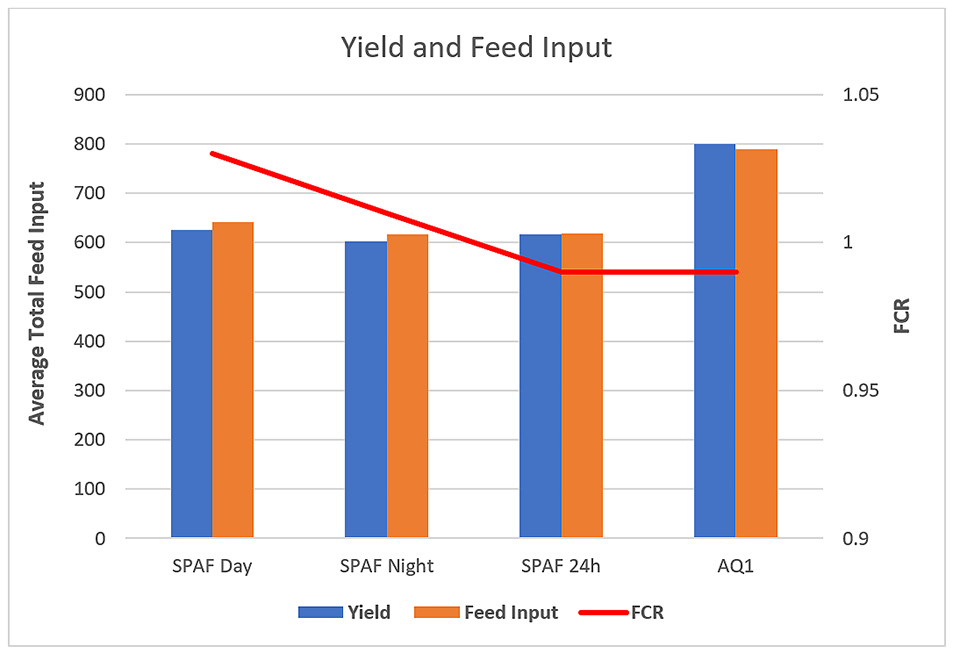
Fig. 2: Yield and cumulative feed input for the different\r\ntreatments in this study.
The main objective of this trial was to establish a new\r\nstandard feeding protocol, specifically designed to automatic timer feeders.\r\nBased on the results for this trial and previously published data under\r\nidentical experimental conditions (Ullman et al. 2019; Reis et al. 2019)\r\nand the results presented in this publication, it is clear that acoustic\r\non-demand feeders are the most efficient and result in higher productivity.\r\nHowever, it is possible to establish high efficiency feeding protocols for\r\ntimer-feeders. This is especially important for facilities that are equipped\r\nwith timer feeders and would rather adjust feeding tables and protocols instead\r\nof reinvesting in higher technology acoustic on-demand feeders.
As reported by Iescovitch et al. and\r\nUllman et al. (2019) and Reis et al. (2019), the conjunction of soy\r\noptimized diets and adequate feed management protocols in automatic feeding\r\ntechnologies resulted in good growth and productivity, including during this\r\ntrial as well. The wide variety of production systems in shrimp aquaculture\r\nmakes it virtually impossible to make broad conclusions regarding how long it\r\nwould take for investment in automatic feeders to be recovered. However, it is\r\nclear that these technologies are an extremely useful tool to achieve higher\r\nproductivity and a more valuable product.
Perspectives
\r\n\r\n\r\n\r\n\r\n\r\n\r\n\r\n\r\n\r\n\r\n\r\n\r\n\r\n\r\n\r\n\r\n\r\n\r\n\r\n\r\n\r\n\r\n\r\n\r\n\r\n\r\n\r\n\r\n\r\n\r\n\r\n\r\n\r\n\r\n\r\n\r\n\r\n\r\n\r\n\r\n\r\n\r\n\r\n\r\n\r\n\r\n\r\n\r\n\r\n
The objective of this project was to update our standard\r\nfeeding protocol into an optimized version for timer-feeders. Although the\r\nobjective was successfully reached it remains clear that acoustic feedback\r\nsystems have become the standard for optimal shrimp growth in pond culture.\r\nTherefore, future feed management work in our systems will likely focus on\r\nexploring the nutritional potential of different feeds while using the AQ1\r\nsystem across all ponds.
Source: Global Aquaculture Alliance

Ditulis oleh
Tim Minapoli
Kontributor
Pakar di bidang akuakultur dengan pengalaman lebih dari 15 tahun. Aktif berkontribusi dalam pengembangan industri perikanan Indonesia.