

Artificial intelligence (AI) is already making huge\r\nimprovements to the efficiency and sustainability of global aquaculture, as\r\nthis practical guide to some of the best systems currently availab...
Artificial intelligence (AI) is already making huge\r\nimprovements to the efficiency and sustainability of global aquaculture, as\r\nthis practical guide to some of the best systems currently available shows.
Artificial intelligence – machines that constantly learn.\r\nWe’re not talking about monosyllabic Arnie-Esque Terminators nor Matrix-style\r\nfloating robot squids – just the emerging apps and programs which make living\r\nin 2020 easier.
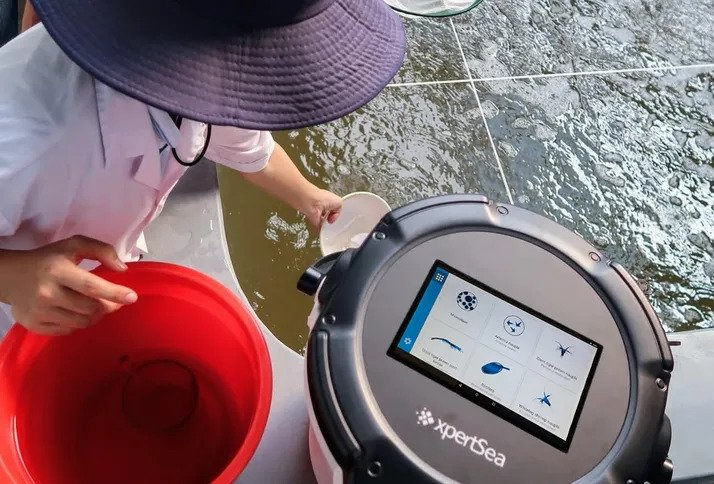
XpertSea's XperCount uses cameras and machine learning\r\napplied to computer vision to count, size, weight and image shrimp in seconds
Things have changed drastically since 2010 and AI is already\r\na part of the daily lives of millions of people. No need to drive to the big\r\ncity to pick up that book or tool you’ve been drooling over – just a few clicks\r\nand it’ll be delivered to your doorstep. You can avoid the indignity of asking\r\nfor driving directions because of the magic of Waze and Google Maps. Even the\r\nads that pop-up, when you’re scrolling through social media, are customized.
By providing a variety of services AI has become a potent\r\ntool in strengthening various industries – especially aquaculture.
Reducing waste feed
Feeding represents the biggest cost to fish farmers, so\r\noptimization in this area always means better profitability. But feeding\r\nstrategies are often arbitrary and dependent on people who constantly watch how\r\nmuch the farmed stocks are gobbling up. Pellet dispersal is based on\r\nobservation or, very often, intuition.
Fine-tuning feeding regimes are crucial because stocks fed\r\ntoo little lose valuable weight while overfeeding wastes money and pollutes\r\nlocal waterways. The skill of gauging when and how much to feed takes years to\r\ndevelop. To gain knowledge and experience, farmers remain on site every day\r\n(weekends and holidays included) for months – spending more time at work than\r\nwith their families. And not every farmhand is a fish-feeding expert. But what\r\nif human skills and knowledge could be passed on to machines?
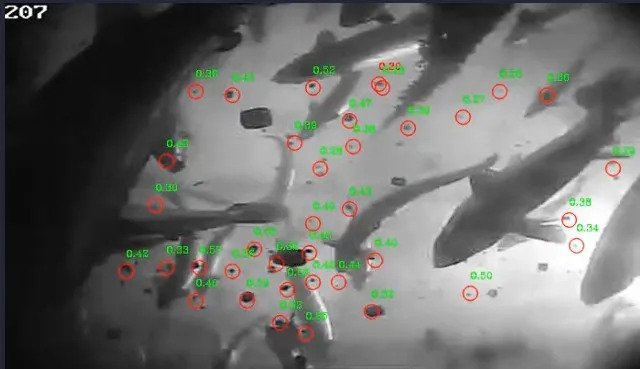
The constantly learning AI of Observe Technologies gauges\r\nwhy feed pellets remain uneaten past a certain point, helping farmers manually\r\nor automatically adjust how much to feed, minimizing waste and maximizing\r\nprofit. © Observe Technologies
A company called Observe\r\nTechnologies offer a plug-and-play AI and data-processing system to\r\ntrack measurable patterns when stocks are feeding. Their goal is to provide\r\nfarmers' empirical and objective guidance on how much to feed.
Another player, called eFishery, has developed a system which\r\nuses sensors to detect hunger levels in shrimp and fish, controlling dispensers\r\nwhich release the right amounts of food; the company claims this can reduce\r\nfeed costs by up to 21 percent.
Elsewhere, Japanese and Singaporean aquaculture technology\r\nfirm Umitron Cell offers\r\na smart fish feeder that can be controlled remotely. “Farmers are given\r\ndata-driven decision-making advice to optimize feeding schedules. This reduces\r\nwaste, improves both profitability and sustainability while offering users a\r\nbetter work-life balance by eliminating the need to be out in the water in\r\ndangerous conditions,” notes Umitron product manager Andy Davison.
These systems consider weather events like storms or the\r\nsapping glare of hot summer months, helping farmers produce more seafood with\r\nfewer resources, ultimately increasing profits significantly.
Preventing diseases\r\nand tracking prices
Diseases are the next big cost driver and something AI can\r\nreadily address. Programs can predict disease outbreaks before they happen by\r\nannotating collected data, presenting it and applying preventive measures.
In April 2017, Norway’s Seafood Innovation Cluster launched\r\nthe AquaCloud platform,\r\na cloud-based program which aims to help fish-health managers and researchers\r\ndeal with sea lice, predicting or even preventing lice development in sea cages\r\nwith the goal of reducing dependency on expensive medical treatments, thus\r\nminimizing stock mortality.
Indian aquaculture technology start-up Aquaconnect offers FarmMOJO, a mobile\r\napplication that helps shrimp farmers predict diseases and enhance water\r\nquality. “Smart technology is the key to better productivity and disease\r\nmanagement,” says Aquaconnect CEO, Raj Somasundaram.
Sensor-equipped drones and robots can also collect data such\r\nas water pH, salinity, dissolved oxygen levels, turbidity, pollutants and even\r\nthe heart rates of stock – all accessible via a smartphone. One of the most\r\ninnovative is SHOAL, which uses robot fish to detect underwater pollution sources near fish farms and other\r\nfacilities.
Through AI, farmers can remotely switch pumps, motors,\r\naerators or diffusers on or off. Production and demand can be forecasted by\r\naltering program parameters, further improving farm efficiency and monitoring\r\nability.
Even optimizing economics during harvesting, which most\r\nfarmers gauge based on educated guesswork, can be dictated by machines. XpertSeauses computer vision and AI to\r\ncalculate the growth of shrimp, helping farmers predict the most profitable\r\nharvest periods. Advanced AI techniques like deep learning are used to pinpoint\r\ntimeframes by continuously using machine learning on historical growth cycle\r\ndata.
“The company’s Growth\r\nPlatform provides online management software that uses artificial\r\nintelligence to capture, ingest, store and process field data to give farmers\r\nand industry experts actionable, data-driven insights throughout the whole production cycle,” explains Valérie Robitaille, CEO of XpertSea. “This platform\r\nis used by farmers but also feed, health, genetics, and certification\r\nenterprises to provide data-driven services to farmers. The second part of our solution is the XperCount that collects critical animal data by using cameras\r\nand machine learning which is applied to count, size and weigh animals in\r\nseconds.”
Through this dual solution, farmers are able to track the\r\ngrowth of their crops, feeding regimes and up to 20 water parameters. Very\r\nhandily, the system can also predict shrimp growth 14 days in advance, based on\r\nexisting data. The company goes even further by combining this shrimp growth\r\ndata with market prices, making it much easier for farmers to make the right\r\ndecisions.
Over 600 farmers and other customers have already embraced\r\ndigital solutions from XpertSea. The company is proud to report that in the\r\npast year alone, the platform has processed over 2.3 billion animal data points\r\nand optimized the performance of 6,000 crops.
Conclusions
Though great strides in mechanized aquaculture are being\r\nmade, full automation is still a long way off. We probably won’t see fish farms\r\nthat can manage entirely without the sure hands of humans any time soon. But\r\nfully embracing and investing in AI plus automation can significantly produce\r\nmore seafood to feed the growing world population, while reducing the cost and environmental\r\nfootprint of aquaculture operations.
\r\n\r\n\r\n\r\n\r\n\r\n\r\n\r\n\r\n\r\n\r\n\r\n\r\n\r\n\r\n\r\n\r\n\r\n\r\n\r\n\r\n\r\n\r\n\r\n\r\n\r\n\r\n\r\n\r\n\r\n\r\n\r\n\r\n\r\n\r\n\r\n\r\n\r\n\r\n\r\n\r\n\r\n\r\n\r\n\r\n\r\n\r\n\r\n\r\n\r\n\r\n\r\n\r\n\r\n
Done right, AI means fish farmers can earn more and finally\r\nhave more time to spend with their families. Are you in favor? Then just\r\nsay AI.
Source: The Fish Site

Ditulis oleh
Tim Minapoli
Kontributor
Pakar di bidang akuakultur dengan pengalaman lebih dari 15 tahun. Aktif berkontribusi dalam pengembangan industri perikanan Indonesia.