

In a new study, US and Vietnamese researchers found that\r\nfarm-raised Pacific white shrimp (Litopenaeus vannamei) fed a diet formulated\r\nwith Veramaris Natural\r\nMarine Algal Oil and Menon Renewa...
In a new study, US and Vietnamese researchers found that\r\nfarm-raised Pacific white shrimp (Litopenaeus vannamei) fed a diet formulated\r\nwith Veramaris Natural\r\nMarine Algal Oil and Menon Renewable Product’s MrFeed had\r\nsignificantly higher survival rates for early mortality syndrome (EMS) / acute\r\nhepatopancreatic necrosis syndrome (AHPNS) compared to shrimp fed diets\r\ncontaining fishmeal and fish oil.
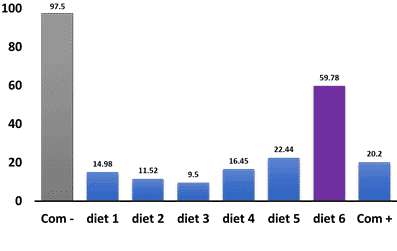
Shrimp fed the Veramaris/Menon feed formulation had roughly\r\n60 percent survival. The Com- and Com+ groups were fed identical diets with the\r\nCom+ receiving bacterial challenge
EMS/AHPNS, caused by the bacterium Vibrio\r\nparahaemolyticus, has had a significant impact on shrimp production\r\nglobally, with mortality rates as high as 100 percent in the first 30 days.
The technical article, published in last week’s edition\r\nof the Global Aquaculture Alliance’s Advocate, examined the benefits of\r\ntotal fish oil and fishmeal replacement in the shrimp diet and found that it\r\nwas not only technically feasible, but endowed shrimp with enhanced immunity.\r\nThe Veramaris algal oil, rich in both EPA and DHA omega-3, constituted a\r\ncomplete fish oil replacement. Fishmeal was replaced with Menon’s sustainable\r\nand functional Oleo-Protein, produced by converting plant-based products into\r\nhighly digestible nutrients and high nucleotides and small chain peptides that\r\nappear to serve as a universal immune stimulant.
Future studies would be needed to assess if this diet\r\nenhances the immune system against viruses, including Decapod iridescent virus\r\n1, or DIV1, currently impacting Chinese shrimp farms.
Pacific white shrimp is the most widely cultivated shrimp in\r\nthe world, which along with tiger prawn (Penaeus monodon) account for roughly\r\n80 percent of farm-raised shrimp globally.
In the 40-day trial conducted at the ShrimpVet Laboratory in\r\nVietnam, the research team compared the Veramaris/Menon diet to six other\r\nexperimental and commercial feeds to assess the animal’s ability to withstand\r\nan EMS/AHPNS infection.
The researchers found that 60 percent of the shrimp fed the\r\nVeramaris/Menon diet survived. These results were significantly higher than all\r\nother experimental and commercial diets tested, which ranged between 9 and 22\r\npercent survival.
“The study\r\ndemonstrates that shrimp, and likely many other species, can be fed diets\r\nwithout fishmeal and fish oil, thereby enabling aquaculture expansion to\r\ncontinue unabated, despite fluctuations in forage fish resources,” said the\r\nstudy’s lead author Ewen McLean, principal at Aqua Cognoscenti. “A higher\r\nsurvival rate results in better yield and improved feed conversion ratios since\r\nless feed is wasted.”
In a related study published in the online edition\r\nof the journal Aquaculture, the research team substituted fishmeal with\r\nblends of soybean meal, soy protein concentrates and poultry by-product meals\r\nto examine growth rates of Pacific white shrimp.
Those results showed that fishmeal replacements do not\r\naffect the animal’s growth performance and that complete replacement of\r\nfishmeal in Pacific white shrimp is possible. No antibiotics were used before\r\nor during either study.
Fish farming, or aquaculture, now provides more than half of\r\nthe world’s seafood. Aquaculture-raised seafood, one of the fastest growing\r\nfood sectors in the world today, is expected to fill in the supply-demand gap\r\nfor high-quality, easily-digested protein as the world population expands.
Currently, many forage fish are ground up to feed the\r\nburgeoning aquaculture sector. Aquaculture consumes 70 percent of total\r\nfishmeal and 73 percent of total fish oil production. Crustaceans alone,\r\nincluding shrimp, consume roughly 31 percent of global fishmeal production.
As shrimp aquaculture continues to expand globally there is\r\nan urgent need to prevent emerging disease and resistant pathogens which stem\r\nfrom the overuse of antibiotics in shrimp farming. The chemicals and\r\nantibiotics used to prevent disease in shrimp farms can pollute groundwater and\r\ncoastal estuaries, which provide the nursery grounds for many marine organisms.
Feeding forage fish to aquaculture-raised animals presents a\r\nsustainability issue because of its reliance as a major building block of the\r\nfood chain for seafood. A recent study estimated the global economic\r\nbenefit of forage fish to be $18.7 billion per year, over three times their\r\ndirect catch value. Overfishing and disappearance of this building block would\r\nresult in a collapse of higher trophic species that depend on forage fish,\r\nwhich would have a ripple effect on many commercial fisheries, including\r\nsalmon, cod and tuna as well as many ocean tourism-based economies.
These fish also sustain seabirds and marine mammals such as\r\nwhales, seals, and dolphins. If the fish at the center of the ocean food chain\r\ndisappear, so will the life that depends on them.
\r\n\r\n\r\n\r\n\r\n\r\n\r\n\r\n\r\n\r\n\r\n\r\n\r\n\r\n\r\n\r\n\r\n\r\n\r\n\r\n\r\n\r\n\r\n\r\n\r\n\r\n\r\n\r\n\r\n\r\n\r\n\r\n
“This study evaluated the nutritional value of shrimp feeds\r\nwithout fishmeal and fish oil, and using new innovative ingredients and found\r\nthem very effective,” said fish nutritionist Rick Barrows of Aquatic Feed\r\nTechnologies LLC and co-author of the study. “The next question is the cost of\r\nimproved feeds. Since each farming operation is different, costs will reflect\r\neach operation.”
Source: The Fish Site

Ditulis oleh
Tim Minapoli
Kontributor
Pakar di bidang akuakultur dengan pengalaman lebih dari 15 tahun. Aktif berkontribusi dalam pengembangan industri perikanan Indonesia.